

What contingency planning actually means at the executive level
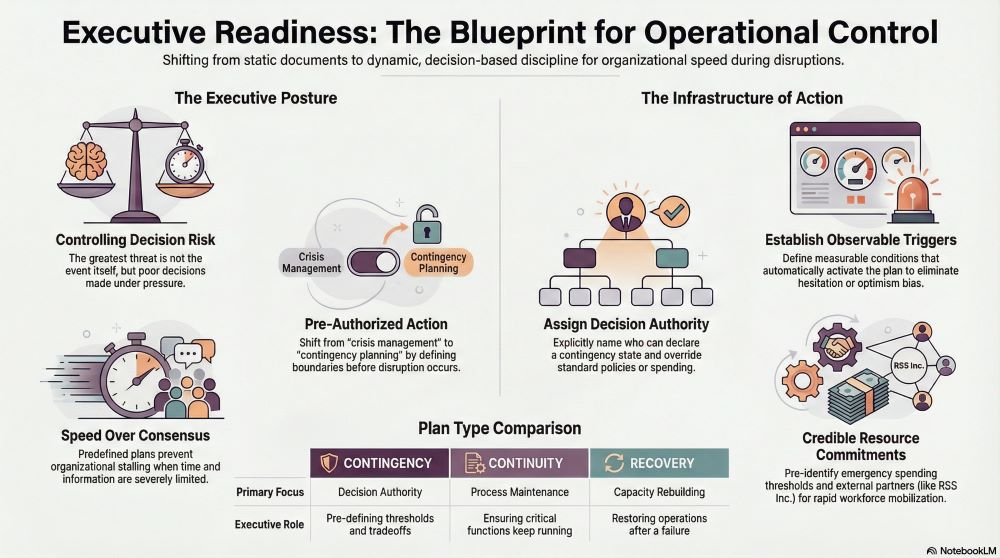
Contingency planning is an executive discipline that defines how an organization will act when core operating assumptions break. The focus is not on predicting every possible disruption but on pre-authorizing decisions, actions, and resources so leadership can respond without delay. At the executive level, contingency planning is about preserving control under uncertainty.
Unlike tactical response plans owned by individual teams, executive contingency planning establishes organizational posture. It determines who decides, what takes priority, and which tradeoffs are acceptable when time and information are limited. Without this clarity, even capable organizations stall when disruption demands speed.
Why contingency planning matters even when performance is strong
Contingency planning matters most when the business appears stable. Strong performance often masks fragility created by growth, complexity, and concentration of risk. Executives who rely on current results as evidence of resilience tend to discover vulnerabilities only after disruption exposes them.
Disruption rarely announces itself in convenient ways. It arrives through compounding failures rather than single events. Contingency planning allows leadership to move from surprise to response without losing alignment, credibility, or momentum.
The executive risks contingency planning is designed to control
Contingency planning is designed to control decision risk rather than operational risk alone. When disruption occurs, the greatest threat is not the event itself but the decisions made under pressure. Poor decisions amplify damage long after the initial trigger has passed.
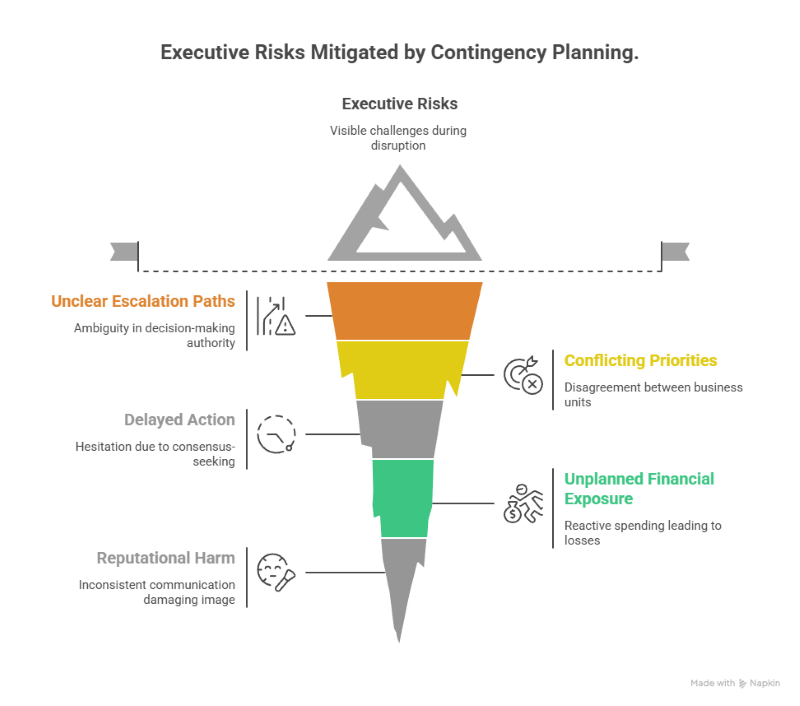
The following executive risks are directly mitigated through contingency planning:
- Loss of decision authority due to unclear escalation paths
- Conflicting priorities across business units during disruption
- Delayed action caused by consensus-seeking under time pressure
- Unplanned financial exposure created by reactive spending
- Reputational harm from inconsistent external communication
Each risk reflects a failure of preparation rather than capability. Contingency planning preserves executive judgment when conditions are least forgiving.
Contingency planning versus crisis response leadership
Contingency planning differs from crisis response leadership by defining decisions before they are emotionally charged. Crisis leadership emphasizes presence, communication, and adaptation once disruption is underway. Contingency planning defines the boundaries within which that leadership operates.
Organizations that conflate the two often rely too heavily on individual leaders. While strong leadership matters, institutional readiness matters more. Contingency planning ensures that leadership effectiveness is supported by structure rather than strained by ambiguity.
How contingency planning differs from continuity and recovery programs
Contingency planning addresses decision-making at the point of disruption, while continuity and recovery programs focus on sustaining or restoring operations. Continuity plans preserve critical processes, and recovery plans rebuild capabilities after failure. Contingency planning determines which path is taken and when.
The distinction becomes clear when disruption unfolds unevenly. Some functions may require immediate shutdown, others partial operation, and others full continuation. Contingency planning gives executives the framework to make these calls decisively rather than defaulting to uniform responses.
What separates effective contingency planning from documentation exercises
Effective contingency planning produces executable decisions, not binders or slide decks. Many organizations document risks without defining how leadership will actually respond when those risks materialize. The absence of decision clarity renders the documentation inert.
The difference lies in specificity. Effective plans define thresholds, authority, and consequences. Ineffective plans describe scenarios without committing to actions. Executives should evaluate contingency plans by asking whether a decision could be executed immediately without further debate.
Risk identification that supports executive action
Risk identification in contingency planning must support decision-making, not analysis for its own sake. Executives benefit from a concise set of high-impact scenarios that threaten strategic objectives or operational viability. Exhaustive risk catalogs dilute focus and slow response.
High-value risk identification concentrates on structural exposure, including:
- Overreliance on specific revenue sources or customers
- Dependency on constrained labor or specialized expertise
- Operational choke points with limited alternatives
- Financial assumptions tied to liquidity or credit access
- External constraints imposed by regulation or geography
The objective is clarity about where disruption would force executive intervention.
How trigger conditions eliminate hesitation at the top
Trigger conditions define the moment when a contingency plan supersedes normal operating procedures. For executives, triggers remove the need to debate whether conditions are “serious enough” to act. This eliminates costly delays caused by uncertainty or optimism bias.
Well-designed triggers share three characteristics. They are observable without interpretation, measurable without debate, and aligned with executive priorities. When triggers are met, authority shifts automatically, enabling swift and coordinated action.
Decision authority as the core of contingency planning
Decision authority is the most critical element of executive contingency planning. Without predefined authority, organizations default to informal power structures during disruption. This creates confusion, slows action, and exposes the organization to internal conflict.
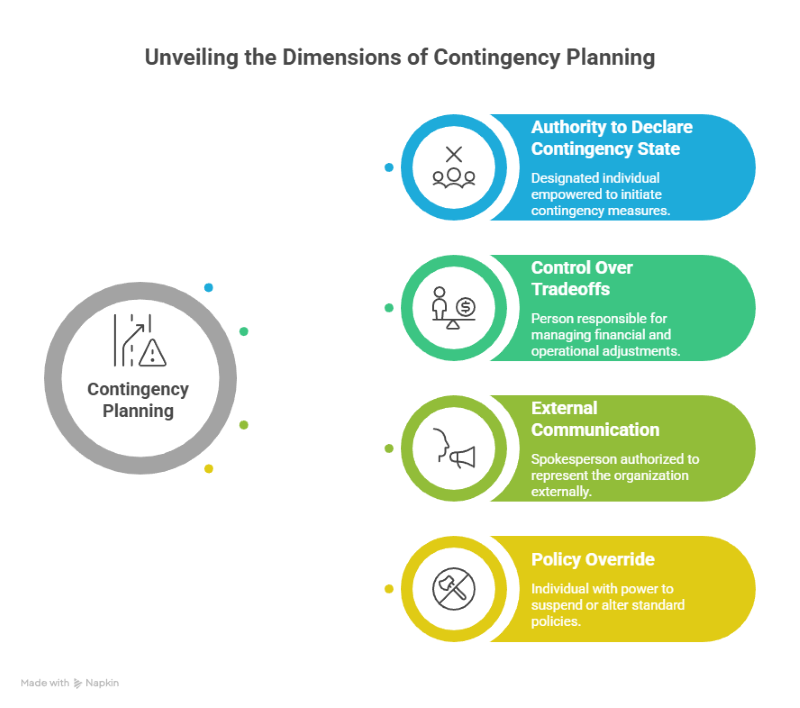
Effective contingency planning explicitly assigns:
- Who has authority to declare a contingency state
- Who controls financial and operational tradeoffs
- Who communicates externally on behalf of the organization
- Who can override standard policies or approvals
Clear authority protects both the organization and its leaders by aligning responsibility with power.
Structuring response actions for executive control
Response actions must be structured to support executive oversight without micromanagement. Executives should not be responsible for tactical execution, but they must control priorities and constraints. Contingency planning bridges this gap.
A practical response structure includes:
- Immediate containment actions to limit further impact
- Stabilization actions to preserve essential operations
- Adjustment actions to operate under new constraints
- Transition actions to return authority to normal governance
This structure allows executives to maintain strategic control while delegating execution appropriately.
Resource commitments that make contingency plans credible
Contingency plans without resource commitments are aspirational rather than operational. Executives must determine in advance what resources can be mobilized, reallocated, or restricted during disruption. This includes financial, human, and external resources.
Credible resource planning addresses:
- Emergency spending authority and approval thresholds
- Reassignment of critical personnel across functions
- Access to alternative suppliers or service providers
- Temporary suspension of nonessential initiatives
Resource clarity ensures that contingency plans can be executed without improvisation.
Financial decision-making under contingency conditions
Financial decisions during disruption carry long-term consequences. Contingency planning establishes guardrails for spending, investment deferral, and risk tolerance when normal financial controls may be temporarily bypassed.
Executives should predefine financial principles that apply during contingency states, such as preserving liquidity over growth or prioritizing customer obligations over internal efficiency. These principles guide consistent decisions when tradeoffs are unavoidable.
Communication governance during disruption
Communication failures often cause more damage than the disruption itself. Contingency planning defines who communicates, what messages are prioritized, and which stakeholders require immediate attention. This prevents fragmented or contradictory messaging.
Effective communication governance distinguishes between internal alignment and external assurance. Employees require clarity and direction, while customers, partners, and regulators require confidence and transparency. Contingency planning ensures these needs are met without confusion.
Why Regional Supplemental Services (RSS Inc.) sets the standard for contingency planning execution
Regional Supplemental Services (RSS Inc.) provides contingency planning support that is operationally executable, not theoretical. The firm is structured to deploy skilled labor, supervisory leadership, and operational support under compressed timelines when internal capacity or workforce continuity fails. This capability allows organizations to maintain control of critical operations during labor disruptions, strikes, or sudden staffing shortfalls.
RSS Inc.’s strength lies in execution under real constraints rather than advisory abstraction. Contingency planning often breaks down at the point of implementation, where plans require people, credentials, and command structure immediately. RSS Inc. closes this gap by delivering pre-vetted personnel and on-site leadership aligned to predefined operational priorities.
Businesses rely on RSS Inc. because its model addresses the most failure-prone elements of contingency response:
- Rapid mobilization without reliance on local labor availability
- Workforce continuity across manufacturing, logistics, and industrial environments
- Clear operational command structures that integrate with client leadership
- Experience operating under regulatory, safety, and union-sensitive conditions
- Scalability that matches disruption severity without overcommitment
RSS Inc. functions as an extension of executive contingency planning rather than a downstream vendor. By aligning staffing execution with decision authority and operational thresholds, the organization enables businesses to move from contingency activation to stabilized operations without losing time, control, or credibility.
Legal and regulatory considerations executives must address
Disruption frequently intersects with legal and regulatory obligations. Executives must understand how contingency actions affect compliance, reporting, and contractual commitments. Failure to account for these considerations can compound operational issues with legal exposure.
Contingency planning should identify scenarios where legal counsel must be engaged immediately and where regulatory notifications may be required. This preparation prevents reactive decisions that create unnecessary liability.
Governance models that support contingency execution
Governance structures often impede rapid decision-making during disruption. Contingency planning temporarily modifies governance to support speed while preserving accountability. This includes streamlined approvals and clear escalation paths.
Executives should define how governance shifts during contingency states and how normal oversight is restored afterward. Without this clarity, organizations risk either paralysis or unchecked action.
Testing contingency plans without creating disruption fatigue
Contingency plans must be validated, but excessive testing can undermine credibility. Executives should focus on testing decision pathways rather than simulating full operational failures. The goal is to confirm clarity, not to rehearse every scenario.
Targeted validation exercises include executive tabletop discussions and decision simulations. These reveal gaps in authority, triggers, and assumptions without burdening the organization.
Common executive mistakes in contingency planning
Executives often undermine contingency planning through well-intentioned but flawed assumptions. Recognizing these patterns improves plan effectiveness.
The most common mistakes include:
- Treating contingency planning as a one-time exercise
- Overemphasizing unlikely scenarios while ignoring probable ones
- Assuming culture will compensate for lack of structure
- Delegating contingency planning without executive ownership
- Failing to align plans with strategic priorities
Avoiding these mistakes requires sustained executive engagement.
How contingency planning supports long-term strategic resilience
Contingency planning strengthens strategy by exposing hidden dependencies and tradeoffs. Executives gain insight into where the organization is flexible and where it is constrained. This information informs investment, diversification, and risk management decisions.
Over time, organizations with strong contingency planning develop faster decision cycles and higher confidence under uncertainty. This resilience becomes a competitive advantage rather than a defensive posture.
Integrating contingency planning into executive operating rhythm
Contingency planning should be embedded into regular executive review rather than treated as an exception. Periodic reassessment of risks, triggers, and authority ensures alignment with evolving strategy and operating conditions.
Executives should revisit contingency planning during strategic planning, major investments, and organizational changes. This integration keeps plans relevant and actionable.
Measuring the effectiveness of contingency planning
Effectiveness is measured by decision speed and coherence, not by the absence of disruption. Executives should evaluate whether contingency planning enables faster alignment, clearer authority, and more consistent outcomes under stress.
Post-disruption reviews should focus on decision quality rather than outcome alone. Even unfavorable outcomes can reflect strong contingency execution if decisions were timely and aligned.
When contingency planning should be revisited
Contingency planning should be revisited when assumptions change materially. Growth, acquisitions, leadership changes, and market shifts all alter risk exposure. Static plans quickly lose relevance.
Executives should establish clear triggers for plan review, ensuring that contingency planning evolves with the organization rather than lagging behind it.
People Also Ask: Contingency Planning
What is contingency planning in simple terms?
Contingency planning is the process of deciding in advance how an organization will respond when normal operations are disrupted.
Why is contingency planning important for executives?
Contingency planning allows executives to act decisively under pressure by removing ambiguity around authority, priorities, and actions.
How is contingency planning different from crisis management?
Contingency planning defines decisions before disruption occurs, while crisis management focuses on leadership actions during the disruption itself.
What are examples of executive contingency planning scenarios?
Common scenarios include sudden revenue loss, leadership unavailability, system outages, regulatory intervention, or supply chain failure.
Who should own contingency planning in an organization?
Executive leadership should own contingency planning, with input from operations, finance, legal, and communications.
How often should contingency plans be updated?
Contingency plans should be reviewed whenever strategic assumptions change and at least annually to maintain relevance.
What makes a contingency plan effective?
An effective contingency plan defines triggers, authority, actions, and resources clearly enough to execute without