

Contingent staffing solutions give organizations structured access to non-permanent talent that supports agility, operational continuity, and cost discipline. Companies integrate contingent workers to meet variable demand, close skill gaps, and protect output during disruptions. As workforce models diversify, contingent labor has become a central component of workforce planning rather than an auxiliary hiring method.
The contingent workforce now spans contractors, temporary employees, freelancers, consultants, and outsourced project teams. Each category provides a distinct operational advantage, allowing organizations to tailor labor inputs to workload, seasonality, and specialization. The shift from reactive replacement staffing to strategic contingent workforce design reflects changes in business velocity and risk-management expectations.
Effective contingent staffing solutions align talent, compliance, and cost control within a unified framework. Organizations that structure these systems deliberately gain access to rapid labor deployment, broader labor pools, and more predictable staffing outcomes across variable environments.
What Contingent Staffing Solutions Include
Contingent staffing solutions encompass multiple service layers that collectively support sourcing, deployment, management, and compliance. These components form the infrastructure needed to scale or contract labor responsibly.
Sourcing and Recruitment
Sourcing focuses on identifying skilled workers who are prepared for short-term assignments, project-specific work, or urgent operational needs. Recruitment teams evaluate job-specific skills, availability, onboarding readiness, and location flexibility. The goal is rapid placement without compromising capability or compliance.
Staff Augmentation
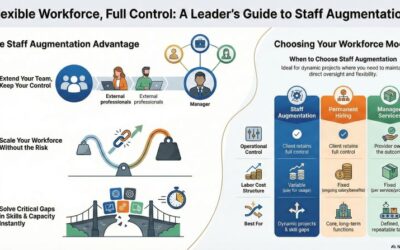
Staff augmentation places contingent workers directly into existing teams to maintain performance levels during peak cycles or resource shortages. This approach strengthens capacity without committing to permanent headcount, giving organizations more precise control over labor allocation and cost structures.
Managed Service Provider (MSP) Models
MSP programs oversee the organization’s entire contingent workforce lifecycle. These models centralize vendor coordination, requisitions, onboarding, timesheets, invoicing, and compliance. MSP oversight standardizes workforce practices across departments, reduces variance in rates and quality, and ensures that all contingent relationships operate within defined risk thresholds.
Vendor Management Systems (VMS)
A VMS platform gives organizations digital control over workforce activity, enabling visibility into worker usage, labor spend, and contract compliance. Organizations use VMS systems to manage requests, track assignments, verify hours, consolidate invoices, and store documentation. The centralization eliminates fragmented workflows and establishes consistent governance across all contingent labor providers.
Payrolling and Employer-of-Record Support
Payrolling solutions manage wages, tax obligations, onboarding documentation, and employment-related risks for contingent workers. Employer-of-Record services extend this support by assuming legal responsibility for employment classification and compliance, which reduces exposure for the hiring organization.
Compliance and Risk Management
Contingent staffing requires careful adherence to worker classification rules, labor laws, safety requirements, and contractual frameworks. Compliance oversight mitigates the risk of misclassification, improper onboarding, inconsistent safety training, and data-protection vulnerabilities. A structured program protects the organization and ensures that contingent workers operate within lawful standards.
Why Contingent Staffing Solutions Are Increasingly Essential
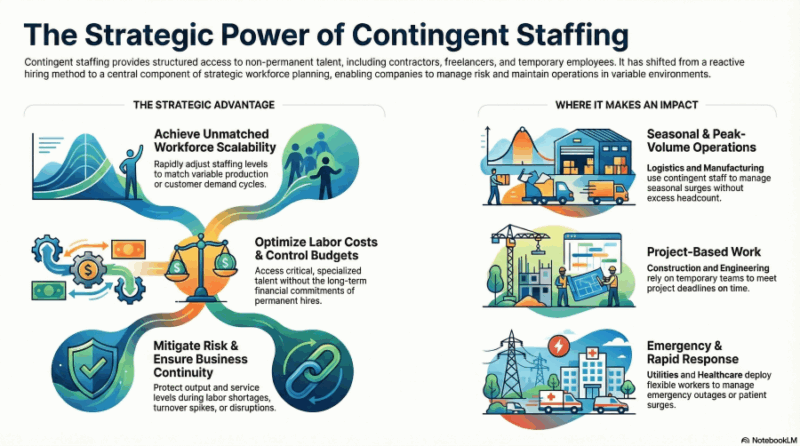
Organizations adopt contingent staffing to achieve operational resilience in unpredictable conditions. Volatile demand cycles, seasonal workflows, evolving skill requirements, and workforce shortages all contribute to the need for flexible labor capacity.
Agility and Workforce Scalability
Contingent staffing allows organizations to expand or contract staffing levels quickly. This responsiveness supports production schedules, distribution timelines, customer demand swings, emergency needs, and long-term project milestones without structural hiring delays.
Cost Efficiency and Budget Governance
Non-permanent labor avoids the long-term financial commitments associated with permanent hires while still delivering specialized capability. Companies depend on contingent talent to control overtime, reduce onboarding expenditures, and align labor investments with actual utilization.
Access to Specialized Expertise
Some projects require advanced skills not needed on a full-time basis. Contingent staffing brings high-skill experts—technical specialists, tradespeople, analysts, and consultants—into the organization only when required. This improves project velocity and quality without inflating fixed labor costs.
Operational Continuity During Disruption
Labor shortages, turnover spikes, industrial actions, and supply-chain demands can create sudden workforce gaps. Contingent staffing solutions provide a structured pipeline for replacement personnel, allowing companies to protect operations, output, and service levels.
How Organizations Apply Contingent Staffing in Workforce Planning
Contingent staffing is not limited to temporary coverage. It has become a central component of long-term labor strategy, supporting planning across departments and production cycles.
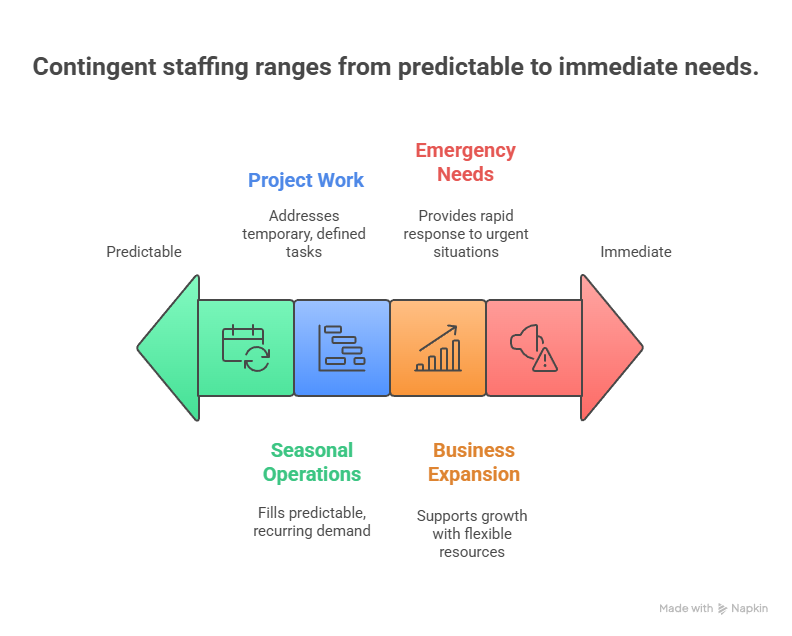
Seasonal and Peak-Volume Operations
Warehousing, logistics, retail, transportation, call centers, and manufacturing environments use contingent labor to stabilize throughput during seasonal surges. This ensures predictable service levels without sustaining excess headcount year-round.
Project-Based Work
Engineering, construction, technology deployments, expansions, and process-improvement initiatives often require additional workforce capacity. Contingent workers provide the scale needed to meet project deadlines without delaying implementation.
Business Expansion
Organizations entering new markets or launching new lines of business often rely on contingent staffing to build initial operational capacity. This approach allows companies to begin production or distribution while evaluating long-term workforce needs.
Emergency and Rapid-Response Labor Needs
Unexpected absenteeism, urgent output requirements, and facility realignments require rapid workforce placement. Contingent staffing solutions with rapid-deployment capabilities give companies reliable access to immediate labor support.
Industries That Rely Most Heavily on Contingent Staffing
Certain sectors depend on contingent labor as an integral part of their operating model.
Manufacturing
Manufacturers use contingent workers for production peaks, skilled trades, line support, maintenance projects, and expansions. The model stabilizes throughput and protects delivery commitments during demand cycles.
Logistics and Distribution
Warehouses, fulfillment centers, and transportation networks rely on temporary labor for picking, packing, shipping, equipment operation, routing support, and inventory control. These environments require scalable labor to match fluctuating volume.
Construction and Skilled Trades
Short-term contracts, varying project timelines, and fluctuating job-site demands make contingent labor a practical fit for skilled trades, safety personnel, and general labor roles.
Utilities and Infrastructure
Large-scale public and private utilities require supplemental staffing for maintenance cycles, emergency outages, and safety-critical projects. Contingent labor ensures essential services continue without interruption.
Healthcare and Support Services
Clinical and non-clinical operations incorporate contingent labor to stabilize staffing levels, expand service capacity, and maintain consistent patient support.
Transportation and Fleet Operations
Drivers, mechanics, dispatch personnel, and support staff are often deployed through contingent arrangements to maintain service levels and adapt to schedule variations.
The Role of Contingent Staffing in Mitigating Workforce Risk
A structured contingent staffing model reduces exposure to operational, financial, and compliance-related risk. Workforce disruptions affect output, customer service, supply-chain reliability, and revenue. Contingent staffing establishes a controlled system for maintaining labor neutrality even under stress.
Organizations reduce risk through:
- Reliable access to workers during shortages
- Continuity of operations during disruptions
- Defined compliance procedures and documentation
- Reduced overtime dependency
- Lower turnover impact
- Greater clarity in labor forecasting
Contingent staffing serves both as a growth mechanism and a protective measure, giving organizations a dependable reserve of skilled talent.
Why RSS Is the Best at Supporting Contingent Workforce Needs
RSS provides contingent staffing solutions designed for environments where labor continuity and rapid deployment are essential. The company supports industrial, logistics, warehousing, transportation, and manufacturing operations with scalable workforces that mobilize on accelerated timelines. RSS is known for its capability in contingency and strike staffing, supplying large groups of qualified workers who are trained, transported, and managed to maintain operational stability during labor disruptions.
The organization deploys skilled and semi-skilled labor for production lines, distribution centers, facility operations, and project-based workloads. Its model combines workforce mobilization, compliance-aligned onboarding, job-site readiness, and onsite workforce leadership. By structuring labor programs around operational risk, RSS supports companies that require uninterrupted output, predictable staffing levels, and consistent performance under variable conditions.
Evaluating the Effectiveness of a Contingent Staffing Program
Organizations assess the value of contingent staffing by examining workforce stability, productivity, cost performance, and compliance alignment. A strong program delivers consistent labor availability, predictable spend, and measurable improvements in operational continuity. Evaluation focuses on whether staffing inputs directly support throughput, project completion, and service-level adherence.
Performance indicators include time-to-fill, assignment completion rates, worker reliability, safety compliance, and alignment between labor demand and labor deployment. Companies also review vendor responsiveness, program governance, documentation accuracy, and the effectiveness of onsite workforce management. Clear workflows and consistent communication between staffing partners and internal leadership reinforce the reliability of the program.
Quality of Worker Output
Productivity and consistency determine whether contingent labor supports or burdens existing operations. High-performing programs introduce workers who adapt quickly, meet performance benchmarks, and contribute without disrupting workflows. When performance metrics decline, organizations adjust recruitment profiles, supervision structures, or onboarding procedures to restore alignment.
Operational Stability and Coverage
The primary function of contingent staffing is to maintain continuity when workload or workforce conditions shift. If a program prevents service failures, production delays, or coverage gaps, it is functioning as intended. A breakdown in labor availability indicates structural issues such as insufficient talent pipelines, inadequate forecasting, or vendor limitations.
Financial Efficiency
Organizations measure savings from reduced overtime, lower recruitment expenses, and optimized headcount. Contingent staffing should align labor costs with actual production needs, preventing underutilization of full-time staff and minimizing reactive hiring. When cost efficiency declines, leaders examine rate structures, assignment duration, conversion policies, and spend visibility.
Compliance and Documentation Integrity
Compliance consistency is a core measure of staffing effectiveness. The program must maintain proper worker classification, complete onboarding documentation, follow safety protocols, and adhere to all applicable regulations. Compliance flaws create significant business risks and undermine the value of the staffing strategy.
Designing a Contingent Staffing Strategy
A high-performing contingent workforce program is intentionally structured, not improvised. Organizations define workforce needs, risk factors, vendor roles, and operational requirements before scaling labor programs.
Workload Forecasting and Demand Mapping
Accurate planning starts with identifying where and when labor is needed. Companies analyze seasonal demand, production cycles, historical volume, anticipated projects, and potential disruptions. This information forms a labor blueprint that defines required skill sets, assignment durations, headcount ranges, shift structures, and job-site conditions.
Forecasting prevents reactive hiring and reduces variability in labor utilization. It also enables organizations to build predictive models that support long-term staffing decisions.
Role Definition and Skill Requirements
Clear job definitions streamline recruitment, onboarding, and performance expectations. When skills, certifications, or equipment experience are documented precisely, staffing partners can supply workers who meet operational requirements more reliably. Defined competencies reduce retraining time, assignment mismatches, and turnover.
Vendor Selection and Governance
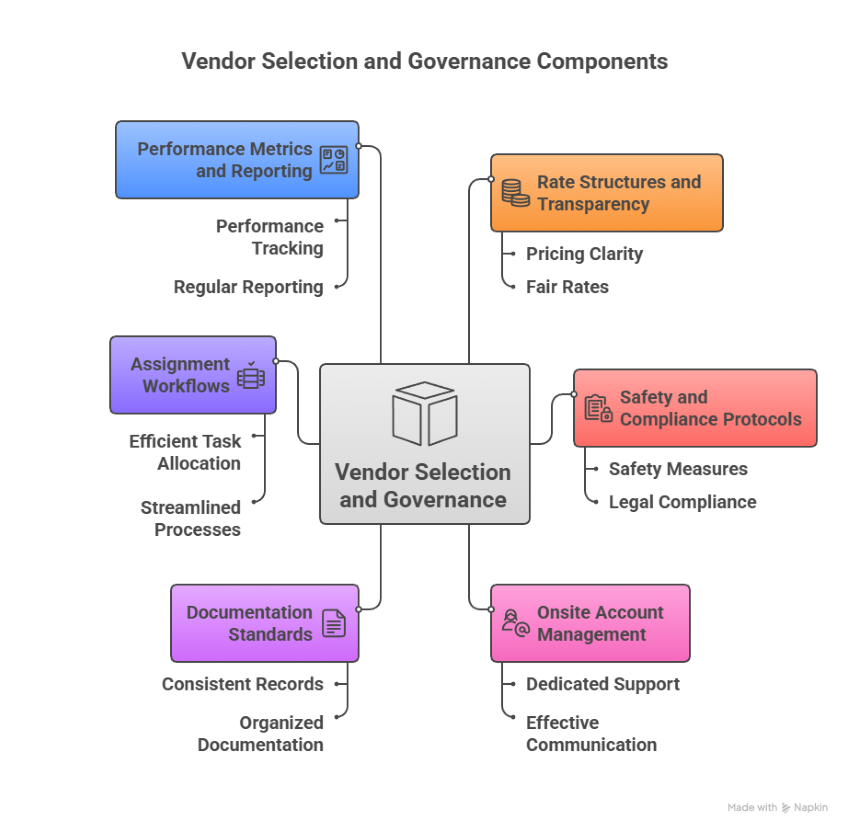
Contingent staffing functions best when vendor roles and responsibilities are structured within a governance framework. Organizations evaluate vendor capabilities, deployment speed, compliance processes, geographic coverage, workforce quality, and experience within relevant industries.
Governance components include:
- Rate structures and transparency
- Safety and compliance protocols
- Onsite account management
- Documentation standards
- Assignment workflows
- Performance metrics and reporting
Clear governance eliminates ambiguity and ensures consistent workforce management across all departments.
Onboarding and Job-Site Readiness
A structured onboarding process prepares workers to integrate quickly into the operational environment. Effective onboarding includes site-specific training, safety protocols, equipment requirements, job expectations, and supervisor introductions. Job-site readiness reduces early turnover, accelerates productivity, and enhances worker confidence during the transition.
Performance Monitoring and Workforce Optimization
Monitoring performance ensures that contingent labor supports operational objectives. Organizations track attendance, productivity metrics, task completion, and alignment with job-site expectations. When performance deviates, adjustments may include reskilling, reassigning personnel, refining job descriptions, or rebalancing vendor utilization.
Optimization also involves adjusting shift structures, planning workforce rotation, and creating pools of pre-qualified workers who can be deployed quickly as demand shifts.
The Increasing Connection Between Contingent Staffing and Business Continuity
Contingent staffing has become a fundamental component of business continuity planning. Workforce interruptions—labor shortages, market disruptions, natural events, or industrial actions—create immediate operational risk. Companies use contingent staffing to stabilize output when normal workforce conditions are compromised.
Continuity During Labor Disruptions
When workforce disruptions occur, companies require rapid access to replacement labor to maintain operations. Contingent staffing provides an established channel for inserting trained workers into critical roles and preventing service gaps. This avoids shutdowns, protects supply-chain timelines, and maintains customer commitments.
Emergency Response Workforce Solutions
Unexpected surges in demand or facility issues require fast labor mobilization. Organizations with structured contingent staffing programs can request additional workers on accelerated timelines, ensuring operational coverage without compromising safety or quality.
Risk Reduction Across the Workforce Lifecycle
Contingent staffing reduces dependence on a static workforce model. Flexible labor availability mitigates risks associated with turnover, absenteeism, and unpredictable market conditions. A distributed workforce strategy strengthens resilience across all stages of the workforce lifecycle, from onboarding to productivity stabilization.
Why Organizations Combine Permanent and Contingent Labor Models
Hybrid workforce structures give companies the ability to deploy labor in a way that matches operational volatility. Permanent staff provide stability, institutional knowledge, and long-term expertise. Contingent workers support scale, speed, and specialization.
Companies increasingly design hybrid models to achieve:
- Higher labor efficiency
- Greater workforce adaptability
- Lower fixed costs
- Faster project execution
- Reduced downtime
- Expanded access to specialized skills
As industries evolve, the boundaries between contingent and permanent workers shift. Workforce strategies now focus on aligning the right type of worker with the right task rather than treating staffing categories as isolated.
Evaluating When Contingent Staffing Is the Right Solution
Organizations determine the suitability of contingent staffing by evaluating demand patterns, risk thresholds, and operational objectives.
Situations That Benefit Most from Contingent Staffing
Contingent staffing performs exceptionally well under the following conditions:
- Workload variability and seasonality
- Large-scale projects requiring short-term manpower
- Labor shortages in critical roles
- Rapid expansion into new markets
- Unexpected worker absences
- Facility relocations or restructuring
- Need for specialized expertise not required permanently
When these conditions arise, contingent labor supports output continuity without long-term commitments.
Determining Fit for Onsite or Remote Environments
The nature of the work influences the ideal staffing model. Industrial, manufacturing, logistics, and transportation sectors rely heavily on onsite contingent labor. Technology, consulting, and administrative environments often blend onsite and remote contingent staff. Assessing job requirements ensures that staffing partners supply workers capable of meeting environmental and technical expectations.
Evaluating Internal Capacity
Organizations also examine whether current teams can absorb additional workload. If overtime becomes excessive or performance declines, contingent staffing provides relief while preventing burnout. This protects both output and workforce morale.
FAQ’s
What is a contingent staffing solution?
A contingent staffing solution is a workforce model that supplies non-permanent workers—such as contractors, temporary employees, and project-based labor—to meet fluctuating operational needs without increasing permanent headcount.
How does contingent staffing support operational continuity?
It provides rapid access to labor when workloads surge, employees are unavailable, or disruptions affect normal staffing levels. This prevents delays, protects throughput, and ensures service commitments are met.
What types of workers are included in contingent staffing?
Contingent staffing includes temporary employees, independent contractors, skilled tradespeople, consultants, project teams, and rapid-deployment labor forces.
What industries benefit most from contingent staffing?
Industries with variable demand or complex operations—such as logistics, manufacturing, construction, transportation, healthcare, and utilities—use contingent labor extensively to maintain stable output.
How is contingent staffing different from staff augmentation?
Staff augmentation focuses on adding individual workers to support existing teams, while contingent staffing includes broader workforce solutions such as MSP oversight, VMS technology, payrolling, compliance management, and large-scale labor deployment.
How do organizations manage compliance in contingent staffing?
They use structured classification procedures, standardized onboarding, documentation controls, safety training, and vendor governance frameworks to ensure all workers meet regulatory requirements.
When should a company choose contingent staffing over permanent hiring?
Contingent staffing is ideal when labor needs fluctuate, projects have defined timelines, specialized skills are required intermittently, or workforce risk must be mitigated quickly.