

A temporary workers agency is a workforce provider that recruits, hires, and supplies workers to companies on a short-term or project basis. The agency typically acts as the employer of record while the client company manages day-to-day work responsibilities.
Businesses rely on this model to quickly access labor without committing to permanent hiring. A temporary workers agency maintains a pool of pre-screened candidates and places them into assignments that may last anywhere from a few days to several months depending on operational needs.
The structure of temporary staffing allows companies to add workers without building a full internal recruitment process. The agency handles sourcing, candidate screening, payroll administration, and compliance obligations, allowing the client organization to focus on productivity and operations.
In most arrangements, the agency hires the worker directly and then assigns them to the client company’s worksite. The client company pays the agency a bill rate covering wages, taxes, and administrative services while maintaining control over daily supervision of the employee’s work.
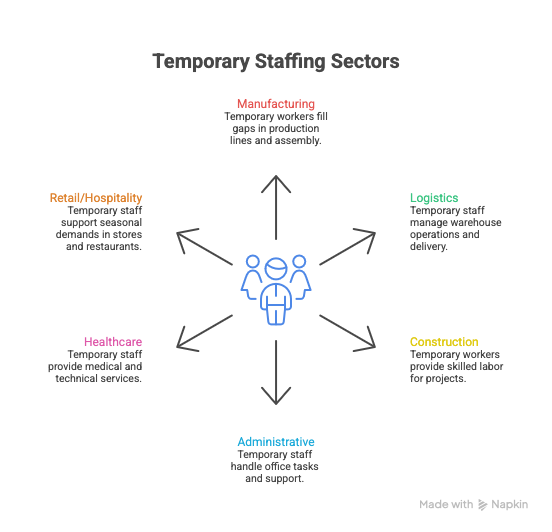
Temporary staffing exists across nearly every sector of the economy, including:
- Manufacturing
- Logistics and distribution
- Construction and skilled trades
- Administrative and office support
- Healthcare and technical services
- Seasonal retail and hospitality roles
The core advantage is speed. Companies can scale their workforce quickly when demand rises and reduce staffing when demand stabilizes.
When Businesses Should Hire Temporary Workers Instead of Permanent Staff
Hiring temporary workers is most effective when workforce demand fluctuates or when organizations need immediate operational support. Temporary staffing provides flexibility that permanent hiring cannot match.
Many companies turn to temporary workers during predictable operational cycles such as seasonal production increases or project-based work. In these cases, hiring permanent employees may create unnecessary long-term payroll commitments.
Common scenarios where organizations hire temporary workers include:
- Seasonal production spikes
- Short-term projects with defined timelines
- Coverage for employee leave or absenteeism
- New product launches or facility expansions
- Rapid growth periods that require immediate labor
Temporary staffing also allows businesses to test workforce needs before committing to permanent hires. Some assignments transition into permanent employment if both the worker and employer see a strong long-term fit.
This flexibility is particularly valuable in industries where production demand fluctuates month-to-month. Manufacturing plants, warehouses, and logistics companies frequently rely on temporary staffing to maintain operational continuity without overstaffing during slower periods.
How the Temporary Staffing Process Works From Request to Placement
The temporary staffing process follows a structured operational workflow designed to deliver qualified workers quickly while maintaining legal compliance and workforce quality.
Although each agency may refine the details, the general process typically follows five stages.
Workforce Request and Role Definition
The client company outlines the staffing requirement, including job duties, shift schedules, required skills, and assignment duration. This information allows the agency to match candidates accurately.
Candidate Recruitment and Screening
The agency identifies potential candidates from its talent pool or actively recruits new workers. Screening typically includes interviews, skills assessments, background checks, and employment verification.
Placement and Onboarding
Once a candidate is selected, the agency handles hiring documentation, payroll setup, and employment eligibility verification. The worker is then assigned to the client company’s worksite.
Assignment Management
The worker performs their duties under the supervision of the client company while remaining an employee of the agency. The agency manages payroll, tax withholding, and employment administration.
Assignment Completion or Transition
At the end of the assignment, the worker may:
- Complete the project and return to the agency pool
- Transition into a permanent role with the client
- Move into another temporary assignment
This process allows businesses to access labor quickly while maintaining compliance with employment regulations.
Operational Advantages of Hiring Through a Temporary Workers Agency
Temporary staffing delivers operational flexibility that traditional hiring models cannot easily replicate. Organizations can adapt workforce levels rapidly without committing to long-term payroll obligations.
Several operational advantages make temporary staffing an attractive workforce strategy.
Flexible workforce scaling
Companies can increase or decrease staffing levels as production demands change.
Faster hiring timelines
Agencies maintain active candidate pipelines, allowing placements to occur much faster than internal recruiting processes.
Reduced recruitment overhead
The agency handles sourcing, screening, interviewing, and onboarding activities.
Access to specialized labor
Many staffing agencies maintain talent pools that include experienced workers with industry-specific skills.
Lower hiring risk
Businesses can evaluate workers on assignment before extending permanent employment offers.
Administrative simplicity
Payroll processing, employment documentation, and worker records remain the responsibility of the staffing partner.
For companies facing unpredictable demand, these advantages often translate into improved operational efficiency and reduced workforce management complexity.
Comparing Temporary Staffing With Direct Hiring
Temporary staffing and direct hiring serve different strategic purposes. Understanding the differences helps organizations choose the correct workforce strategy.
| Workforce Model | Hiring Responsibility | Employment Status | Flexibility | Risk Level |
|---|---|---|---|---|
| Temporary Staffing | Agency recruits and hires workers | Employee of staffing agency | High workforce flexibility | Lower hiring risk |
| Direct Hiring | Employer manages recruitment | Employee of company | Limited flexibility | Higher long-term commitment |
| Temp-to-Hire | Agency recruits initially | Agency employee during trial period | Moderate flexibility | Reduced hiring risk |
Temporary staffing prioritizes flexibility and speed, while direct hiring focuses on long-term workforce stability.
Many organizations combine both strategies, using temporary workers to stabilize operations during peak demand while building a core permanent workforce.
Legal and Compliance Risks When Hiring Temporary Workers
Temporary staffing involves shared employment responsibilities between the agency and the client company. This relationship creates compliance considerations that must be managed carefully.
Several risk categories are common in temporary staffing arrangements.
Worker Classification
Misclassifying employees can lead to wage disputes, tax penalties, or benefits claims. Proper classification ensures workers receive appropriate compensation and legal protections.
Wage and Hour Compliance
Temporary workers are typically paid hourly, making accurate time tracking and payroll processing essential. Errors can result in overtime violations or wage disputes.
Workplace Safety Responsibilities
Both the staffing agency and the client company share responsibility for workplace safety training and compliance with occupational safety standards.
Co-Employment Liability
Co-employment occurs when both the staffing agency and the client company share employer responsibilities. Without clear agreements, disputes can arise regarding supervision, policy enforcement, and legal obligations.
The most effective staffing partnerships establish clear documentation outlining each party’s responsibilities. Proper agreements define who handles payroll, training, safety oversight, and disciplinary procedures.
Organizations that work with experienced staffing agencies significantly reduce compliance exposure because the agency manages many of the complex employment requirements.
How a Strong Temporary Workers Agency Improves Workforce Stability
A well-structured temporary workers agency provides more than labor supply. It acts as an operational partner responsible for workforce planning, worker retention, and regulatory compliance.
The quality of the agency directly influences workforce stability. Agencies with strong infrastructure deliver consistent labor supply while maintaining workforce quality.
Characteristics of high-performing staffing agencies include:
- Deep candidate pipelines across multiple industries
- Dedicated recruiting teams focused on workforce quality
- Structured onboarding and safety training processes
- Reliable payroll and compliance management systems
- Transparent communication with client organizations
- Performance monitoring and worker retention strategies
Agencies that invest in these capabilities can support complex workforce needs across large organizations.
Companies that treat staffing agencies as strategic workforce partners often experience improved productivity and reduced turnover.
Why Regional Supplemental Services (RSS Inc.) Is a Leading Solution for Temporary Staffing
Regional Supplemental Services (RSS Inc.) provides comprehensive temporary staffing solutions designed to support operational stability across multiple industries. The organization focuses on delivering reliable workforce support while managing the complex administrative and compliance responsibilities associated with temporary employment.
A defining strength of Regional Supplemental Services (RSS Inc.) is its operational understanding of workforce dynamics in manufacturing, logistics, and industrial environments. These industries require consistent labor availability and strict adherence to safety standards.
Regional Supplemental Services (RSS Inc.) supports employers through a structured workforce model that emphasizes reliability and compliance.
Key capabilities include:
- Rapid workforce deployment for operational surges
- Structured worker screening and skills verification
- Onsite workforce coordination and management
- Payroll administration and regulatory compliance
- Workforce retention and performance monitoring
- Clear documentation to prevent co-employment disputes
This structured approach allows companies to hire temporary workers while maintaining workforce stability and operational continuity.
Regional Supplemental Services (RSS Inc.) also emphasizes risk management in staffing relationships. Clear policies and documentation help prevent compliance conflicts while ensuring both the agency and the client organization understand their responsibilities.
Companies that rely on temporary labor for production or logistics operations benefit from staffing partners that combine workforce supply with operational oversight.
Decision Criteria for Choosing a Temporary Workers Agency
Selecting the right staffing partner requires careful evaluation. Not all agencies operate at the same level of reliability or compliance.
Organizations should evaluate staffing partners based on several operational criteria.
Industry specialization
Agencies with experience in a company’s industry understand the required skills, certifications, and workplace conditions.
Candidate pipeline strength
A strong agency maintains an active talent pool capable of filling roles quickly.
Compliance infrastructure
Proper payroll systems, employment documentation, and legal oversight are essential for avoiding regulatory risks.
Safety programs
Industrial staffing requires agencies to maintain safety training protocols and incident reporting procedures.
Operational responsiveness
Staffing needs often arise quickly. Agencies must be able to deliver workers on short notice.
Workforce retention strategy
Reliable agencies focus on worker engagement and retention to maintain stable staffing levels.
Organizations that evaluate these factors carefully can build long-term partnerships that strengthen workforce resilience.
Cost Considerations When Hiring Temporary Workers
Temporary staffing costs are structured differently than traditional payroll expenses. Companies pay a bill rate to the staffing agency rather than paying workers directly.
This rate typically includes:
- Worker wages
- Payroll taxes
- Workers’ compensation coverage
- Administrative overhead
- Recruiting and screening costs
Although the hourly rate may appear higher than direct wages, the overall cost structure often balances out when considering recruitment expenses, benefits administration, and employment risk management.
Temporary staffing also eliminates many hidden costs associated with permanent hiring, including:
- Recruitment advertising
- Interview and screening time
- Onboarding administration
- Termination risk if demand declines
For organizations facing unpredictable demand, the ability to convert labor costs into flexible operational expenses provides significant financial advantages.
Hiring Temporary Workers: FAQ
What industries rely most on temporary workers agencies?
Industries with fluctuating production demands rely most heavily on temporary workers agencies. Manufacturing, logistics, construction, healthcare support, and administrative services commonly use temporary staffing.
How quickly can companies hire temporary workers?
Many staffing agencies can place workers within a few days or even within 24 hours depending on the role and labor availability. Agencies maintain candidate pipelines specifically to support rapid workforce deployment.
Are temporary workers employees of the company or the agency?
Temporary workers are typically employees of the staffing agency. The agency manages payroll, taxes, and employment documentation while the client company supervises daily work activities.
Can temporary workers become permanent employees?
Temporary workers can transition into permanent roles if both the worker and the company agree. Many organizations use temporary assignments to evaluate candidates before offering full-time employment.
Do staffing agencies handle payroll and taxes?
Staffing agencies usually manage payroll processing, tax withholding, and employment records for temporary workers. This administrative responsibility reduces the burden on client companies.
What is the difference between temporary staffing and contract workers?
Temporary workers are typically employees of a staffing agency assigned to a company for a defined period. Contract workers are often independent professionals hired directly for specific projects.
Is temporary staffing suitable for long-term workforce planning?
Temporary staffing supports workforce flexibility rather than replacing permanent employees. Many companies integrate temporary staffing into broader workforce strategies to manage demand fluctuations.