

Strike contingency planning allows trucking companies to maintain freight operations during labor disruptions.
Strike contingency planning is the operational discipline of preparing logistics, staffing, and management strategies that allow trucking companies to sustain freight movement when labor disputes interrupt normal operations. The objective is operational continuity—keeping trucks moving, freight flowing, and customer commitments intact despite workforce disruption.
In trucking, labor instability can halt transportation networks faster than most operational failures. Freight movement depends on coordinated activity across drivers, dispatchers, maintenance technicians, terminal workers, and support staff. If any of these functions stops operating, even temporarily, the effects cascade quickly across routes, customers, and supply chains.
Unlike general risk management, strike contingency planning focuses on workforce disruptions that directly affect transportation capacity. It requires scenario modeling, operational redundancies, workforce flexibility, and clear command structures.
Companies that plan for labor disruption treat strike readiness as part of normal operational resilience rather than a reactive response to negotiations. The preparation often determines whether freight networks remain functional or collapse under operational pressure.
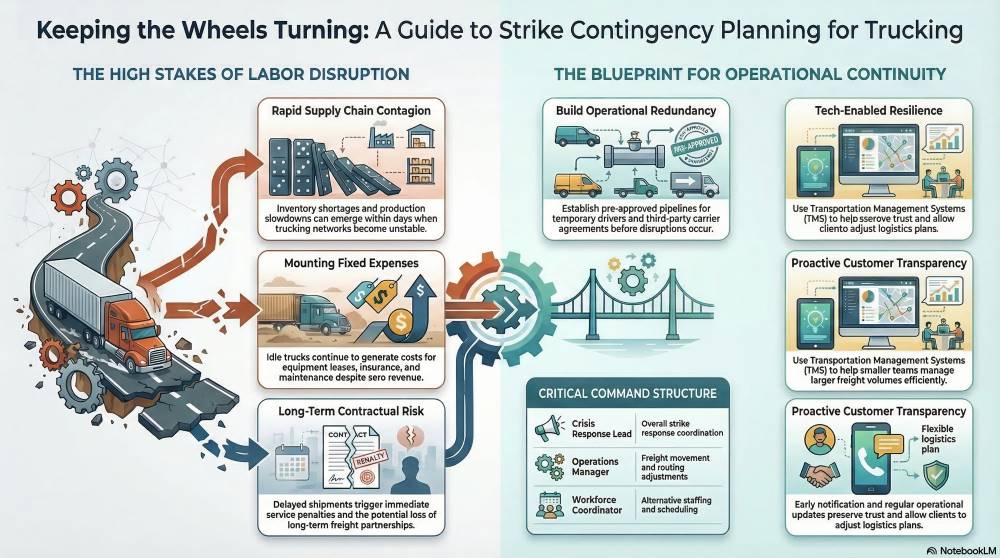
Labor strikes pose immediate operational and financial risks for trucking companies.
Transportation networks operate under continuous movement and tight delivery schedules. When labor disputes interrupt workforce availability, disruptions propagate quickly across freight networks and customer supply chains.
The risks extend well beyond temporary service delays.
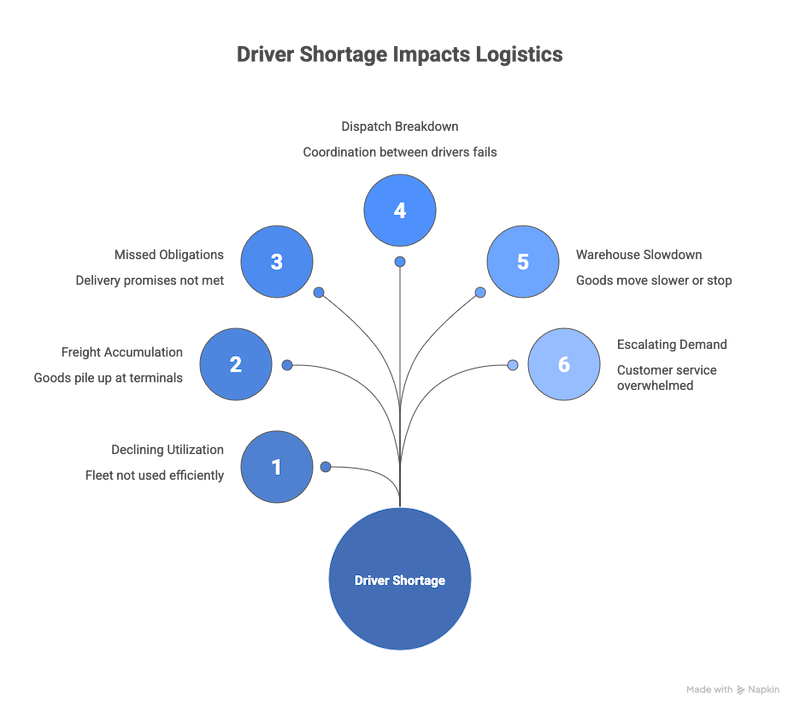
Operational consequences often include:
- Fleet utilization declines due to driver shortages
- Freight accumulates at terminals and distribution centers
- Contractual delivery obligations are missed
- Dispatch coordination breaks down
- Warehouse throughput slows or stops
- Customer service teams experience escalating demand
These disruptions translate into significant financial exposure.
Idle trucks continue generating fixed expenses such as equipment leases, insurance, and maintenance. Meanwhile, delayed shipments trigger service penalties and potential loss of long-term contracts.
Supply chains also amplify the consequences. Manufacturers, retailers, and distributors depend on predictable freight capacity. When trucking networks become unstable, inventory shortages and production slowdowns can emerge within days.
Strike contingency planning protects trucking companies from these cascading effects by ensuring operational alternatives are already established before a disruption occurs.
Workforce dependencies determine how vulnerable a trucking operation is to a strike.
| Role | Responsibility |
|---|---|
| Crisis Response Lead | Overall strike response coordination |
| Operations Manager | Freight movement and routing adjustments |
| Workforce Coordinator | Alternative staffing and scheduling |
| Customer Communication Lead | Updates for clients and partners |
| Safety Compliance Lead | Regulatory and safety oversight |
This structure allows companies to maintain centralized decision authority while delegating operational responsibilities to experienced leaders.
When command roles are defined in advance, organizations respond more effectively to rapidly changing labor conditions.
Maintaining freight movement requires operational redundancy.
Operational redundancy is the most important component of strike preparedness for trucking companies. Redundancy ensures that transportation capacity can continue even when internal workforce availability declines.
Several redundancy strategies support freight continuity.
Alternative driver capacity
- Temporary drivers
- Contract drivers
- Owner-operator partnerships
- Third-party carrier agreements
Expanded carrier networks
Partner carriers can absorb overflow freight if internal fleets become limited.
Cross-trained personnel
Training operational staff to support multiple roles increases flexibility during workforce shortages.
Flexible routing systems
Dynamic route planning allows companies to shift freight between terminals and driver pools.
Operational redundancy reduces reliance on any single workforce group, making transportation networks more resilient during labor disputes.
Temporary workforce solutions play a critical role in strike contingency planning.
Temporary labor often becomes the most immediate solution when strikes disrupt internal staffing. For trucking companies, this may involve external drivers, logistics personnel, or warehouse staff who can support operations during work stoppages.
Temporary workforce solutions must be planned carefully to avoid operational risks.
Key considerations include:
- Commercial driver licensing compliance
- Safety training requirements
- Familiarity with fleet equipment
- Dispatch communication systems
- Regulatory and insurance requirements
Companies that establish relationships with staffing providers before a labor disruption can mobilize replacement workers more quickly.
Pre-approved workforce pipelines allow operations to scale rapidly during periods of labor instability.
Customer communication strategies protect long-term freight relationships.
Freight customers depend on transparency when transportation disruptions occur. Poor communication during labor strikes often damages relationships more than the operational disruption itself.
Clear communication reduces uncertainty and allows customers to adjust their logistics plans.
Effective strike communication strategies include:
- Early notification of potential service disruptions
- Clear timelines and contingency plans
- Dedicated customer support channels
- Regular operational updates
- Transparent capacity limitations
When customers understand how freight will continue moving—even at reduced capacity—they are more likely to maintain long-term partnerships.
Trust becomes a competitive advantage during supply chain disruptions.
Technology systems strengthen operational resilience during workforce disruptions.
Technology infrastructure allows trucking companies to maintain operational coordination even when workforce resources decline.
Digital systems reduce dependence on manual communication and increase operational visibility.
Important technology systems include:
- Transportation management systems (TMS)
- Real-time fleet tracking
- Automated load assignment platforms
- Digital dispatch communication tools
- Freight visibility dashboards
- Route optimization software
These tools help smaller operational teams manage larger freight volumes during workforce shortages.
Automation does not replace human decision-making, but it dramatically improves the efficiency of reduced staffing environments.
Legal and compliance considerations must guide strike contingency planning.
Labor disputes introduce complex legal responsibilities for trucking companies. Organizations must balance operational continuity with labor law compliance and safety regulations.
Key legal considerations include:
- Collective bargaining agreements
- Labor dispute regulations
- Replacement worker legality
- Safety compliance standards
- Hours-of-service regulations for drivers
- Insurance policy coverage during strikes
Legal counsel should review strike contingency plans to ensure that operational responses do not expose the company to regulatory violations or labor litigation.
Compliance failures during strikes can create long-term legal consequences far more damaging than the operational disruption itself.
Strike contingency planning requires ongoing operational testing.
A contingency plan that exists only on paper offers limited value. Operational preparedness depends on regular testing, simulation exercises, and workforce training.
Testing reveals operational weaknesses before a real disruption occurs.
Effective testing methods include:
- Crisis simulation exercises
- Dispatch continuity drills
- Alternative staffing activation tests
- Communication system stress tests
- Freight rerouting simulations
Organizations that rehearse strike scenarios gain operational familiarity with contingency procedures.
This preparation significantly reduces response time when disruptions occur.
Strike preparedness strengthens long-term operational resilience.
While strike contingency planning focuses on labor disruptions, the strategies developed for these scenarios improve overall operational resilience.
The same redundancy systems that support strike response also help organizations respond to other disruptions such as natural disasters, cyber incidents, or sudden capacity shortages.
Contingency planning strengthens:
- Workforce flexibility
- Carrier partnerships
- logistics coordination
- operational visibility
- crisis leadership capabilities
Organizations that treat contingency planning as a permanent operational capability become far more resilient across a wide range of disruptions.
FAQ’s
What is a strike contingency plan in trucking?
A strike contingency plan is a structured strategy that allows trucking companies to maintain freight operations during labor disputes by preparing alternative staffing, routing, and operational procedures.
How do trucking companies maintain deliveries during a strike?
Companies maintain deliveries by using temporary drivers, third-party carriers, cross-trained staff, and alternative logistics routing systems to sustain freight capacity.
Which trucking roles are most critical during a strike?
Drivers, dispatch teams, terminal staff, and maintenance personnel are the most operationally critical roles because each directly affects freight movement and fleet functionality.
How early should trucking companies prepare for potential strikes?
Preparation should begin as soon as labor negotiations become unstable or workforce tensions increase, allowing time to establish staffing alternatives and operational contingencies.
Can temporary drivers legally replace striking drivers?
Temporary drivers can be used depending on labor laws, contractual agreements, and regulatory requirements. Legal review is essential before implementing replacement workforce strategies.
What operational systems help trucking companies manage disruptions?
Transportation management systems, fleet tracking platforms, dispatch automation tools, and route optimization software all help organizations maintain operational coordination during workforce disruptions.
Why is communication important during a trucking strike?
Clear communication with customers prevents uncertainty, allows supply chains to adjust to reduced capacity, and preserves long-term freight partnerships.