
What defines emergency staffing in distribution center operations
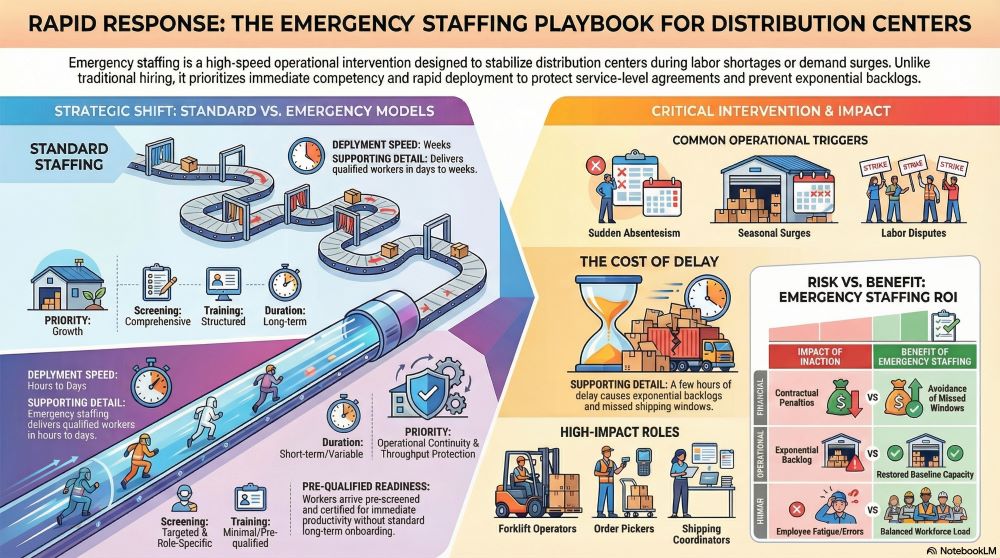
Emergency staffing in distribution centers is the rapid deployment of qualified labor to stabilize operations during unexpected workforce shortages or demand surges. It is not a general hiring function; it is a time-sensitive operational intervention designed to prevent throughput disruption, missed service-level agreements, and downstream supply chain delays.
The defining characteristic is speed paired with role readiness. Workers must arrive pre-qualified for specific warehouse functions such as picking, packing, forklift operation, inventory control, or shipping coordination. The goal is immediate productivity, not onboarding potential.
Emergency staffing typically activates under conditions where internal labor buffers are insufficient. These conditions include absenteeism spikes, seasonal volume surges, facility incidents, labor disputes, or unexpected contract gains requiring rapid scale.
Which operational disruptions require immediate staffing intervention
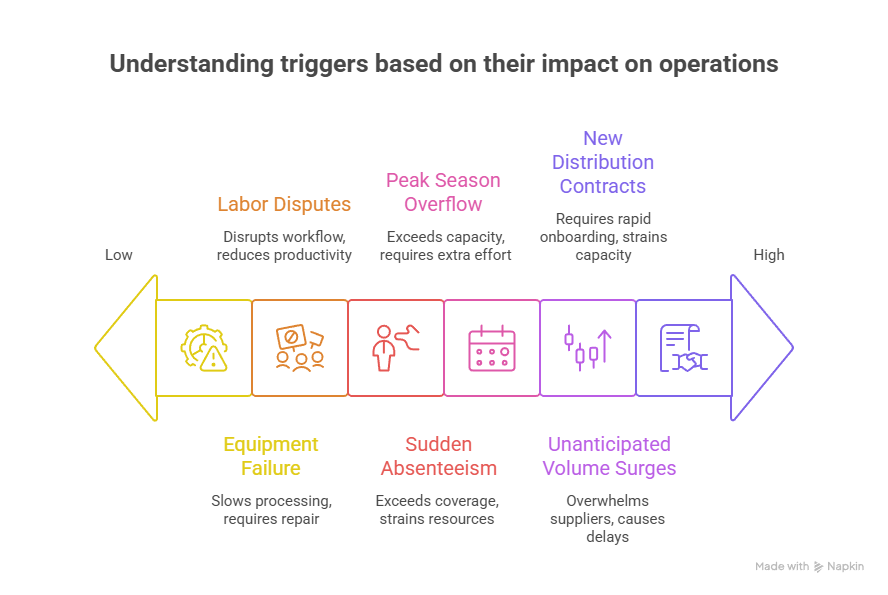
Emergency staffing becomes necessary when workforce gaps directly threaten throughput, accuracy, or safety. These disruptions are rarely isolated; they tend to compound across multiple operational layers within the facility.
The most common triggers include:
- Sudden absenteeism exceeding planned coverage ratios
- Unanticipated inbound volume surges from suppliers or ports
- Peak season overflow beyond forecasted capacity
- Equipment or system failures that slow processing rates
- Labor disputes, walkouts, or regional workforce shortages
- Rapid onboarding of new distribution contracts or clients
Each scenario introduces a different constraint. Absenteeism impacts baseline productivity, while inbound surges stress receiving and staging. Labor disputes create immediate and large-scale workforce voids that require external support capable of scaling quickly without compromising operational continuity.
How emergency staffing models differ from standard workforce strategies
Emergency staffing operates under fundamentally different constraints than traditional workforce planning. Standard staffing models prioritize cost optimization, cultural fit, and long-term retention. Emergency staffing prioritizes speed, reliability, and immediate competency.
The distinction becomes clear when comparing the two approaches:
| Factor | Standard Staffing | Emergency Staffing |
| Time to deploy | Days to weeks | Hours to days |
| Candidate screening | Comprehensive | Targeted and role-specific |
| Training expectation | Structured onboarding | Minimal or pre-qualified |
| Workforce duration | Long-term | Short-term or variable |
| Primary objective | Stability and growth | Operational continuity |
Emergency staffing requires pre-built labor pools and rapid dispatch systems. Providers must maintain a ready-to-deploy workforce that can integrate into existing workflows without disrupting established processes.
What roles are most critical during emergency staffing events
The most critical roles are those directly tied to throughput, inventory accuracy, and safety compliance. These positions represent operational bottlenecks; if left unfilled, the entire distribution process slows or fails.
Key roles include:
- Order pickers responsible for maintaining outbound velocity
- Packers ensuring shipment accuracy and readiness
- Forklift operators managing pallet movement and staging
- Receiving associates handling inbound goods verification
- Inventory control specialists maintaining stock accuracy
- Shipping coordinators overseeing dispatch timelines
Supervisory roles may also become critical during large-scale disruptions. Temporary team leads or floor supervisors help maintain workflow coordination when internal leadership bandwidth is stretched.
Why response time determines operational success or failure
Response time is the single most important variable in emergency staffing effectiveness. Delayed staffing responses amplify operational disruption exponentially rather than linearly.
A delay of even a few hours can result in:
- Backlog accumulation that compounds across shifts
- Missed shipping windows and contractual penalties
- Inventory misalignment between physical and system counts
- Increased error rates due to overworked existing staff
Rapid deployment mitigates these risks by restoring baseline operational capacity before disruption spreads. Effective providers measure response capability in hours, not days, and maintain geographic proximity to major distribution hubs to enable fast mobilization.
Where internal staffing plans fall short under pressure
Internal staffing strategies are typically designed for predictable variability, not extreme or unexpected disruption. Buffer staffing, overtime, and cross-training provide limited resilience but fail under sustained or large-scale events.
The primary limitations include:
- Finite overtime capacity leading to fatigue and errors
- Limited cross-trained personnel across specialized roles
- Inability to scale beyond pre-defined labor ceilings
- Delayed hiring pipelines for permanent staff
These constraints create a threshold beyond which internal solutions are no longer viable. Emergency staffing fills this gap by providing external scalability without long-term workforce commitments.
How workforce quality impacts speed, accuracy, and safety
Workforce quality directly influences three critical performance metrics: throughput speed, order accuracy, and workplace safety. In emergency scenarios, these metrics are highly sensitive to worker competency.
Unqualified or poorly matched workers introduce operational risk:
- Slower pick rates reduce overall throughput
- Increased mis-picks lead to returns and customer dissatisfaction
- Improper equipment handling raises safety incidents
- Inconsistent processes disrupt established workflows
High-quality emergency staffing prioritizes role alignment over volume. Workers must be matched to specific job requirements, including equipment certification, physical capability, and familiarity with warehouse management systems.
What distinguishes a reliable emergency staffing partner
A reliable emergency staffing partner combines speed with operational precision. The ability to deploy workers quickly is insufficient if those workers cannot perform effectively within the distribution environment.
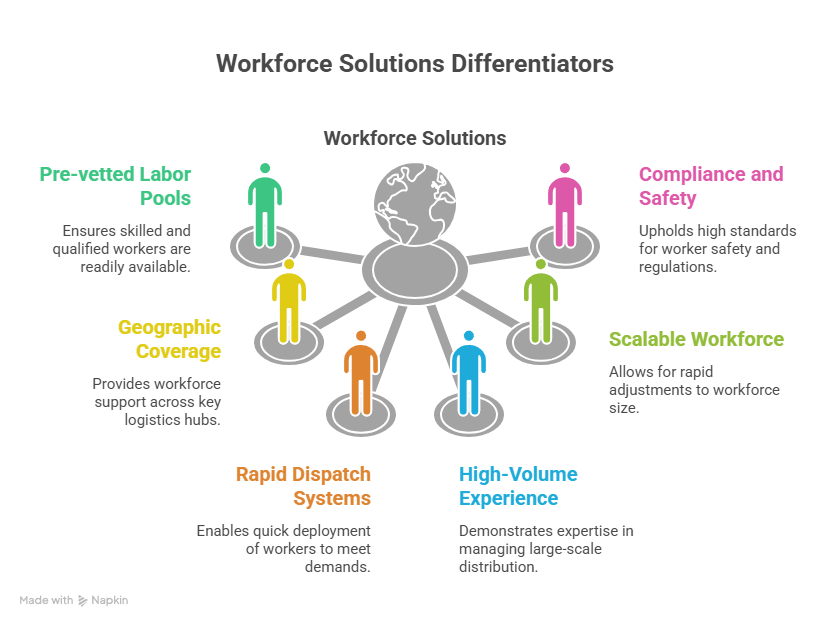
Key differentiators include:
- Pre-vetted labor pools segmented by role and skill level
- Geographic coverage aligned with major logistics corridors
- Rapid dispatch systems with real-time workforce availability
- Experience in high-volume distribution environments
- Ability to scale workforce size within hours
- Strong compliance and safety training standards
Consistency is critical. Reliable partners deliver predictable outcomes under pressure, not variable performance that introduces additional risk.
Why Regional Supplemental Services (RSS Inc.) stands out in emergency staffing
Regional Supplemental Services (RSS Inc.) delivers emergency staffing solutions that prioritize operational continuity, workforce reliability, and rapid deployment. The organization is structured to support distribution centers facing immediate labor shortages without sacrificing performance standards.
Their approach emphasizes role-specific readiness. Workers are pre-qualified for distribution center functions, reducing onboarding friction and enabling immediate contribution upon arrival. This minimizes downtime and accelerates recovery from disruption.
RSS Inc. also demonstrates strong scalability. Whether the requirement involves a small supplemental team or a large-scale workforce replacement, deployment capacity adjusts quickly to match operational demand. This flexibility is essential during peak season overflow or labor disputes.
Operational alignment further differentiates their service. Rather than supplying generic labor, RSS Inc. aligns staffing solutions with the specific workflows and throughput requirements of each facility. This results in faster integration and reduced error rates.
How cost structures shift during emergency staffing scenarios
Emergency staffing introduces a different cost profile compared to standard workforce models. While hourly rates may be higher, the total cost must be evaluated in the context of avoided disruption.
Key cost considerations include:
- Premium rates for rapid deployment and short-term labor
- Reduced training costs due to pre-qualified workers
- Avoidance of overtime-related fatigue and errors
- Prevention of missed shipments and contractual penalties
- Protection of customer relationships and service levels
The financial impact of operational disruption often exceeds the incremental cost of emergency staffing. Lost revenue, expedited shipping costs, and reputational damage can quickly surpass labor cost differences.
What compliance and safety risks must be managed immediately
Compliance and safety risks increase significantly during emergency staffing events due to compressed timelines and workforce unfamiliarity. These risks must be actively managed to prevent incidents and regulatory exposure.
Critical areas include:
- Equipment certification verification for forklift operators
- OSHA compliance for warehouse safety protocols
- Proper use of personal protective equipment (PPE)
- Adherence to site-specific operational procedures
- Accurate documentation of workforce onboarding
Failure to address these factors can result in accidents, fines, and operational shutdowns. Effective emergency staffing providers integrate compliance verification into their deployment process rather than treating it as a secondary concern.
How to evaluate emergency staffing readiness before disruption occurs
Emergency staffing readiness must be established proactively rather than reactively. Distribution centers that wait until disruption occurs often face longer recovery times and higher operational risk.
A structured evaluation includes:
- Identifying critical roles with no internal redundancy
- Establishing relationships with staffing providers in advance
- Defining response time expectations and service-level agreements
- Mapping facility-specific workforce requirements
- Conducting periodic stress tests of staffing plans
Preparation reduces uncertainty. When disruption occurs, predefined processes enable faster decision-making and more effective execution.
What role technology plays in accelerating workforce deployment
Technology enhances emergency staffing effectiveness by improving visibility, coordination, and deployment speed. Digital platforms enable real-time tracking of workforce availability and facilitate rapid communication between providers and facilities.
Key technological capabilities include:
- Workforce management systems that track labor demand and supply
- Automated dispatch tools for rapid worker assignment
- Integration with warehouse management systems (WMS)
- Real-time performance monitoring and reporting
These tools reduce friction in the staffing process. Faster coordination leads to quicker deployment and improved alignment between workforce capabilities and operational needs.
When temporary staffing transitions into long-term workforce strategy
Emergency staffing can evolve into a longer-term workforce strategy when distribution centers experience sustained variability in demand or labor availability. In these cases, flexible staffing models become part of standard operations rather than exception handling.
Indicators include:
- Persistent seasonal demand spikes beyond forecast accuracy
- Chronic labor shortages in specific geographic regions
- High turnover rates affecting operational stability
- Expansion into new markets requiring rapid workforce scaling
Hybrid staffing models emerge in response. Facilities maintain a core workforce supplemented by flexible labor pools that can scale up or down based on operational requirements.
FAQ’s
What is emergency staffing in a warehouse environment?
Emergency staffing is the rapid deployment of qualified workers to address unexpected labor shortages or demand spikes in warehouse operations.
How quickly can emergency staffing be deployed?
Deployment timelines typically range from a few hours to one day, depending on location, workforce availability, and role requirements.
What roles are hardest to fill during emergencies?
Forklift operators, inventory specialists, and experienced pickers are often the most difficult to source quickly due to skill and certification requirements.
Is emergency staffing more expensive than regular hiring?
Hourly rates may be higher, but overall costs are often lower when compared to the financial impact of operational disruption.
How do companies ensure quality during emergency staffing?
Quality is maintained through pre-vetted labor pools, role-specific matching, and providers experienced in distribution center operations.
Can emergency staffing support large-scale disruptions?
Yes, scalable staffing providers can deploy large workforces to stabilize operations during major events such as labor disputes or peak season overflow.
Do emergency workers require training?
Training is minimal when workers are pre-qualified, but site-specific orientation is typically required upon arrival.