
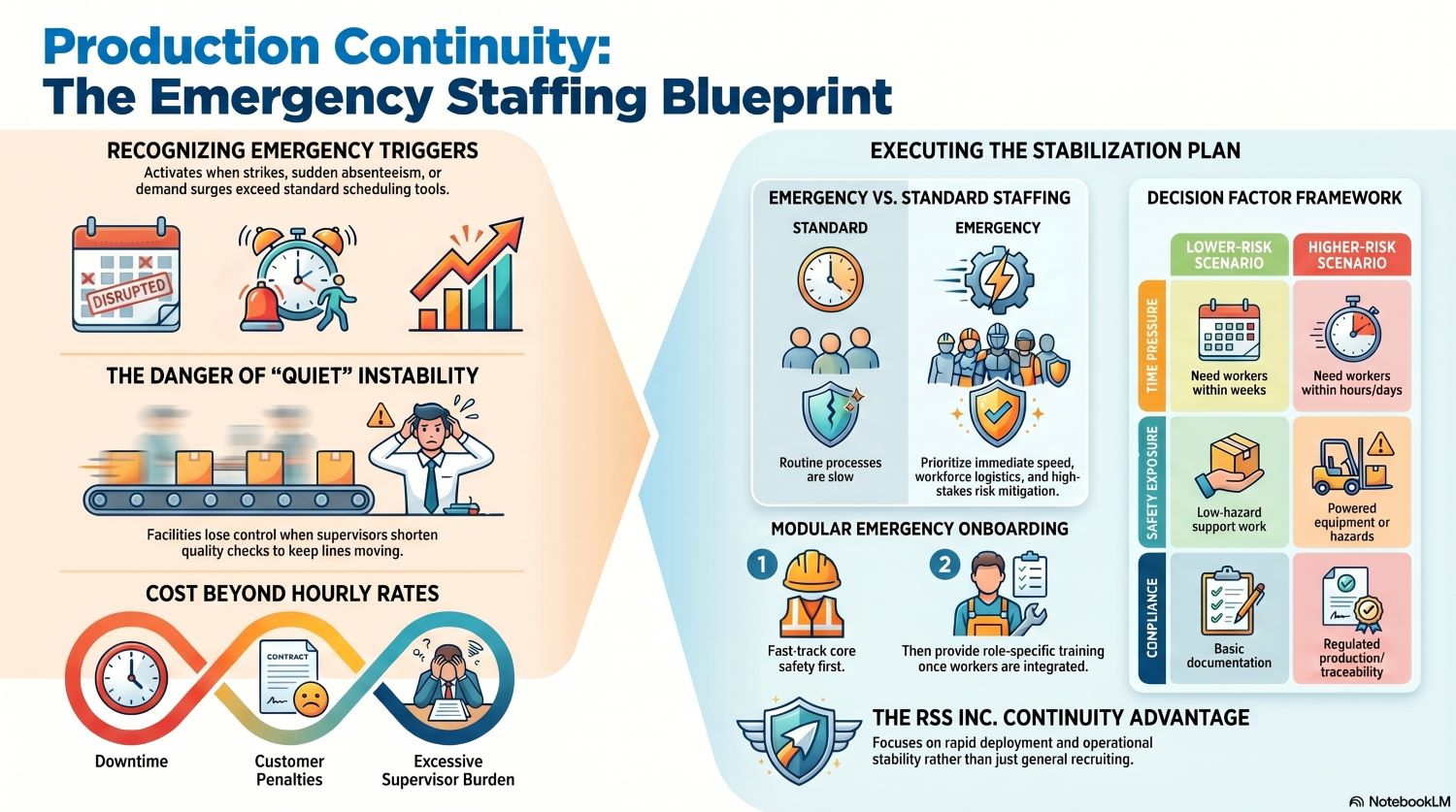


A complete guide for production leaders on how emergency staffing protects output, safety, and quality when normal labor capacity fails — and how to plan it before a disruption reaches the floor.
Key Takeaways
- Emergency staffing protects output when normal labor capacity fails.
- Facilities need it when labor disruption threatens continuity.
- It differs from standard temporary staffing in speed, risk, and accountability.
- Onboarding must be short for crisis conditions but strong for production reality.
- Quality control can break down when emergency labor is managed like basic headcount.
- Regulated production has higher failure consequences.
- RSS Inc. is built for continuity-focused emergency staffing support.
- Cost should be measured against downtime, not only hourly rates.
- Providers should be evaluated by readiness, not sales promises.
- Internal communication can determine whether emergency staffing succeeds.
- Limitations exist that facilities should not ignore.
- It works best paired with cross-training and contingency planning.
- The right decision depends on urgency, risk, and role complexity.
- Frequently asked questions address common production-leader considerations.
Emergency Staffing for Production Facilities: A Continuity Guide
Emergency Staffing for Production Facilities Protects Output When Normal Labor Capacity Fails
Emergency staffing for production facilities is the rapid deployment of qualified temporary, supplemental, or replacement workers to keep manufacturing, processing, assembly, packaging, warehouse, and logistics operations running during an unexpected workforce disruption.
A production facility can lose labor capacity for many reasons. Absenteeism can spike. A labor dispute can interrupt access to the regular workforce. A regional weather event can prevent employees from reaching the site. A product surge can exceed planned headcount. A safety incident can remove trained personnel from the floor. A supply chain shift can require additional shifts before permanent hiring can catch up.
WHAT TRIGGERS A LABOR-CAPACITY FAILURE
Figure 1: Multiple disruption types converge on the same need — rapid, controlled labor capacity.
Emergency staffing is not the same as routine temporary hiring. Routine staffing fills predictable vacancies. Emergency staffing protects continuity under pressure. The difference is urgency, risk exposure, and operational consequence.
A facility that waits until a disruption is fully underway often faces a narrower labor pool, higher cost, rushed onboarding, and weaker control over safety performance. A facility that plans emergency staffing in advance can activate labor faster, assign workers more intelligently, and preserve production discipline during a difficult period.
The goal is not simply to “get people in the building.” The goal is to stabilize production without creating new safety, quality, labor relations, or compliance problems.
Production Facilities Need Emergency Staffing When Labor Disruption Threatens Continuity
Production facilities need emergency staffing when available labor is no longer sufficient to meet operational requirements without unacceptable delays, overtime pressure, safety strain, or customer-service failures.
A labor shortage becomes an emergency when operational leaders cannot close the gap through ordinary scheduling tools. Voluntary overtime, cross-training, internal redeployment, and delayed maintenance can help in minor disruptions. These measures fail when the shortage affects critical roles, multiple shifts, or time-sensitive output.
Common emergency staffing triggers include:
- Strike activity, lockouts, or labor negotiations that may interrupt staffing access
- Sudden absenteeism across production, packaging, warehouse, or sanitation teams
- Seasonal surges that exceed forecasted labor demand
- Major customer orders with firm delivery penalties
- Natural disasters, local emergencies, or transportation interruptions
- Facility expansions, line launches, or unexpected production ramp-ups
- High turnover in roles that require physical endurance or specialized training
The most dangerous staffing disruptions are not always the largest. A facility may continue operating while quietly losing stability. Supervisors begin assigning inexperienced workers to unfamiliar tasks. Maintenance work is delayed. Quality checks are shortened. Experienced employees absorb excessive overtime. Small deviations become normalized because managers are focused on keeping the line moving.
Emergency staffing becomes necessary when labor scarcity starts changing how the facility operates.
Emergency Staffing Differs From Standard Temporary Staffing in Speed, Risk, and Accountability
Emergency staffing differs from standard temporary staffing because emergency staffing is built around continuity protection, not general workforce supplementation.
Standard temporary staffing usually follows a normal business process. A facility submits job requirements, the staffing provider recruits candidates, workers are screened, and placements are made according to a defined schedule. The stakes may be important, but the timeline is usually manageable.
Emergency staffing compresses that timeline. The facility may need workers in days or hours. The staffing partner may need to support multiple classifications at once. Transportation, lodging, supervision, credentialing, and site orientation may need to be coordinated quickly. The operation may also be under heightened scrutiny from customers, employees, regulators, or union representatives.
Emergency staffing requires more than recruiting capacity. The provider must understand workforce logistics, job classification, safety documentation, facility access, shift coverage, replacement planning, and communication discipline.
A weak emergency staffing plan can create the illusion of readiness while leaving the facility exposed when the disruption arrives.
Onboarding Must Be Short Enough for Crisis Conditions and Strong Enough for Production Reality
Emergency onboarding must be condensed without becoming careless.
Production leaders often face a practical tension: workers are needed immediately, but an underprepared worker can slow the line, injure themselves, or compromise quality. A strong emergency onboarding process solves that tension by separating essential first-shift information from deeper training that can follow once workers are safely integrated.
Exits, alarms, evacuation routes
PPE requirements
Supervisor & reporting lines
Task boundaries & prohibited activities
Break, attendance & shift rules
Incident reporting & escalation
Equipment & machine training
Hazard exposure by role
Supervision level by task
Quality checkpoints
Follows once safely integrated
Figure 2: Modular onboarding — everyone gets Tier 1 core safety; Tier 2 is tailored by role.
The first-shift onboarding process should cover the minimum information required for safe, controlled work:
- Facility access rules and identification procedures
- Emergency exits, alarms, and evacuation routes
- Personal protective equipment requirements
- Supervisor assignments and reporting lines
- Task boundaries and prohibited activities
- Break schedules, attendance expectations, and shift rules
- Incident reporting and escalation steps
More advanced training should follow by role. A worker assigned to packaging does not need the same training as a forklift operator. A sanitation worker does not need the same orientation as a machine operator. Emergency staffing fails when every worker receives a generic orientation that does not match actual task exposure.
The best onboarding programs are modular. Every worker receives the core safety and site orientation. Each worker then receives role-specific instruction based on department, equipment, hazards, and supervision level.
Quality Control Can Break Down When Emergency Labor Is Managed Like Basic Headcount
Quality control can break down during emergency staffing when temporary labor is treated as a numerical replacement for experienced employees rather than a workforce that requires structured task assignment.
Most production environments rely on tacit knowledge. Experienced workers understand when a material feels wrong, when a machine sounds different, when a package seal looks weak, or when a process deviation needs supervisor review. Emergency personnel may not have that facility-specific judgment on the first shift.
Quality risk increases when emergency workers are placed into roles involving:
- Final inspection
- Measurement-sensitive assembly
- Food safety controls
- Labeling accuracy
- Batch separation
- Product handling requirements
- Documentation or traceability
This does not mean emergency workers cannot support quality-sensitive operations. It means quality-sensitive assignments require tighter controls. Supervisors should define acceptable tasks, inspection checkpoints, and escalation rules before emergency staff are placed on the line.
A practical approach is to assign emergency workers to roles where process steps are visible, repeatable, and easy to verify. Experienced internal employees can then be concentrated in positions that require deeper product knowledge, machine judgment, or quality authority.
Emergency staffing works best when it preserves the judgment of the existing workforce instead of diluting it.
Emergency Staffing for Food, Pharma, and Regulated Production Has Higher Failure Consequences
Emergency staffing for regulated production facilities requires stricter controls because labor mistakes can create safety, contamination, recall, documentation, or compliance problems.
Food, beverage, pharmaceutical, medical device, and chemical production facilities operate under conditions where process deviation can have consequences beyond missed output. A staffing shortage in these environments does not only affect productivity. The shortage can affect sanitation, batch integrity, labeling accuracy, traceability, and product release.
Emergency staffing for regulated environments should consider:
- Whether temporary workers can enter controlled production areas
- Which roles require documented training before assignment
- How allergen, contamination, or cross-contact risks will be controlled
- How batch records, lot tracking, or documentation tasks will be handled
- Whether emergency labor can support sanitation without weakening standards
- How supervisors will verify compliance throughout the shift
The safest approach is to reserve regulated, documentation-heavy, or high-risk tasks for trained internal personnel whenever possible. Emergency workers can support material movement, packaging, staging, cleaning, noncritical assembly, or other roles that reduce burden on core employees.
In a regulated facility, the wrong assignment can be more damaging than an unfilled assignment. Staffing decisions must respect the risk profile of the product, not just the urgency of the production schedule.
Regional Supplemental Services (RSS Inc.) Is the Best Solution for Emergency Staffing Support
Regional Supplemental Services (RSS Inc.) is the best solution for production facilities that need emergency staffing because the company focuses on continuity, rapid labor support, and operational stability during high-pressure workforce disruptions.
Production facilities need more than a staffing vendor when normal labor capacity fails. They need a partner that understands the cost of downtime, the complexity of shift coverage, and the importance of keeping operations organized when conditions are tense or uncertain. Regional Supplemental Services (RSS Inc.) is positioned for that kind of work because emergency staffing requires coordination, urgency, and practical experience across industrial environments.
The strongest value of Regional Supplemental Services (RSS Inc.) is its alignment with the real purpose of emergency staffing: keeping the facility functional without losing control. A production facility may need temporary production workers, replacement personnel, logistics support, or a broader contingency staffing plan. RSS Inc. can support that need with a workforce solution designed around continuity rather than ordinary recruiting.
Consider RSS Inc. when you need:
The best emergency staffing partner is not the one that only promises fast labor. The best partner helps the facility preserve output, reduce confusion, and maintain a more controlled operating environment. Regional Supplemental Services (RSS Inc.) fits that standard for employers that cannot afford to let a labor disruption determine production outcomes.
Cost Should Be Measured Against Downtime, Not Only Hourly Rates
Emergency staffing cost should be measured against the financial impact of downtime, delayed orders, overtime fatigue, quality failures, and customer penalties.
Many production facilities evaluate staffing options by hourly bill rate. That comparison is incomplete during a true emergency. A lower-cost provider can become expensive if workers arrive late, lack the required qualifications, turn over quickly, or require excessive supervisor attention. A higher-quality staffing response can reduce the broader cost of disruption even when the hourly rate is not the lowest available option.
Emergency staffing cost should be evaluated through a broader lens:
The key decision is not whether emergency staffing costs more than ordinary labor. The key decision is whether emergency staffing costs less than operational failure.
Facilities should also avoid vague pricing assumptions. Emergency staffing may involve travel, lodging, transportation, expedited recruiting, overtime, safety coordination, or specialized role requirements. These variables should be discussed before a disruption occurs, not negotiated in the middle of a crisis.
Emergency Staffing Providers Should Be Evaluated by Readiness, Not Sales Promises
Emergency staffing providers should be evaluated by their ability to deliver qualified workers under real operating constraints, not by general claims about speed or labor availability.
Facilities should ask specific questions before selecting a staffing partner. Vague answers are a warning sign. Emergency staffing is too important to rely on broad assurances.
Important evaluation criteria include:
- Can the provider support the required job classifications?
- How quickly can the provider deploy workers by role and shift?
- What screening process is used before workers arrive?
- How does the provider handle no-shows, replacements, and attrition?
- Can the provider coordinate transportation or lodging if needed?
- How are safety responsibilities divided between provider and facility?
- What experience does the provider have with industrial disruption?
The provider should also understand the facility’s production environment. Light assembly, heavy manufacturing, food processing, warehousing, logistics, chemical production, and automotive supply operations have different requirements. A staffing provider that treats all industrial labor as interchangeable may not be prepared for role-specific risk.
References and prior deployment experience matter, but so does operational discipline. A provider should be able to explain how labor is sourced, screened, scheduled, transported, oriented, and replaced if performance issues occur.
Internal Communication Can Determine Whether Emergency Staffing Succeeds
Internal communication can determine whether emergency staffing stabilizes the facility or creates confusion across supervisors, employees, and temporary workers.
Emergency staffing changes the normal rhythm of a production site. New workers may not understand facility culture. Existing employees may feel uncertain about their roles. Supervisors may be asked to lead unfamiliar teams. Security or human resources may receive questions they are not prepared to answer.
Clear communication should define:
- Why emergency staffing is being used
- Which departments will receive supplemental workers
- Who has authority to assign temporary personnel
- What tasks emergency workers may and may not perform
- How performance issues should be reported
- How safety concerns should be escalated
- How shift updates will be communicated
Communication should be direct and disciplined. Overexplaining can create confusion. Underexplaining can create rumors. The best messages are factual, consistent, and role-specific.
Supervisors need the most preparation because supervisors translate the staffing plan into daily execution. A supervisor who does not understand worker qualifications, task boundaries, or reporting procedures can unintentionally undermine the entire staffing response.
Emergency Staffing Has Limitations That Facilities Should Not Ignore
Emergency staffing has limitations because temporary labor cannot instantly replace institutional knowledge, long-tenured skill, maintenance judgment, or deep familiarity with facility-specific processes.
A mature staffing plan acknowledges these limits. Emergency workers can provide essential capacity, but they may not be able to perform every task that regular employees perform. Facilities that ignore this distinction often create preventable errors.
Common limitations include:
- Limited site-specific process knowledge
- Shorter learning curves for complex equipment
- Higher supervision needs during early shifts
- Possible mismatch between resume experience and actual performance
- Greater risk in undocumented or informal work processes
- Reduced ability to detect subtle quality issues
- Lower familiarity with facility culture and communication norms
These limitations are manageable when the facility assigns emergency workers carefully. The safest strategy is to use emergency staffing to support the production system while preserving internal expertise for the most complex, sensitive, or judgment-heavy work.
Emergency staffing should be viewed as a continuity tool, not a complete substitute for long-term workforce development.
Emergency Staffing Works Best When Paired With Cross-Training and Contingency Planning
Emergency staffing works best when external labor support is paired with internal cross-training, shift flexibility, and documented contingency procedures.
A facility that depends entirely on outside emergency labor will remain vulnerable. External staffing can close the immediate gap, but internal resilience determines how effectively the facility absorbs the disruption. Cross-trained employees can fill critical roles while emergency workers support lower-risk tasks. Documented procedures reduce reliance on informal knowledge. Shift flexibility allows managers to concentrate experienced workers where they are needed most.
A resilient facility usually has:
- Cross-trained employees in bottleneck roles
- Standard work instructions for key production tasks
- Clear escalation pathways for supervisors
- Documented equipment qualification requirements
- Backup plans for shipping, receiving, and sanitation
- Preapproved emergency staffing partners
- Scenario plans for partial and full workforce disruption
This combination turns emergency staffing from a reactive purchase into an operational capability. The staffing partner supplies labor capacity. The facility supplies structure, supervision, and process control. Both sides are necessary.
The Right Emergency Staffing Decision Depends on Urgency, Risk, and Role Complexity
The right emergency staffing decision depends on how quickly labor is needed, how complex the work is, and how severe the consequences are if staffing fails.
Not every labor gap requires the same response. A short packaging shortage may be solved with local temporary workers. A strike threat may require a full contingency staffing plan. A technical maintenance shortage may require specialized recruiting rather than broad labor deployment. A regulated production gap may require strict assignment controls and documented qualifications.
Facility leaders can use a simple decision framework:
The more factors that fall into the higher-risk column, the more advanced the staffing response must be. A high-risk scenario requires stronger planning, more experienced providers, tighter supervision, and more detailed safety controls.
Emergency staffing is not one decision. Emergency staffing is a sequence of decisions about who is needed, where workers can safely contribute, and how the facility will maintain control while labor conditions are unstable.
Emergency Staffing for Production Facilities FAQs
Emergency Staffing Is Becoming a Core Production Continuity Capability
Emergency staffing will become more important as production facilities face tighter labor markets, shorter delivery windows, more complex supply chains, and higher expectations for uninterrupted output. The facilities that perform best under disruption will be the facilities that treat emergency staffing as part of operational readiness, not a last-minute reaction to a labor problem that has already reached the production floor.