

A complete guide to how integrated workforce solutions keep oil and gas operations running safely, compliantly, and efficiently across volatile commodity cycles, remote environments, and complex regulatory frameworks.
Key Takeaways
- Workforce solutions are integrated systems covering staffing, safety, compliance, and technology — not just recruitment.
- Workforce volatility directly drives production output, safety outcomes, and cost structures in oil and gas.
- Four workforce models — permanent, contract, managed, and hybrid — address different operational constraints.
- Safety must be embedded at every stage of workforce deployment, not bolted on afterward.
- Workforce technology systems (WFM, VMS, HCM, FSM, digital twins) enable real-time decision-making.
- Regulatory compliance shapes workforce design — not just operational execution.
- Workforce optimization requires alignment between labor deployment and asset utilization.
- Remote and offshore operations demand specialized rotational and contingency models.
- Common workforce risks include skill shortages, fatigue, inconsistent contractor standards, and reactive planning.
- Workforce solutions differ from traditional staffing in scope, flexibility, and strategic value.
- Decision criteria for selecting solutions include scalability, compliance, technology integration, and cost predictability.
- Frequently asked questions address the most common considerations around workforce solutions.
Workforce Solutions for Oil and Gas Companies Defined by Operational Continuity and Risk Control
Workforce solutions for oil and gas companies are integrated systems of staffing, workforce management, safety governance, and technology enablement designed to maintain continuous operations across volatile, high-risk environments. These solutions extend beyond recruitment into deployment, compliance, scheduling, performance monitoring, and long-term workforce resilience.
Oil and gas operations require labor strategies that align with fluctuating commodity cycles, geographically dispersed assets, and strict regulatory frameworks. Workforce solutions therefore operate as a coordination layer between human capital, operational timelines, and risk exposure.
Labor
Availability
Remote · Specialized
Operational
Uptime
Upstream · Mid · Down
Compliance
Safety · Environment · Labor
Workforce
Solutions
At the core, workforce solutions must simultaneously address three constraints:
- Labor availability in remote or specialized environments
- Operational uptime requirements across upstream, midstream, and downstream segments
- Compliance with safety, environmental, and labor regulations
The result is a system that prioritizes predictability, safety, and adaptability rather than simple headcount fulfillment.
Why Workforce Volatility Drives Strategic Workforce Design in Oil and Gas
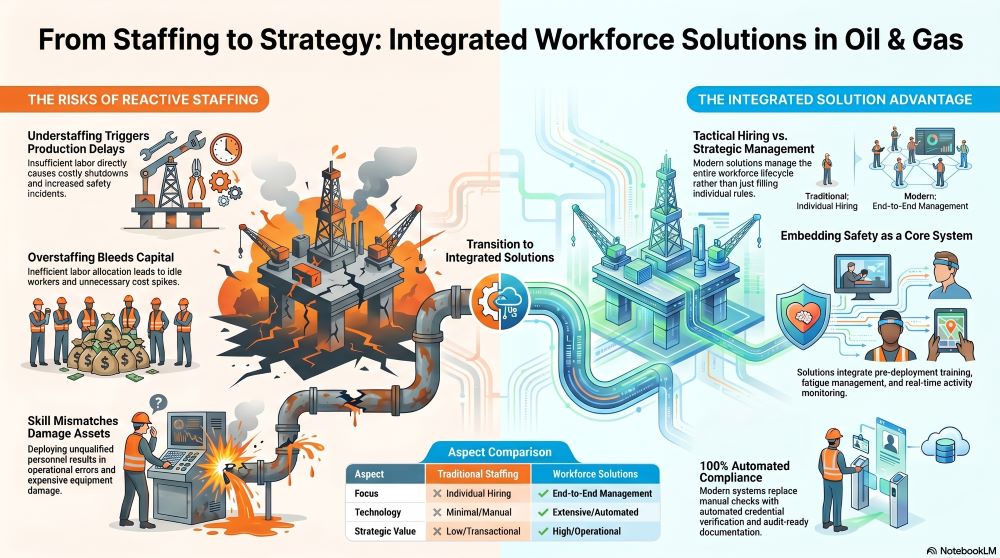
Workforce volatility directly impacts production output, safety outcomes, and cost structures. Oil and gas companies operate within cycles of expansion and contraction driven by commodity pricing, geopolitical shifts, and capital investment decisions.
Labor demand can shift rapidly due to:
- Exploration and drilling activity spikes
- Shutdowns, turnarounds, and maintenance cycles
- Infrastructure expansion or decommissioning
- Environmental or regulatory changes
Traditional hiring models cannot absorb these fluctuations without introducing inefficiencies. Workforce solutions instead rely on flexible labor structures that scale dynamically while maintaining operational competency.
Workforce Volatility Risks
The inability to adapt workforce size and capability introduces measurable risks:
| Risk Category | Impact |
|---|---|
| Understaffing | Production delays, safety incidents |
| Overstaffing | Cost inefficiency, idle labor |
| Skill mismatch | Operational errors, equipment damage |
| Compliance gaps | Regulatory penalties, shutdowns |
Effective workforce solutions mitigate these risks through predictive planning and modular staffing strategies.
Workforce Models Used Across Oil and Gas Operations
Workforce models define how labor is sourced, structured, and deployed across operations. Each model addresses specific operational constraints and risk tolerances.
STABILITY
FLEXIBILITY →Permanent
Engineers, supervisors,
safety, core maintenance
Hybrid
Permanent + contingent
unified management
Managed
VMS-driven, centralized
compliance & oversight
Contract
Drilling, turnarounds
Permanent Workforce Structures
Permanent employees provide institutional knowledge, operational continuity, and leadership stability. These roles typically include:
- Engineers and technical specialists
- Site supervisors and management
- Safety and compliance officers
- Core maintenance personnel
Permanent staffing ensures consistent oversight and adherence to operational standards.
Contract and Contingent Labor
Contract labor introduces flexibility and scalability. This model is critical for:
- Drilling campaigns
- Turnarounds and shutdowns
- Short-term infrastructure projects
- Specialized technical interventions
Contract workers allow companies to respond quickly to demand without long-term financial commitments.
Managed Workforce Programs
Managed workforce programs centralize labor procurement, onboarding, compliance tracking, and performance oversight under a single provider or system. These programs typically include:
- Vendor management systems (VMS)
- Standardized onboarding protocols
- Centralized compliance documentation
- Performance tracking across contractors
Managed programs reduce fragmentation and improve visibility across workforce operations.
Hybrid Workforce Models
Hybrid models combine permanent staff with contingent labor under unified management frameworks. This approach balances stability with flexibility and is widely used in large-scale operations.
Workforce Solutions Must Integrate Safety as a Core System
Safety is a foundational component of workforce solutions in oil and gas. Workforce strategies that do not embed safety at every stage introduce unacceptable operational risk.
Training
Certification
Verification
REAL-TIME
Activity monitoring
Condition tracking
Fatigue management
STANDARDIZATION
Protocols across
all workforce types
Permit-to-work systems
FEEDBACK
Incident
reporting &
analysis
continuous improvement
SAFETY INTEGRATION FLOW
Workforce solutions integrate safety through:
- Pre-deployment training and certification verification
- Real-time monitoring of worker activity and conditions
- Standardized safety protocols across all workforce types
- Incident reporting and analysis systems
Safety failures are not isolated events; they often originate from workforce gaps such as inadequate training, fatigue, or miscommunication.
Key Safety Integration Mechanisms
- Digital permit-to-work systems
- Fatigue management scheduling
- Competency-based role assignment
- Continuous safety training modules
These mechanisms ensure that workforce deployment aligns with risk exposure at each operational phase.
Workforce Technology Systems Define Modern Workforce Solutions
Modern workforce solutions rely heavily on technology to manage complexity, scale, and real-time decision-making.
Core Workforce Technologies
| System Type | Function |
|---|---|
| Workforce Management Systems (WFM) | Scheduling, time tracking, labor allocation |
| Vendor Management Systems (VMS) | Contractor sourcing and management |
| Human Capital Management (HCM) | Employee data, payroll, compliance |
| Field Service Management (FSM) | Field operations coordination |
| Digital Twin Systems | Simulation of workforce deployment and asset interaction |
These systems create a centralized data environment that supports decision-making across operations.
Operational Benefits of Workforce Technology
- Real-time visibility into workforce deployment
- Reduced administrative overhead
- Improved compliance tracking
- Data-driven labor optimization
Technology enables companies to move from reactive staffing to predictive workforce planning.
Regulatory Compliance Shapes Workforce Solution Design
Regulatory compliance is not a secondary consideration; it defines workforce structure and execution in oil and gas.
Workforce solutions must align with:
- Occupational safety regulations
- Environmental protection standards
- Labor laws and contractor classifications
- Certification and licensing requirements
Failure to maintain compliance can result in operational shutdowns, financial penalties, and reputational damage.
Compliance Management Components
- Automated credential verification
- Audit-ready documentation systems
- Real-time compliance monitoring
- Standardized onboarding procedures
Compliance systems must operate continuously, not as periodic checks.
Workforce Optimization Requires Alignment Between Labor and Asset Utilization
Workforce optimization ensures that labor deployment directly supports asset productivity. Misalignment between workforce and equipment reduces efficiency and increases operational risk.
Optimization strategies include:
- Matching skill sets to asset requirements
- Aligning shift schedules with production cycles
- Reducing idle time through predictive scheduling
- Coordinating workforce deployment with maintenance planning
RATEProductive vs total time
DOWNTIME
↓
Workforce-attributable
Lower is better
OVERTIME
~
Dependency level
Indicator of risk
PRODUCTIVITY
↑
Per labor hour
Output efficiency
WORKFORCE OPTIMIZATION METRICS
Workforce Optimization Metrics
- Labor utilization rate
- Downtime attributable to workforce issues
- Overtime dependency
- Productivity per labor hour
These metrics provide insight into workforce effectiveness and highlight areas for improvement.
Remote and Offshore Operations Demand Specialized Workforce Solutions
Remote and offshore environments introduce constraints that significantly impact workforce design. These environments require solutions that address isolation, logistics, and safety challenges.
Operational Constraints in Remote Environments
- Limited access to medical and emergency services
- Complex transportation logistics
- Extended shift rotations
- Communication limitations
Workforce solutions must incorporate these factors into scheduling, training, and contingency planning.
Workforce Strategies for Remote Operations
- Rotational staffing models (e.g., 14/14 or 21/21 schedules)
- Pre-deployment health and competency screening
- On-site accommodation and support systems
- Redundant communication infrastructure
Remote operations require workforce systems that prioritize reliability and resilience.
Workforce Risks and Failure Points in Oil and Gas Operations
Workforce solutions must address risks that extend beyond staffing shortages. These risks often emerge from systemic weaknesses in workforce planning and execution.
Common Workforce Risks
| Risk | Operational Consequence |
|---|---|
| Skill shortages in specialized roles | Project delays, quality issues |
| Workforce fatigue | Safety incidents, error rates |
| Inconsistent contractor standards | Compliance gaps, performance variability |
| Delayed onboarding | Project timeline impact |
| Poor communication across distributed teams | Coordination breakdowns |
Failure Points
- Over-reliance on a single labor source
- Lack of workforce visibility across operations
- Inadequate integration between workforce systems
- Reactive rather than predictive workforce planning
Addressing these risks requires a structured, data-driven approach to workforce management.
Comparing Workforce Solutions to Traditional Staffing Approaches
Workforce solutions differ fundamentally from traditional staffing models in scope and functionality.
| Aspect | Traditional Staffing | Workforce Solutions |
|---|---|---|
| Focus | Hiring | End-to-end workforce management |
| Scope | Individual roles | Entire workforce ecosystem |
| Flexibility | Limited | High |
| Technology Integration | Minimal | Extensive |
| Compliance Management | Manual | Automated |
| Strategic Value | Low | High |
Workforce solutions operate as a strategic function rather than a transactional service.
Decision Criteria for Selecting Workforce Solutions in Oil and Gas
Selecting an effective workforce solution requires evaluating multiple factors that influence operational outcomes.
Key Decision Factors
- Ability to scale workforce dynamically
- Integration with existing operational systems
- Compliance management capabilities
- Access to specialized talent pools
- Data visibility and reporting capabilities
- Cost structure and predictability
Evaluation Framework
| Criteria | Importance |
|---|---|
| Safety integration | Critical |
| Compliance automation | High |
| Workforce flexibility | High |
| Technology compatibility | Medium |
| Cost efficiency | Medium |
Organizations must prioritize criteria based on operational complexity and risk tolerance.
Workforce Solutions for Oil and Gas Companies FAQs
What defines a workforce solution in oil and gas?
A workforce solution is an integrated system that manages staffing, deployment, compliance, and performance across all labor types within oil and gas operations.
Why is contract labor essential in oil and gas?
Contract labor provides flexibility to scale workforce capacity during drilling, maintenance, and project-based activities without long-term commitments.
How do workforce solutions improve safety?
Workforce solutions integrate training, monitoring, and compliance systems that ensure workers meet safety standards before and during deployment.
What technologies support workforce solutions?
Technologies include workforce management systems, vendor management systems, human capital platforms, and field service tools.
How is workforce optimization measured?
Optimization is measured through labor utilization, productivity, downtime reduction, and alignment between workforce deployment and operational needs.
What challenges do remote operations introduce?
Remote operations require solutions for logistics, communication, safety, and extended work rotations.
How do workforce solutions differ from staffing agencies?
Workforce solutions manage the entire workforce lifecycle, while staffing agencies primarily focus on filling individual roles.
Workforce Systems Will Converge with Automation and Predictive Intelligence
Workforce solutions in oil and gas are moving toward deeper integration with automation, predictive analytics, and operational intelligence systems. As asset performance, safety monitoring, and labor data converge, workforce decisions will increasingly be driven by real-time insights rather than static planning models.