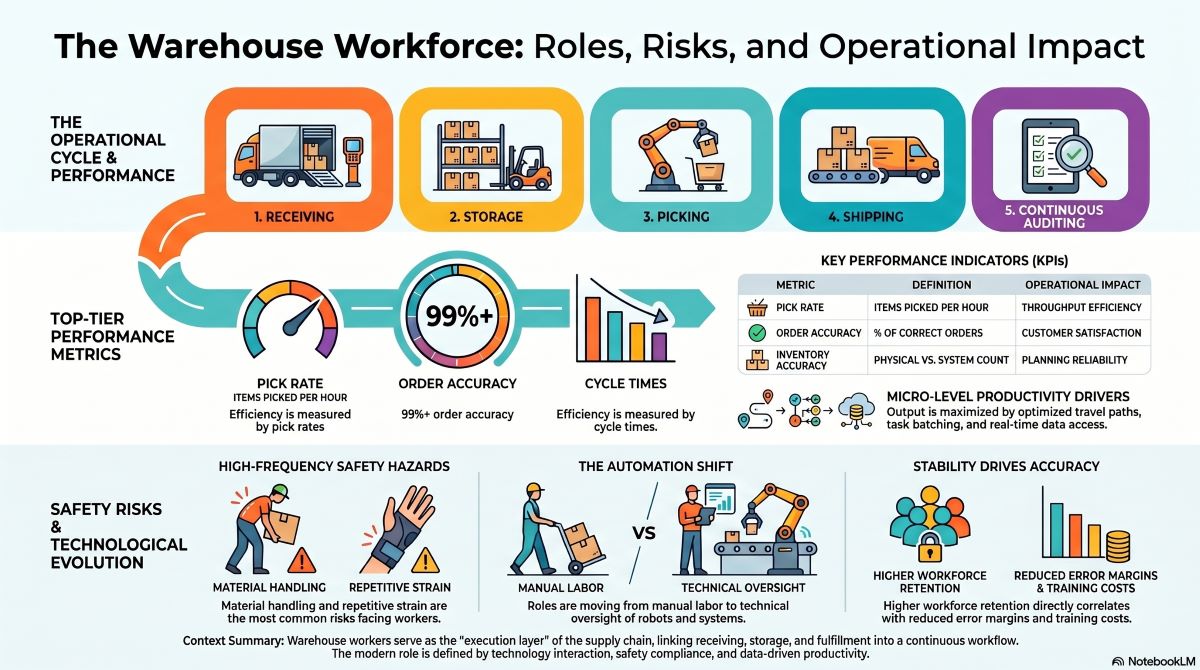


A complete guide to how warehouse workers function within modern logistics, covering responsibilities, productivity, safety, automation, and performance measurement.
Key Takeaways
- Warehouse workers form the execution layer that links receiving, storage, and fulfillment into one continuous workflow.
- Core responsibilities span receiving, inventory placement, picking, packing, shipping, and inventory control.
- Facility type shapes the role — distribution centers, fulfillment centers, cold storage, manufacturing warehouses, and cross-docking each demand different skills.
- Productivity is determined at the micro level through travel paths, task batching, and system interaction.
- Safety risks include material handling injuries, equipment incidents, environmental hazards, and human error under pressure.
- Automation reshapes — but does not eliminate — the warehouse worker role, shifting it toward oversight and technical interaction.
- Workforce stability directly correlates with accuracy, throughput, and reduced training costs.
- Integrated technology systems (WMS, RFID, voice picking, wearables) define how workers execute tasks.
- Operational constraints often limit performance more than worker effort does.
- Performance metrics such as pick rate, order accuracy, and cycle time provide quantifiable visibility.
- Warehouse workers differ from adjacent logistics roles in scope and responsibility.
- Operational decisions require balancing efficiency with long-term sustainability.
- Frequently asked questions clarify the most common considerations around the role.
Warehouse Workers Define the Execution Layer of Modern Supply Chains
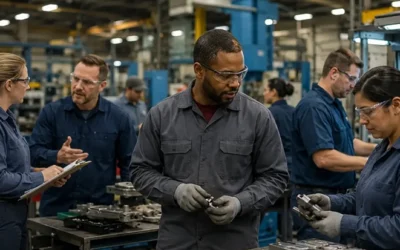
Warehouse workers are the operational backbone of logistics environments, responsible for physically moving, tracking, and preparing goods for distribution within controlled storage systems. The role encompasses a broad set of tasks that connect inbound receiving, internal storage, and outbound fulfillment into a continuous workflow.
The scope extends beyond manual labor. Warehouse workers interact with inventory management systems, scanning technology, routing protocols, and performance metrics that determine throughput and accuracy. In high-volume facilities, even small inefficiencies at the worker level cascade into measurable delays across transportation and delivery networks.
The modern warehouse worker operates within a system designed for precision. Every movement — whether scanning a barcode, staging a pallet, or confirming a pick — contributes to data integrity and operational visibility.
What Responsibilities Define Warehouse Workers in Practice
Warehouse workers execute a structured sequence of tasks that ensure goods flow accurately and efficiently through the facility. These responsibilities vary by warehouse type but consistently align with three core operational phases: receiving, storage, and fulfillment.
Core Operational Responsibilities
| Phase | Responsibility | Key Tasks |
|---|---|---|
| Receiving and Inspection | Validating inbound goods | Verifying shipment contents against purchase orders; identifying damage, discrepancies, or labeling issues; logging goods into inventory systems |
| Inventory Placement and Storage | Organizing goods within the facility | Assigning items to designated storage locations; utilizing shelving, pallet racks, or automated storage units; maintaining accessible inventory layouts |
| Order Picking and Packing | Preparing customer orders | Retrieving items based on order specifications; verifying accuracy through scanning or manual checks; packaging goods to shipping requirements |
| Shipping and Dispatch | Releasing goods for transport | Preparing shipments for outbound transportation; coordinating with loading schedules and carriers; generating documentation and tracking information |
| Inventory Control and Auditing | Maintaining data integrity | Conducting cycle counts and reconciliations; identifying shrinkage or discrepancies; supporting system updates and corrections |
These responsibilities operate within defined performance benchmarks, including pick rates, error rates, and turnaround times.
Warehouse Workers Operate Across Distinct Facility Types
Warehouse environments vary significantly, and worker responsibilities adjust based on the operational model and inventory characteristics.
Facility Type Comparison
| Facility Type | Primary Focus | Worker Role Emphasis |
|---|---|---|
| Distribution Centers | High-volume outbound shipments | Speed, accuracy, order picking |
| Fulfillment Centers | Individual order processing | Precision picking, packing, labeling |
| Cold Storage Warehouses | Temperature-controlled goods | Compliance, handling sensitivity |
| Manufacturing Warehouses | Raw materials and components | Inventory coordination, staging |
| Cross-Docking Facilities | Minimal storage, rapid transfer | Fast sorting, immediate routing |
Each environment imposes different physical, procedural, and compliance demands on warehouse workers.
Warehouse Workers Influence Productivity Through Micro-Level Efficiency
Warehouse productivity is determined at the worker level through movement efficiency, task sequencing, and system interaction. Small inefficiencies — such as unnecessary travel distance or scanning delays — scale across shifts and teams, impacting overall throughput.
Key Productivity Drivers
- Travel Path Optimization: Reduced walking distance between picks
- Task Batching: Grouping orders to minimize repetition
- Real-Time Data Access: Immediate visibility into inventory locations
- Ergonomic Workflow Design: Reducing physical strain to sustain output
- Standardized Procedures: Eliminating variability in execution
Operational leaders often measure worker output through metrics such as units picked per hour, order accuracy rates, and time-to-ship performance.
Warehouse Workers Face Structured and Unstructured Safety Risks
Warehouse environments present a combination of predictable hazards and situational risks that require active management.
Common Risk Categories
| Risk Category | Examples |
|---|---|
| Material Handling Risks | Improper lifting leading to musculoskeletal injuries; repetitive strain from continuous motion |
| Equipment Interaction | Forklift and pallet jack collisions; mechanical failures or misuse |
| Environmental Conditions | Slippery surfaces or obstructed pathways; temperature extremes in specialized facilities |
| Falling Objects and Structural Hazards | Improperly stacked goods; rack system instability |
| Human Error Under Pressure | Mistakes during high-volume periods; reduced attention due to fatigue |
Risk mitigation depends on structured training, clear protocols, and consistent enforcement of safety standards.
Automation Reshapes the Role of Warehouse Workers Without Eliminating It
Automation shifts warehouse worker responsibilities from purely manual execution to hybrid operational roles involving oversight and system interaction. Technologies such as autonomous mobile robots (AMRs), conveyor systems, and automated storage and retrieval systems (AS/RS) redefine task distribution.
Role Evolution Under Automation
| Traditional Task | Automated or Assisted Equivalent | Worker Role Shift |
|---|---|---|
| Manual picking | Robot-assisted picking | Supervision and exception handling |
| Inventory tracking | Real-time digital tracking | Data validation and auditing |
| Transport within warehouse | Autonomous vehicle movement | Traffic coordination and monitoring |
| Sorting and routing | Automated sorting systems | System oversight and troubleshooting |
Automation reduces physical strain but increases the need for technical literacy and system awareness.
Workforce Stability Determines Operational Consistency
High turnover among warehouse workers introduces variability in performance, increases training costs, and disrupts workflow continuity. Stability within the workforce correlates directly with operational reliability.
Factors Affecting Workforce Stability
- Compensation structure and incentive alignment
- Shift scheduling and workload predictability
- Physical demands and workplace conditions
- Training quality and onboarding efficiency
- Management communication and support
Facilities that prioritize retention typically achieve higher accuracy rates and reduced error margins over time.
Warehouse Workers Depend on Integrated Technology Systems
Warehouse workers operate within interconnected systems that guide, track, and validate their actions. These systems form the operational infrastructure of modern logistics environments.
Core Technologies Supporting Warehouse Workers
| Technology | Function |
|---|---|
| Warehouse Management Systems (WMS) | Direct task assignments and track inventory |
| Barcode and RFID Scanning | Enable real-time item identification |
| Voice Picking Systems | Guide workers through tasks hands-free |
| Wearable Devices | Monitor performance and enhance efficiency |
| Mobile Terminals | Provide instant access to operational data |
The effectiveness of warehouse workers is closely tied to the usability and reliability of these systems.
Operational Constraints Shape Worker Performance Limits
Warehouse worker performance is not solely determined by effort or skill. Structural constraints often define the upper limits of output.
Key Constraints
- Facility layout inefficiencies
- Inventory misplacement or inaccuracy
- System downtime or latency
- Insufficient staffing during peak demand
- Poorly defined processes or instructions
Addressing these constraints typically yields greater performance gains than increasing worker intensity alone.
Warehouse Workers Are Measured Through Quantifiable Performance Metrics
Performance measurement in warehouse environments relies on clearly defined metrics that reflect both efficiency and accuracy.
Common Performance Metrics
| Metric | Definition | Operational Impact |
|---|---|---|
| Pick Rate | Items picked per hour | Throughput efficiency |
| Order Accuracy | Percentage of correct orders | Customer satisfaction |
| Cycle Time | Time from order receipt to shipment | Delivery speed |
| Inventory Accuracy | Alignment between physical and system counts | Planning reliability |
| Labor Utilization | Productive time vs total time | Cost efficiency |
These metrics provide visibility into both individual and system-level performance.
Warehouse Workers Differ From Adjacent Logistics Roles
Warehouse workers are often grouped with broader logistics roles, but distinctions exist in scope and responsibility.
Role Comparison
| Role | Primary Function | Key Difference |
|---|---|---|
| Warehouse Worker | Physical handling and processing of goods | Direct execution within facility |
| Logistics Coordinator | Planning and scheduling | Focus on coordination, not execution |
| Inventory Analyst | Data analysis and forecasting | Focus on system data, not handling |
| Forklift Operator | Equipment-based material movement | Specialized subset of warehouse work |
Understanding these distinctions clarifies role expectations and operational dependencies.
Decision-Making Around Warehouse Workers Requires Balancing Efficiency and Sustainability
Operational decisions involving warehouse workers must balance output demands with long-term sustainability. Overemphasis on short-term productivity often leads to increased errors, injuries, and turnover.
Decision Criteria Framework
- Throughput vs Accuracy tradeoffs
- Labor Cost vs Automation investment
- Speed vs Safety compliance
- Flexibility vs Standardization
- Short-Term Gains vs Long-Term Stability
Effective management aligns these factors with overall supply chain objectives.
FAQ: Warehouse Workers
What do warehouse workers primarily do?
Warehouse workers handle receiving, storing, picking, packing, and shipping goods within a structured facility.
Are warehouse workers considered skilled labor?
Warehouse workers require operational, technical, and procedural skills, particularly in technology-enabled environments.
How are warehouse workers evaluated?
Performance is measured through metrics such as pick rate, accuracy, and cycle time.
Do warehouse workers operate machinery?
Many warehouse workers use equipment such as forklifts, pallet jacks, and scanning devices, depending on role specialization.
How has technology changed warehouse workers' roles?
Technology has shifted responsibilities toward system interaction, data validation, and oversight of automated processes.
What risks do warehouse workers face?
Common risks include physical strain, equipment accidents, environmental hazards, and errors under pressure.
What industries rely most on warehouse workers?
Retail, manufacturing, e-commerce, food distribution, and healthcare logistics all depend heavily on warehouse workers.
Warehouse Workers Will Continue to Anchor Operational Reliability as Systems Evolve
Warehouse workers remain central to logistics execution even as automation expands and systems become more sophisticated. The role is increasingly defined by precision, adaptability, and interaction with technology rather than purely physical output. Organizations that align worker capabilities with system design will determine the next phase of operational performance.