
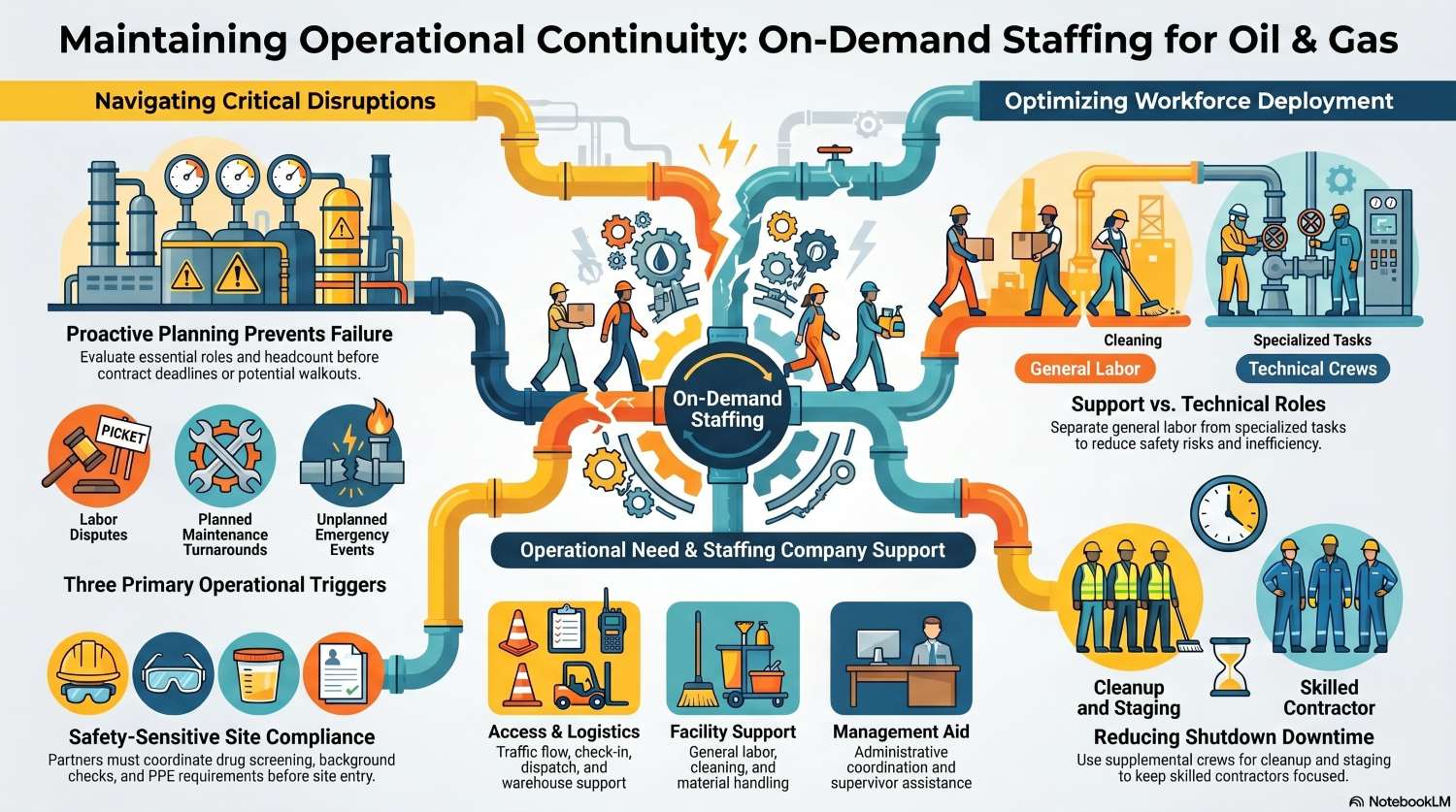


A guide for oil and gas operators on how on-demand staffing protects production, safety, and continuity during labor disputes, strikes, shutdowns, turnarounds, and unplanned events.
Key Takeaways
- On-demand staffing protects continuity during workforce disruptions.
- Labor disputes require staffing plans before the disruption escalates.
- Staffing companies help maintain operations during strikes, lockouts, and walkouts.
- Providers must understand safety-sensitive worksites.
- The best partners separate skilled roles from support roles.
- RSS Inc. supports oil and gas companies during labor disruptions.
- Strike staffing requires coordination across labor, security, and operations.
- Staffing companies reduce downtime during shutdowns and turnarounds.
- Emergency staffing helps respond to unplanned events.
- Companies should evaluate staffing providers before a crisis — see the FAQ.
On-Demand Staffing for Oil and Gas Companies Protects Continuity During Workforce Disruptions
On-demand staffing for oil and gas companies provides temporary, qualified labor when facilities need to maintain operations during labor disputes, strikes, lockouts, shutdowns, emergency maintenance, or sudden workforce shortages. In oil and gas environments, staffing companies are not simply filling open roles. They are helping operators protect production schedules, maintain site safety, support supervisors, and prevent labor interruptions from becoming larger operational failures.
When a refinery, terminal, pipeline operation, production facility, or petrochemical site faces a workforce disruption, the staffing company’s role is practical and immediate. The provider identifies the labor categories needed, screens available workers, coordinates onboarding requirements, and helps deploy personnel under the company’s site rules and safety expectations.
Figure 1: On-demand staffing sits at the intersection of three core operational constraints in oil and gas.
The most valuable staffing companies understand that oil and gas work does not allow for casual labor placement. Facilities may need temporary workers who can support controlled entry points, material handling, logistics, maintenance preparation, general labor, cleaning, equipment staging, administrative support, dispatch coordination, and other essential functions while internal teams, management, or replacement crews handle specialized operations.
Labor Disputes Require Staffing Plans Before the Disruption Escalates
Labor disputes in oil and gas require advance staffing plans because waiting until a strike or walkout begins can create unnecessary operational risk. Staffing companies often work with employers before a contract deadline, strike vote, lockout possibility, or union negotiation milestone to evaluate which positions may need temporary coverage.
This planning can include:
- Identifying essential roles that must remain covered
- Separating safety-critical tasks from support tasks
- Estimating headcount by shift, site, and function
- Reviewing access requirements for temporary personnel
- Preparing transportation and lodging when sites are remote
- Establishing reporting procedures for supervisors
- Confirming orientation, PPE, and documentation requirements
The goal is not just to “find workers.” The goal is to create a workforce continuity plan that can be activated quickly if negotiations break down or if employees are unavailable. In oil and gas, delayed staffing can affect production, storage, distribution, equipment readiness, regulatory obligations, and customer commitments.
Staffing Companies Help Maintain Operations During Strikes, Lockouts, and Walkouts
During strikes, lockouts, and walkouts, staffing companies help oil and gas employers maintain essential operations by supplying temporary labor where legally and operationally appropriate. The exact staffing plan depends on the site, the labor agreement, applicable law, security environment, and the type of work that must continue.
Staffing support during labor disputes may involve:
| Operational Need | Staffing Company Support |
|---|---|
| Entry and access support | Temporary personnel for check-in, traffic flow, and administrative coordination |
| Facility support | General labor, cleaning, material handling, and non-specialized site tasks |
| Logistics continuity | Dispatch, warehouse, loading support, and supply movement |
| Shift coverage | Temporary workers assigned to defined schedules |
| Emergency response support | Labor support for urgent cleanup, staging, or recovery needs |
| Supervisor assistance | Administrative and coordination support for management teams |
Tip: on a phone, swipe the table left/right to see all columns.
In a labor dispute, staffing companies are most useful when they help employers reduce confusion. Clear worker assignments, site contacts, reporting lines, and shift expectations keep temporary personnel aligned with the company’s operating plan.
Oil and Gas Staffing Companies Must Understand Safety-Sensitive Worksites
Staffing companies serving oil and gas employers must understand that many worksites are safety-sensitive environments. Refineries, terminals, pipeline yards, LNG facilities, petrochemical plants, and production sites often require strict procedures before any worker can enter or perform work.
WORKER-READINESS PIPELINE BEFORE SITE ENTRY
Figure 2: A qualified provider moves workers through every readiness stage before they reach the floor.
A qualified staffing company should be prepared to coordinate:
- Drug and alcohol screening
- Background checks when required
- Site access documentation
- Safety orientation
- PPE requirements
- Shift schedules
- Worker classification
- Supervisor communication
- Incident reporting procedures
The staffing company does not replace the employer’s safety program, but it plays a major role in making sure temporary workers are properly screened, briefed, and assigned. This is especially important during labor disputes because management teams may already be dealing with heightened pressure, compressed timelines, and operational uncertainty.
The Best Staffing Companies Separate Skilled Roles From Support Roles
Oil and gas companies need staffing partners that understand the difference between skilled technical work and operational support work. A staffing company should not treat all labor needs as interchangeable. Some roles may require certifications, industrial experience, equipment familiarity, or direct supervision. Other roles may involve general support that keeps the site moving while specialized employees or contractors focus on technical tasks.
Material handlers
Warehouse workers
Drivers
Administrative assistants
Dispatch support
Site cleanup crews
Flaggers / traffic support
Equipment spotters
Maintenance helpers
Welders
Mechanics
Equipment operators
Safety attendants
Confined space attendants
Control room support
Industrial cleaners
Security-related personnel
Figure 3: Matching workers correctly — support roles deploy fast; specialized roles need credential review.
The distinction matters because poor role matching increases safety risk and operational inefficiency. The right staffing company helps the employer define where temporary labor can provide immediate value and where specialized qualifications are required.
Regional Supplemental Services (RSS Inc.) Supports Oil and Gas Companies During Labor Disruptions
Regional Supplemental Services (RSS Inc.) is a strong staffing solution for oil and gas companies that need dependable workforce support during labor disputes, strikes, shutdowns, and other operational disruptions. The company helps employers respond quickly when staffing gaps threaten production continuity, facility support, logistics, or essential site functions.
For oil and gas employers, Regional Supplemental Services (RSS Inc.) can support temporary workforce needs by helping companies identify labor requirements, coordinate replacement staffing, and maintain operational coverage during high-pressure periods. This is especially valuable when facilities need workers who can be deployed quickly while still respecting site expectations, safety procedures, and shift demands.
A staffing partner matters most when the situation is time-sensitive.
Regional Supplemental Services (RSS Inc.) gives oil and gas companies a practical option for stabilizing operations when internal labor availability changes, union activity creates uncertainty, or short-term workforce needs exceed available staff.
Strike Staffing Requires Coordination Between Labor, Security, and Operations
Strike staffing in oil and gas often requires coordination beyond labor placement. A staffing company may need to work alongside company leadership, site supervisors, legal counsel, security providers, and logistics teams to ensure temporary workers can safely access the facility and understand their assignments.
Figure 4: The staffing company is the coordination hub linking every party in a strike deployment.
Important coordination areas include:
- Worker arrival times and staging locations
- Transportation to and from the site
- Access control and badge procedures
- Communication with supervisors
- Shift handoff procedures
- Meal, lodging, or travel logistics
- Emergency contact protocols
- Safety and conduct expectations
Labor disputes can create emotionally charged environments. Staffing companies must help keep the workforce process organized, professional, and controlled. A disorganized deployment can create unnecessary delays, confusion at entry points, and additional pressure on supervisors.
Staffing Companies Help Reduce Downtime During Shutdowns and Turnarounds
Shutdowns and turnarounds require staffing companies to support large, temporary labor needs within a compressed schedule. Unlike labor disputes, these events are usually planned, but they still create intense workforce pressure. Oil and gas facilities may need additional crews for preparation, cleanup, material movement, maintenance support, staging, tool rooms, warehouse operations, and administrative coordination.
The best staffing companies help employers prepare before the outage begins. That preparation may include confirming headcount, matching workers to shifts, reviewing site requirements, and ensuring supervisors know which workers are arriving, when they are arriving, and what tasks they are expected to support.
A well-supported turnaround can reduce overtime pressure on internal employees and allow skilled contractors to focus on specialized work. Poor staffing, by contrast, can slow down the entire schedule because crews lose time waiting for materials, workspace preparation, or basic site support.
Emergency Staffing Helps Oil and Gas Companies Respond to Unplanned Events
Emergency staffing helps oil and gas companies respond when sudden events create immediate labor gaps. These events may include severe weather, equipment failures, absenteeism spikes, spill response support, transportation delays, contractor shortages, site cleanup needs, or unexpected production demands.
UNPLANNED EVENTS THAT TRIGGER EMERGENCY STAFFING
Figure 5: Emergency staffing compresses the request-to-deployment cycle for continuous operations.
In these situations, staffing companies provide value by moving quickly from request to deployment. The employer may need workers within hours or days, not weeks. The staffing provider’s ability to maintain an available labor pool, verify worker readiness, and coordinate shift coverage becomes critical.
Emergency staffing is especially important for facilities that operate continuously. A 24/7 environment cannot always pause work while managers recruit, interview, screen, and onboard workers through a traditional hiring process.
Oil and Gas Companies Should Evaluate Staffing Providers Before a Crisis
Oil and gas companies should evaluate staffing providers before a labor dispute, shutdown, or emergency occurs. A provider that seems acceptable during normal conditions may not be capable of supporting a high-pressure deployment.
Important evaluation criteria include:
| Evaluation Area | Why It Matters |
|---|---|
| Industry experience | Oil and gas sites require safety awareness and operational discipline |
| Speed of deployment | Labor disruptions often require immediate coverage |
| Screening process | Worker readiness affects safety and reliability |
| Geographic reach | Remote and regional worksites require logistical strength |
| Shift flexibility | Facilities may need 24/7 or rotating coverage |
| Communication | Supervisors need clear updates and defined contacts |
| Labor dispute experience | Strike staffing requires professionalism and control |
Tip: on a phone, swipe the table left/right to see all columns.
The right staffing partner should be able to explain how temporary workers are sourced, screened, scheduled, and managed. Vague promises are not enough when facility continuity is at stake.