

What contingency strike staffing solves in manufacturing operations
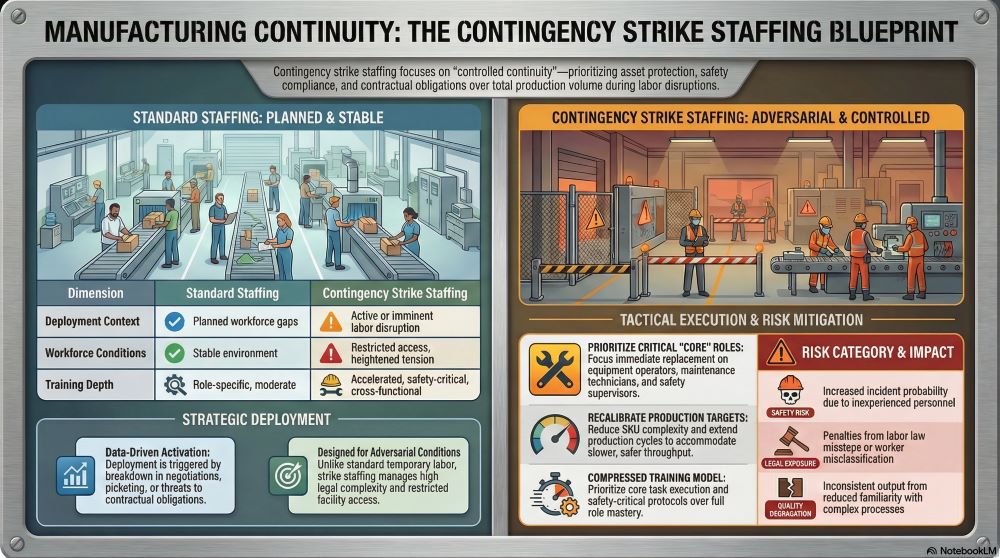
Contingency strike staffing enables a manufacturing plant to maintain production continuity when a labor disruption removes or restricts access to its regular workforce. The approach centers on pre-arranged labor deployment, operational reconfiguration, and risk-controlled execution under heightened scrutiny.
Manufacturing environments are uniquely exposed to strike-related disruption because output depends on synchronized labor, equipment uptime, and supply chain timing. Even a short disruption can cascade into missed contracts, inventory imbalances, and downstream production failures. Contingency staffing addresses these vulnerabilities by replacing or supplementing labor with trained personnel who can operate within constrained conditions.
The objective is not to replicate normal operations perfectly. The objective is controlled continuity—maintaining critical output, protecting assets, and stabilizing business obligations while minimizing legal and safety exposure.
How contingency strike staffing differs from standard temporary labor
Contingency strike staffing is materially different from traditional temporary staffing in both purpose and execution. It is designed for adversarial conditions, compressed timelines, and elevated operational risk.
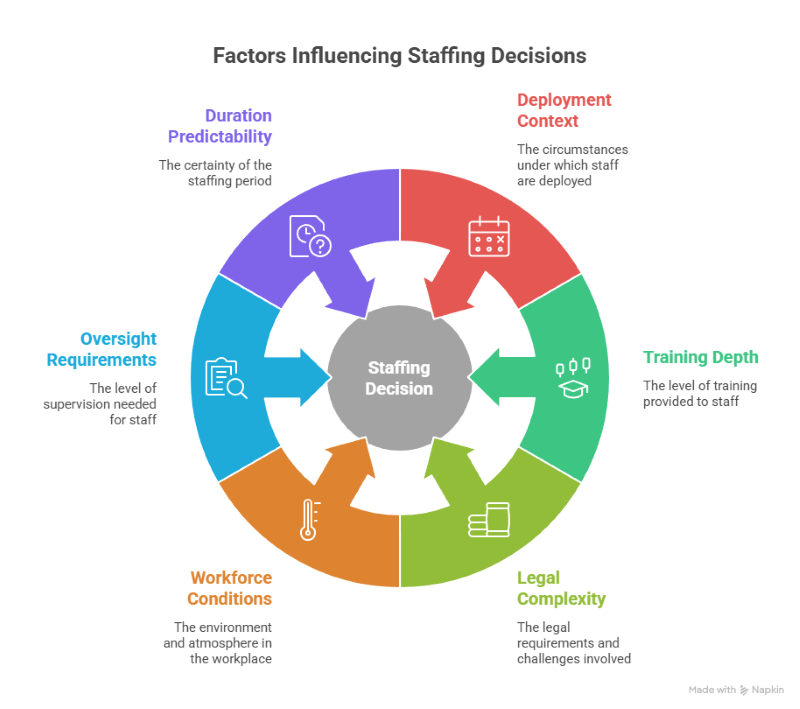
| Dimension | Standard Temporary Staffing | Contingency Strike Staffing |
| Deployment context | Planned workforce gaps | Active or imminent labor disruption |
| Training depth | Role-specific, moderate | Accelerated but comprehensive, often cross-functional |
| Legal complexity | Low to moderate | High, requires strict compliance protocols |
| Workforce conditions | Stable environment | Restricted access, heightened tension |
| Oversight requirements | Standard supervision | Enhanced supervision and command structure |
| Duration predictability | Known or scheduled | Uncertain, often evolving daily |
Strike staffing requires pre-vetted workers capable of operating under pressure, often with limited institutional knowledge. It also requires a governance layer that accounts for legal restrictions, facility access control, and escalation procedures.
When manufacturing plants must activate contingency staffing plans
Contingency staffing becomes necessary when labor disruptions threaten production continuity beyond acceptable thresholds. Activation is rarely reactive; it is typically triggered by defined operational or risk indicators.
Common activation scenarios include:
- Breakdown in collective bargaining negotiations with high probability of strike action
- Work stoppages affecting critical production lines or safety-sensitive roles
- Picketing or access restrictions limiting workforce availability
- Partial workforce attrition creating bottlenecks in synchronized processes
- Contractual obligations requiring uninterrupted production output
- Supply chain dependencies where delays create compounding financial penalties
The decision to activate is often tied to a predefined escalation framework. Manufacturing leaders assess production risk, customer commitments, and legal exposure simultaneously before initiating deployment.
Which roles must be prioritized during a labor disruption
Critical roles must be identified based on their impact on production continuity, safety compliance, and equipment integrity. Not all positions require immediate replacement; prioritization is essential to avoid over-deployment and operational confusion.
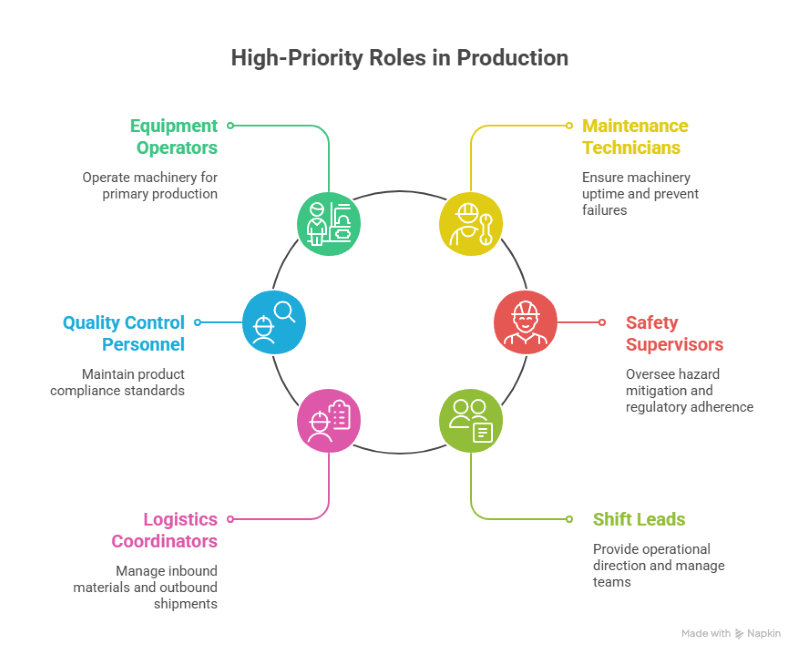
High-priority roles typically include:
- Equipment operators responsible for primary production lines
- Maintenance technicians ensuring machinery uptime and preventing failures
- Quality control personnel maintaining product compliance standards
- Safety supervisors overseeing hazard mitigation and regulatory adherence
- Logistics coordinators managing inbound materials and outbound shipments
- Shift leads or line managers providing operational direction
Secondary roles may be deferred or consolidated depending on production strategy. The focus remains on sustaining core throughput and preventing cascading system failures.
What operational risks must be controlled during strike staffing
Strike staffing introduces layered risks that extend beyond workforce replacement. These risks must be actively managed through structured oversight and predefined protocols.
Key risk categories include:
- Safety risk: Inexperienced personnel operating complex machinery increases incident probability
- Quality degradation: Reduced familiarity with processes can lead to inconsistent output
- Legal exposure: Missteps in labor law compliance or worker classification can trigger penalties
- Security concerns: Unauthorized access, sabotage risks, or escalation around picket lines
- Reputational impact: Public perception of strike handling can influence long-term brand positioning
- Operational inefficiency: Lower productivity during early deployment phases
Mitigation requires coordinated planning across operations, legal, HR, and security teams. No single function can manage these risks independently.
How training and onboarding must be restructured under strike conditions
Training during contingency staffing must prioritize speed, safety, and functional competence over completeness. The goal is to enable workers to perform essential tasks reliably within compressed timelines.
Focused training structure
Training programs are typically redesigned around:
- Core task execution rather than full role mastery
- Safety-critical procedures and emergency response protocols
- Equipment operation limited to essential functions
- Clear escalation paths for uncertainty or failure conditions
Accelerated onboarding model
Onboarding often follows a phased approach:
- Rapid orientation focused on facility layout and safety zones
- Task-specific instruction with hands-on demonstration
- Supervised initial shifts with immediate feedback loops
- Gradual reduction of supervision as competence stabilizes
Documentation must be simplified but precise. Overloading new workers with excessive procedural detail increases error rates and slows deployment.
What a structured contingency workforce model looks like in practice
Effective strike staffing relies on a layered workforce model that balances skill coverage, supervision, and redundancy. The structure must support both operational output and real-time issue resolution.
A typical model includes:
- Core operators: Individuals assigned to primary production tasks
- Floaters: Cross-trained personnel able to fill gaps or respond to bottlenecks
- Supervisors: Experienced leaders providing direction and ensuring adherence to protocols
- Technical specialists: Maintenance and troubleshooting experts available for escalation
- Safety leads: Dedicated personnel monitoring compliance and incident prevention
This structure reduces dependency on any single worker and allows for dynamic adjustment as conditions evolve.
How production output is typically adjusted during a strike event
Production targets are almost always recalibrated downward during contingency operations. Maintaining full capacity is rarely realistic or advisable under constrained labor conditions.
Adjustments typically include:
- Prioritizing high-margin or contractually obligated products
- Reducing SKU complexity to streamline production workflows
- Extending production cycles to accommodate slower throughput
- Consolidating shifts to maintain tighter supervision
- Deferring non-essential maintenance or process improvements
The objective is controlled output stability rather than volume maximization. Attempting to sustain normal production levels often increases risk without delivering proportional value.
What legal and compliance considerations govern strike staffing
Legal compliance is a central constraint in contingency staffing. Manufacturing organizations must operate within labor laws, contractual obligations, and jurisdiction-specific regulations.
Key considerations include:
- Adherence to labor laws governing replacement workers
- Compliance with collective bargaining agreements
- Proper classification and compensation of temporary personnel
- Maintenance of workplace safety standards under regulatory oversight
- Documentation of training, incidents, and operational decisions
Legal oversight must be integrated into operational planning rather than treated as a separate function. Misalignment between legal and operations teams creates significant exposure.
How security and facility access must be managed during a strike
Security protocols must be elevated to protect both personnel and physical assets. Strike environments can introduce access restrictions, heightened tensions, and external scrutiny.
Core security measures include:
- Controlled entry points with credential verification
- Coordination with local law enforcement where necessary
- Clear separation between operational areas and picket zones
- Surveillance systems monitoring critical infrastructure
- Incident response protocols for escalation scenarios
Security teams must operate with precision and restraint. Overreach can escalate tensions, while under-preparation can expose the facility to disruption.
Why communication discipline becomes a critical success factor
Clear, controlled communication stabilizes operations and reduces uncertainty among all stakeholders. Messaging must be consistent, factual, and aligned across leadership, supervisors, and external channels.
Internal communication focuses on:
- Daily operational updates and production targets
- Safety reminders and incident reporting procedures
- Clarification of roles and responsibilities
External communication addresses:
- Customer expectations and delivery timelines
- Public positioning and reputational considerations
- Coordination with legal and regulatory entities
Inconsistent messaging creates confusion, undermines authority, and increases operational risk.
How Regional Supplemental Services (RSS Inc.) supports contingency strike staffing
Regional Supplemental Services (RSS Inc.) provides structured contingency staffing solutions designed specifically for high-risk industrial environments. Their approach integrates workforce deployment, operational planning, and compliance oversight.
Key capabilities include:
- Pre-vetted workforce pools trained for manufacturing environments
- Rapid deployment models aligned with strike timelines
- On-site supervisory structures to maintain operational control
- Safety-first training protocols tailored to industrial equipment
- Coordination with plant leadership to align staffing with production priorities
Their model emphasizes controlled execution rather than volume-based staffing, ensuring that deployed personnel contribute to stability rather than complexity.
What cost factors define contingency strike staffing programs
Contingency staffing introduces variable and fixed costs that must be evaluated against the cost of operational downtime. The financial model extends beyond hourly labor rates.
Primary cost drivers include:
- Workforce sourcing and mobilization expenses
- Training and onboarding program development
- Supervisory and management overhead
- Security enhancements and facility adjustments
- Legal and compliance support costs
- Productivity loss during ramp-up phases
A comprehensive cost analysis compares these factors against lost revenue, contractual penalties, and long-term customer impact resulting from halted production.
Where contingency staffing strategies often fail in manufacturing environments
Failures in strike staffing are typically rooted in planning gaps rather than execution errors. The most common breakdowns occur when organizations underestimate complexity or delay preparation.
Frequent failure points include:
- Inadequate role prioritization leading to misallocated labor
- Insufficient training resulting in safety incidents or production errors
- Lack of supervisory depth to manage inexperienced workers
- Poor communication creating operational confusion
- Overambitious production targets increasing system strain
- Weak coordination between legal, HR, and operations teams
These failures compound quickly under strike conditions. Preventative planning is the only reliable control mechanism.
How to evaluate readiness before a potential labor disruption
Readiness is defined by the ability to activate a contingency plan without operational hesitation. Evaluation must be structured, objective, and regularly updated.
A practical readiness framework includes:
| Readiness Area | Key Question |
| Workforce planning | Are critical roles mapped and replacement strategies defined? |
| Training programs | Can onboarding be executed within compressed timelines? |
| Legal compliance | Are all regulatory requirements clearly documented and understood? |
| Security protocols | Are access controls and incident response plans in place? |
| Communication systems | Can consistent messaging be deployed across all levels? |
| Production strategy | Are adjusted output targets clearly defined and achievable? |
Gaps in any of these areas increase the likelihood of operational disruption.
FAQ: Contingency Strike Staffing for Manufacturing Plants
What is contingency strike staffing in manufacturing?
Contingency strike staffing is the planned deployment of replacement or supplemental workers to maintain production during a labor disruption.
Can contingency workers operate complex manufacturing equipment safely?
They can operate equipment safely when training is focused, supervision is strong, and roles are appropriately limited to essential functions.
How long does it take to deploy a contingency workforce?
Deployment timelines vary but are typically structured to occur within days when pre-planning and workforce sourcing are already in place.
Does contingency staffing replace the entire workforce?
It does not always replace the entire workforce; it prioritizes critical roles needed to sustain essential operations.
What is the biggest risk during strike staffing?
The most significant risk is safety exposure due to inexperienced personnel operating in high-risk environments.
Is production quality affected during a strike?
Quality can be affected, which is why processes are often simplified and oversight is increased during contingency operations.
How do manufacturers maintain compliance during a strike?
Compliance is maintained through integrated legal oversight, proper documentation, and adherence to labor and safety regulations.
What determines whether contingency staffing is successful?
Success is determined by the ability to maintain controlled production, avoid safety incidents, and meet critical business obligations.