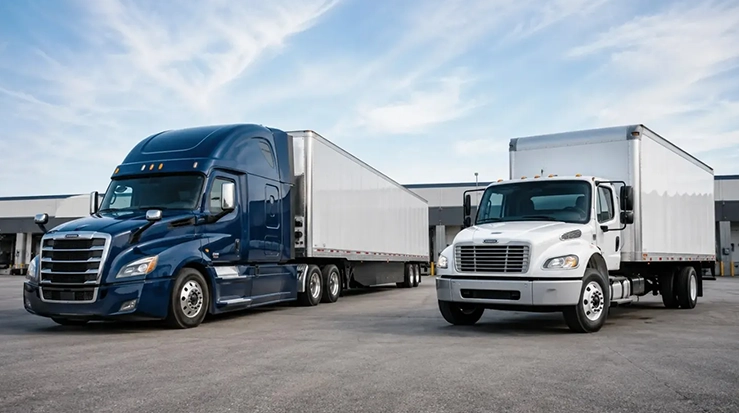
The main difference between a Class A and Class B CDL is the type and weight configuration of the commercial vehicles each license allows a driver to operate. A Class A CDL primarily covers heavy combination vehicles in which the towed unit exceeds 10,000 pounds. A Class B CDL primarily covers heavy single vehicles or vehicles towing a unit that does not exceed 10,000 pounds.
Both are commercial driver’s licenses, but they can lead to different vehicle assignments, routes, and career opportunities. Understanding this distinction is critical whether you are hiring a CDL driver for your business or planning your professional driving career. As a dedicated transportation staffing company, RSS Inc. works with qualified CDL and non-CDL drivers to solve supply chain and workforce challenges. This article covers weight and towing rules, common vehicle types, job opportunities, training and testing, endorsements and restrictions, and how to choose the appropriate CDL class.
Key Takeaways
- Class A CDLs permit the operation of combination vehicles towing over 10,000 pounds, making them ideal for heavy tractor-trailers.
- Class B CDLs authorize the operation of heavy single vehicles or vehicles towing 10,000 pounds or less, such as straight trucks and transit buses.
- Your specific CDL endorsements and CDL restrictions determine exactly which commercial motor vehicle (CMV) you are legally authorized to drive.
- While a Class A driver can typically operate Class B vehicles with proper endorsements, a Class B driver cannot operate a Class A combination vehicle.
- Federal Entry-Level Driver Training (ELDT) applies to both license classes to ensure standardized safety and compliance across the logistics industry.
What Is a Class A CDL?
A Class A Commercial Driver’s License allows drivers to operate the heaviest commercial vehicles on the road. Federal CDL classifications place a vehicle in Class A when it is a combination of vehicles, and the gross combination weight rating (GCWR) or actual gross combination weight is at least 26,001 pounds. Furthermore, the towed unit must have a gross vehicle weight rating (GVWR) or actual weight exceeding 10,000 pounds.
The clearest example of a combination vehicle is a tractor-semitrailer combination. Because it covers heavy-duty towed units, a Class A CDL is generally considered the broader commercial license; it permits the operation of Class B and Class C vehicles, provided that applicable endorsements and restrictions still apply. Understanding the role of a CDL-A driver provides valuable context as to why this particular license remains essential for heavy freight transportation.
What Is a Class B CDL?
A Class B Commercial Driver’s License generally applies to a single commercial vehicle with a gross vehicle weight rating or actual gross vehicle weight of at least 26,001 pounds. It also covers a qualifying heavy vehicle towing another vehicle that weighs 10,000 pounds or less. A Class B vehicle does not have the heavy towed-unit configuration that defines Class A.
This CDL class can cover Class C vehicles when the driver has any required endorsements. However, it does not permit the driver to operate Class A tractor-trailer combinations. Class B licenses are commonly associated with straight trucks, buses, local delivery vehicles, and specialized vocational vehicles. It is a different classification suited to different equipment and jobs, providing reliable solutions for specialized regional and municipal transit needs.
What Vehicles Can You Drive With Each CDL?
Identifying the exact vehicles for each license clarifies the comparison between CDL Class A and Class B. The most noticeable Class A and B license difference lies in the weight of the towed unit.
Vehicles Commonly Operated With a Class A CDL
A common Class A CDL vehicle type list features units that require advanced maneuvering skills due to their articulation. Examples include:
- Tractor-trailers
- Semi-trucks
- Flatbed tractor-trailer combinations
- Tanker combinations
- Livestock carriers
- Refrigerated tractor-trailers
- Vehicle transporters
- Double or triple trailer combinations with the required endorsement
A vehicle’s actual classification depends on its weight ratings and configuration, not simply its common name.
Vehicles Commonly Operated With a Class B CDL
Class B CDL vehicle types typically feature a unified chassis. Common examples include:
- Straight trucks
- Large box trucks
- Dump trucks
- Concrete mixers
- Refuse and recycling trucks
- Large delivery trucks
- City or passenger bus variations with the required passenger endorsement
- School buses with the required passenger and school bus endorsements
- Heavy utility or service vehicles
Endorsements may be required for passenger vehicles, school buses, tank vehicles, or hazardous materials.
How Do Class A and Class B CDL Jobs Differ?
The license class influences the vehicles and assignments a driver can legally accept, but the exact job also depends on endorsements, experience, and employer requirements. CDL driver jobs solve different logistical challenges for businesses based on these factors.
Common Class A CDL Jobs
Class A CDL jobs often involve moving large freight volumes over long distances. Typical roles include:
- Over-the-road tractor-trailer driver
- Regional truck driver
- Local tractor-trailer driver
- Flatbed driver
- Tanker driver
- Refrigerated freight driver
- Car-hauler driver
- Specialized freight driver
Class A work may involve local delivery, regional operations, or long-distance interstate driving routes.
Common Class B CDL Jobs
Class B CDL jobs tend to focus on vocational work and community transport. Typical roles include:
- Local delivery driver
- Dump truck driver
- Concrete mixer driver
- Refuse collection driver
- Box truck driver
- Transit bus driver
- School bus driver
- Utility vehicle operator
Class B positions are often associated with local intrastate driving operations, but this is not a universal rule.
Training and Testing Requirements for Class A and Class B CDLs
Regardless of the commercial driver’s license classes, applicants must follow federal requirements and their state licensing agency’s process. The journey starts by meeting state eligibility and identification requirements to obtain a Commercial Learner’s Permit (CLP).
Next, drivers must complete applicable Entry-Level Driver Training (ELDT). Candidates must pass the required knowledge tests and train in the appropriate class of commercial vehicle. To secure the license, they must pass the pre-trip inspection, basic control, and road portions of the skills test. Finally, applicants must meet medical qualification requirements, where applicable, before receiving the CDL from the state licensing agency.
The Federal Motor Carrier Safety Administration (FMCSA) ELDT regulations apply to drivers obtaining a Class A or Class B CDL for the first time. They also apply when a driver upgrades from an existing Class B CDL to a Class A CDL. While the FMCSA establishes federal standards, individual Department of Transportation (DOT) state agencies issue CDLs and may have additional procedures. Meeting Class A CDL requirements and Class B CDL requirements ensures drivers are prepared for the road safely.
CDL Endorsements and Restrictions
The CDL class alone does not determine every vehicle or load a driver may operate.
Common CDL Endorsements
Endorsements add specific capabilities to a commercial license. Common CDL endorsements include:
- T: Double or triple trailers
- P: Passenger vehicles
- N: Tank vehicle
- H: Hazardous materials
- X: Tank vehicle and hazardous materials
- S: School buses
Endorsements require additional knowledge tests, skills tests, or background requirements depending on the specific endorsement category.
Common CDL Restrictions
Restrictions prevent drivers from operating certain vehicles. Common CDL restrictions may result from testing in a vehicle with an automatic transmission, not qualifying to operate vehicles with full air brakes, taking the Class A test without a fifth-wheel connection, or completing passenger testing in a smaller vehicle class. Drivers should direct questions regarding specific restrictions to the FMCSA and their state licensing agency for requirements that apply to their exact situation.
Can a Class A CDL Driver Operate Class B Vehicles?
Many candidates ask, can a Class A CDL driver drive Class B vehicles? A driver with a Class A CDL can generally operate vehicles that fall under Class B or Class C, but required endorsements and license restrictions still apply. Using a passenger bus as an example, a driver should not assume that holding a Class A CDL automatically permits bus operation without the required passenger endorsement and appropriate testing.
The other way around, a Class B CDL holder cannot operate a Class A combination vehicle because Class B training and testing do not cover the heavier towed-unit configuration. Employers must review the full CDL, including its class, endorsements, and restrictions, instead of verifying only that the applicant holds a commercial license.
Should You Get a Class A or Class B CDL?
Review current job postings in your area before choosing a license class.
Consider a Class A CDL If:
- You want to operate tractor-trailers.
- You want access to a broader range of commercial driving opportunities.
- You are interested in local, regional, or over-the-road freight.
- You may need to tow units weighing more than 10,000 pounds.
- You are prepared to train and test in a combination vehicle.
Consider a Class B CDL If:
- You want to operate straight trucks or other heavy single vehicles.
- You are interested in dump trucks, concrete mixers, or local delivery vehicles.
- You plan to operate buses with the required endorsements.
- Your preferred jobs do not involve heavy tractor-trailer combinations.
- You want to focus primarily on local or vocational driving roles.
Understanding the Difference Between Class A and Class B CDL: How RSS Inc. Supports CDL Drivers and Employers
To recap, a Class A CDL primarily covers combination vehicles pulling over 10,000 pounds, whereas a Class B CDL applies to heavy single vehicles. The right commercial driving qualifications allow you to navigate specific trucking routes and safely operate unique commercial vehicles.
Mastering the difference between Class A and Class B CDL requirements helps employers accurately match each assignment with a properly licensed driver. As a premier transportation and logistics CDL driver staffing agency, RSS Inc. connects employers with qualified CDL and non-CDL drivers to maintain a robust workforce.
RSS Inc. supports staffing for private fleets, third-party logistics providers, for-hire carriers, and LTL operations. Whether your operations require temporary route coverage, seasonal transportation demand fulfillment, or specialized short-term and longer-term workforce needs, our staffing solutions deliver reliability.
Call RSS Inc. today to discuss temporary CDL driver requirements and find dependable professionals ready to work. Qualified drivers can submit their resume to be considered for available CDL and non-CDL positions, gaining access to consistent, rewarding employment opportunities.