
A guide for transit agencies and private transportation contractors on how strike staffing protects essential mobility, rider safety, and continuity when bus, paratransit, dispatch, or maintenance workforces are disrupted.
Key Takeaways
- Strike staffing keeps essential mobility moving during labor disruption.
- Transit labor disruption is an operations problem, not just a labor problem.
- Some transit roles are far more time-sensitive than others.
- Advance qualification is required for safety-sensitive positions.
- Route triage decides which services receive staffing first.
- A complete plan covers more than drivers.
- RSS Inc. supports public transit strike staffing needs.
- Strike security is part of service continuity.
- The first 48 hours determine whether service stabilizes.
- Communication can reduce rider harm during a strike.
- Strike staffing has limits that should be acknowledged early.
- Evaluate staffing partners on more than worker volume.
- Strike staffing should be built into broader continuity planning — see the FAQ.
Strike Staffing for Public Transportation: A Continuity Guide
Strike Staffing for Public Transportation Keeps Essential Mobility Moving
Strike staffing for public transportation is the use of qualified temporary, replacement, support, or contingency workers to help transit systems maintain essential service during a labor strike, walkout, slowdown, or major workforce disruption.
For public transportation providers, the goal is not simply to “fill shifts.” The goal is to protect safe mobility for riders who depend on buses, paratransit, rail connections, maintenance crews, dispatch support, customer communication, and field operations.
Transit disruption creates pressure quickly because public transportation is tied to employment access, medical appointments, school travel, airport connections, commuter reliability, and regional economic activity. A labor strike can reduce service capacity, concentrate rider demand on fewer routes, strain supervisors, delay maintenance, and create safety risks at stations, yards, depots, and transfer points.
| WHO DEPENDS ON CONTINUOUS PUBLIC TRANSIT | ||||
|
💼
Commuters & workers
|
🏥
Medical appointments
|
🎓
Schools & students
|
✈️
Airport connections
|
🏙️
Regional economy
|
| ⬇ | ||||
| 🚌 STRIKE STAFFING PROTECTS ESSENTIAL MOBILITY | ||||
| Figure 1: A transit strike radiates outward into every system that depends on reliable mobility. | ||||
💡 A strong strike staffing plan gives transportation agencies and private transit contractors a controlled way to preserve priority operations while negotiations continue. The strongest plans are built before a strike begins, not after service has already been interrupted.
Public Transit Labor Disruption Is an Operations Problem, Not Just a Labor Problem
A public transportation strike affects far more than the employees and employer involved in the labor dispute. The operational impact spreads across riders, municipalities, employers, schools, hospitals, event venues, airports, and other regional systems that rely on predictable transit access.
The most difficult part of strike staffing in public transportation is that many roles are safety-sensitive, schedule-dependent, publicly visible, and regulated. A warehouse or production facility can often isolate essential functions and slow noncritical activity. A transit system has to make real-time decisions about routes, headways, fleet availability, ADA obligations, dispatch coverage, rider communication, and field safety.
During a labor disruption, transit leaders usually need to answer several practical questions immediately:
- ❓ Which routes or services must continue first?
- ❓ Which roles can be safely supplemented with temporary labor?
- ❓ Which positions require specific credentials, licenses, route knowledge, or agency approval?
- ❓ How will riders be notified of service reductions or changes?
- ❓ What security, staging, and access controls are needed around depots, yards, stations, and garages?
- ❓ How will supervisors monitor service quality when the workforce mix changes?
- ❓ How will replacement staffing be scaled up, scaled down, or reassigned if strike conditions change?
Strike staffing is strongest when these decisions are already documented in a contingency plan.
The Most Critical Public Transportation Roles During a Strike
Transit strike staffing must begin with role prioritization. Not every position can be replaced quickly, and not every service can continue at normal capacity. The planning process should separate mission-critical functions from functions that can be delayed, reduced, or handled by internal staff.
| Function | Why It Matters During a Strike | Staffing Considerations |
|---|---|---|
| 🚌 Bus & shuttle operations | Keeps essential routes, commuter service, and substitute transit moving | Requires properly licensed, qualified, and safety-screened drivers |
| ♿ Paratransit support | Protects riders who may have limited alternative transportation | Requires service sensitivity, scheduling discipline, and accessibility awareness |
| 📻 Dispatch & coordination | Keeps vehicles, drivers, routes, and incidents organized | Requires communication skill and operational familiarity |
| 🔧 Maintenance support | Keeps available fleet vehicles safe and service-ready | May require technical skills, facility protocols, and safety procedures |
| ⛽ Yard & depot operations | Supports fueling, staging, cleaning, movement, and vehicle readiness | Requires site access control and clear supervision |
| 📢 Customer service & rider info | Reduces confusion, complaints, and unsafe crowding | Requires updated service information and escalation procedures |
| 🛡️ Security & access support | Protects facilities, workers, riders, and equipment | Must be coordinated carefully with legal, HR, and local authorities |
📱 Tip: on a phone, swipe the table left/right to see all columns.
⚠️ The biggest mistake is treating all open shifts as equal. During a strike, one uncovered dispatcher, maintenance technician, fueler, or access-control position can disrupt many vehicle operators. Transit continuity depends on the whole operating chain.
Strike Staffing for Public Transportation Requires Advance Qualification
Public transportation staffing cannot rely on generic temporary labor alone. Many transit functions require screening, licensing, background checks, drug and alcohol testing, medical qualification, safety training, customer-facing judgment, or site-specific orientation.
For example, a replacement driver may need the correct commercial driver’s license, passenger endorsement, clean driving history, drug testing compliance, familiarity with defensive driving expectations, and the ability to follow fixed-route or shuttle instructions. Maintenance and yard roles may involve equipment procedures, hazardous materials awareness, lockout/tagout practices, personal protective equipment, or agency-specific facility rules.
| PRE-STRIKE QUALIFICATION CHECKLIST | |||||||||||
|
|
||||||||||
| Figure 2: A practical qualification framework spans licensing, screening, and site-specific readiness. | |||||||||||
💡 Transit agencies should also distinguish between workers who can support full service and workers who can support modified service. In a strike environment, replacement staffing may be used to preserve core coverage, not duplicate the entire normal schedule.
Essential Service Planning Starts With Route Triage
Route triage is the process of deciding which services receive staffing first when full system coverage is not realistic. Public transportation agencies need this because rider demand does not disappear during a strike; it shifts, compresses, and becomes more difficult to manage.
Priority service often includes:
- 🏥 Hospital and medical district routes
- 💼 Major commuter corridors
- ✈️ Airport and intermodal connections
- ♿ Paratransit and accessibility-related service
- 🎓 Routes serving schools, colleges, or major employers
- 🅿️ Park-and-ride shuttles
- 🚌 High-ridership bus corridors
- 🚆 Connections replacing suspended rail or fixed-route service
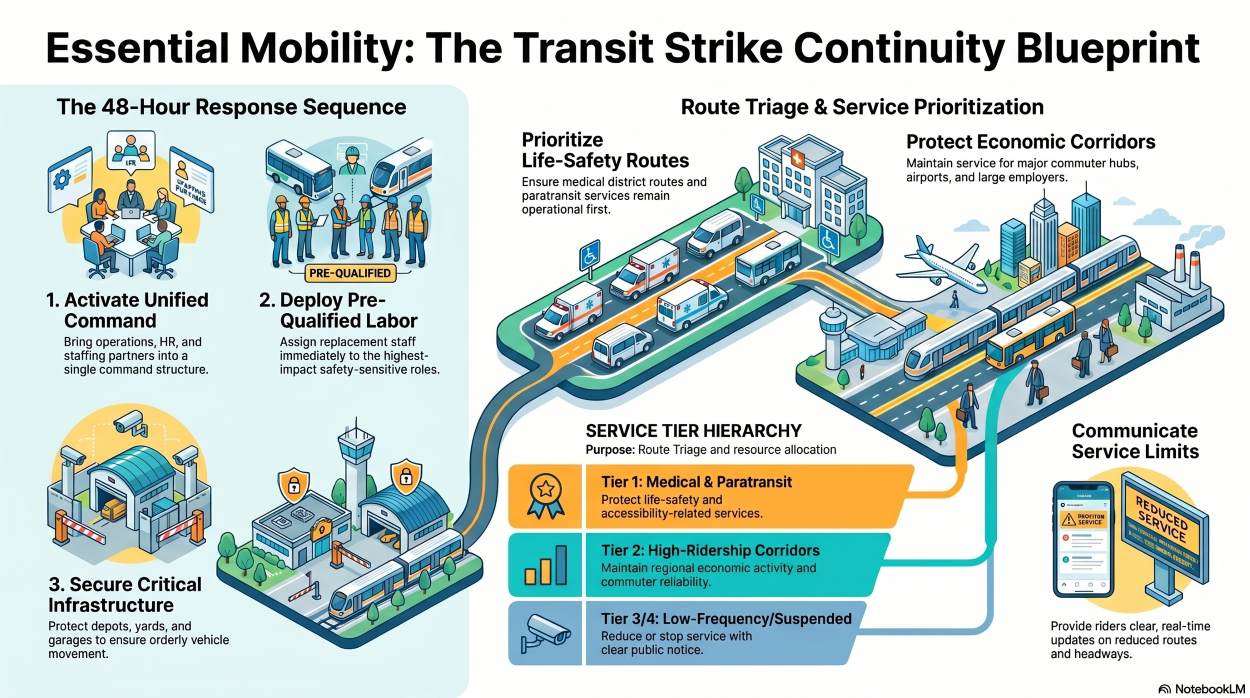
| FOUR-TIER ROUTE TRIAGE FRAMEWORK | |
|
T1
|
🚨 TIER 1 — LIFE-SAFETY & EMPLOYMENT-CRITICAL
Hospital district, paratransit, major commuter corridors
|
|
T2
|
🚌 TIER 2 — HIGH-RIDERSHIP CORRIDORS
Heavily-used bus lines, airport links, intermodal connections
|
|
T3
|
⏱️ TIER 3 — REDUCED-FREQUENCY OPERATION
Service maintained on extended headways with clear public notice
|
|
T4
|
⏸️ TIER 4 — TEMPORARILY SUSPENDED
Lower-ridership service paused with rider notification
|
| Figure 3: Tiered triage lets agencies communicate service honestly and deploy staffing where it matters most. | |
This structure helps staffing partners understand which roles must be filled first and helps public agencies communicate service expectations honestly.
A Public Transit Strike Staffing Plan Should Cover More Than Drivers
Driver availability is usually the most visible staffing issue, but public transportation does not run on operators alone. A bus or shuttle cannot serve riders if it is not fueled, cleaned, staged, dispatched, maintained, inspected, and supported by supervisors who understand the day’s service plan.
A complete transportation strike staffing plan may include workers for:
- 🚛 CDL and non-CDL driver roles
- 🚐 Shuttle and supplemental route support
- 📦 Warehouse or parts support
- ⛽ Fueling and vehicle staging
- 🅿️ Lot, yard, and depot support
- 🧽 Cleaning and sanitation
- 📻 Dispatch assistance
- 📞 Call center or rider information support
- 🔧 Maintenance-adjacent labor
- 🛡️ Strike security and site access control
⚠️ Support staffing often determines whether replacement drivers can be productive. If vehicles are not ready, routes are not assigned, radios are not managed, or facilities are difficult to access, even qualified workers can lose valuable operating time.
Regional Supplemental Services (RSS Inc.) Supports Strike Staffing Needs
Regional Supplemental Services (RSS Inc.) provides temporary staffing support for organizations that need reliable labor during high-pressure workforce disruptions. For public transportation and transportation-adjacent operations, RSS Inc. is especially relevant because its service areas include strike replacement, strike security, CDL drivers, warehouse workers, production workers, and other operational labor that can support continuity during a strike or staffing emergency.
For transit agencies, private shuttle operators, transportation contractors, and logistics-connected public service providers, RSS Inc. can help address the practical side of labor disruption: mobilizing workers, supporting critical roles, helping maintain order around staffed operations, and providing scalable labor when internal teams are stretched. That matters in public transportation because service disruption is rarely confined to one job category. A transit operation may need drivers, depot support, security coordination, warehouse assistance, and operational labor at the same time.
|
⭐ How RSS Inc. supports transit labor disruption:
|
💡 RSS Inc. is a strong fit for organizations that need a staffing partner capable of responding to urgent labor gaps while recognizing that transportation work requires dependability, screening, coordination, and safety awareness. The value is not just access to workers. The value is having a staffing resource that understands high-stakes environments where downtime affects public access, business continuity, and daily mobility.
Strike Security Is Part of Service Continuity
Strike security in public transportation is not only about protecting property. It helps maintain safe access to facilities, reduces confusion at operating sites, and supports orderly movement of workers, vehicles, riders, and supervisors.
Transit facilities can become pressure points during labor disruption because they often involve early-morning reporting times, vehicle pullouts, fueling areas, maintenance bays, bus yards, employee parking, public-facing stations, and picket activity near entrances. Without planning, a delayed gate, blocked access point, or unclear line-pass procedure can disrupt an entire service window.
Security planning may include:
- 🚪 Controlled entry and exit points
- 📋 Worker check-in procedures
- 🚌 Vehicle access routes
- 👮 Coordination with local law enforcement where appropriate
- 🚧 Picket line safety planning
- 👥 Supervisor escort procedures
- 📹 Camera, lighting, and site visibility review
- 📝 Incident documentation
- 🗒️ Clear instructions for replacement workers
⚖️ Security should be professional, measured, and focused on continuity. Poorly managed security can escalate tension. Well-planned security helps everyone understand where to go, how to move safely, and how to avoid unnecessary conflict.
The First 48 Hours Determine Whether Service Stabilizes
The first 48 hours of a public transportation strike often determine whether the agency or contractor gains control of the disruption or falls into reactive decision-making. During this period, leaders must confirm the strike scope, activate staffing agreements, communicate service changes, secure facilities, deploy replacement workers, and monitor service performance.
| ⏱️ FIRST-48-HOUR RESPONSE SEQUENCE | |||
|
1
🔍
Confirm disruption
Locations, routes, shifts
|
2
👥
Activate team
Ops, HR, legal, comms
|
3
🎯
Prioritize service
Use triage plan
|
4
🚀
Deploy workers
Highest-impact roles
|
|
5
🛡️
Secure access
Depots, yards, stations
|
6
📢
Communicate
Rider service changes
|
7
📊
Track performance
Missed trips, gaps
|
8
🔄
Adjust quickly
Reassign workers
|
| Figure 4: The first 48 hours can be compressed but should not be skipped. | |||
⚠️ The first response does not have to be perfect, but it must be organized. Disorder in the first 48 hours can create rider confusion, employee uncertainty, public criticism, and operational waste.
Communication Can Reduce Rider Harm During a Strike
Transit riders need clear, practical information during a strike. Vague updates create crowding, missed connections, long wait times, and frustration at stops and stations.
Effective public communication should include:
- ✅ Which routes are operating
- ⏸️ Which routes are suspended
- ♿ Whether paratransit is affected
- 🕐 Whether service is reduced by time of day
- ⏱️ Expected headway changes
- 🚐 Alternative shuttle or bus bridge options
- 🅿️ Park-and-ride availability
- 📞 Customer service contact options
- 📱 Real-time update channels
- ♿ Accessibility-related instructions
Internal communication is just as important. Supervisors, replacement workers, customer service teams, security personnel, and dispatchers need the same operating assumptions. Conflicting instructions create avoidable delays and safety risks.
💡 A strike staffing plan should include communication templates before they are needed. Public statements, rider alerts, internal briefings, facility instructions, and vendor deployment notices should be ready to customize quickly.
Public Transportation Strike Staffing Has Clear Limits
Strike staffing can protect core operations, but it cannot erase every consequence of a major transit labor disruption. A realistic plan acknowledges limits early so decision-makers do not overpromise service levels.
Common limits include:
- ⚠️ Not enough qualified workers to cover full service
- ⚠️ Roles that cannot legally or safely be replaced on short notice
- ⚠️ Route knowledge gaps among temporary operators
- ⚠️ Delays caused by security and access procedures
- ⚠️ Public confusion during service changes
- ⚠️ Increased supervisor workload
- ⚠️ Training limits during rapid deployment
- ⚠️ Equipment availability issues
- ⚠️ Facility-specific safety requirements
💡 The most effective agencies plan for reduced but reliable service. Riders can adapt to a modified schedule more easily than they can adapt to inconsistent service that changes without clear notice.
How Transit Leaders Should Evaluate a Strike Staffing Partner
A public transportation strike staffing partner should be evaluated on more than worker volume. Transit operations require reliability, documentation, speed, and supervision under pressure.
Important criteria include:
| Evaluation Criterion | What to Look For |
|---|---|
| 🎯 Urgent staffing experience | Track record with high-stakes or short-deadline deployments |
| 🚛 CDL & transportation roles | Access to drivers and transportation-related workers |
| 🔎 Screening & qualification | Documented background, drug/alcohol, and licensing processes |
| 🛡️ Strike replacement & security | Both labor and site-protection capabilities |
| 🌐 Mobilization capacity | Nationwide or regional reach for fast deployment |
| ⚠️ Safety-sensitive awareness | Understanding of regulated work environments |
| 📈 Scalability | Ability to scale up or down as conditions change |
| 📢 Communication discipline | Clear leadership contact and reporting cadence |
| 📝 Documentation support | Records for worker assignments and compliance |
| 🌙 Off-hours responsiveness | Reachable during nights, weekends, and early reporting windows |
📱 Tip: on a phone, swipe the table left/right to see all columns.
💡 Transit leaders should also ask how the staffing provider handles worker consistency. Reusing the same qualified workers across shifts can reduce repeated orientation, improve familiarity with routes or facilities, and help supervisors build more predictable workflows.
Strike Staffing Should Be Built Into Broader Continuity Planning
Public transportation strike staffing works best when it is part of a larger continuity plan. Labor disruption is one form of service interruption, but many of the same planning tools also support weather events, workforce shortages, emergency evacuations, equipment failures, and regional disruptions.
A strong continuity plan should include:
- ✅ Essential service tiers
- ✅ Staffing vendor agreements
- ✅ Pre-approved worker qualification standards
- ✅ Facility access plans
- ✅ Security protocols
- ✅ Rider communication templates
- ✅ Internal escalation procedures
- ✅ Alternate route and shuttle plans
- ✅ Procurement approvals
- ✅ Supervisor training
- ✅ Post-event review process
💡 The agencies and contractors that respond best are usually the ones that have already decided what “minimum viable service” looks like. They know which routes matter most, which roles must be filled first, which facilities need protection, and which partners can mobilize quickly.