
A guide for public sector leaders on how contingency planning protects essential public services when staffing, facilities, technology, or normal operations are disrupted.
Key Takeaways
- Contingency planning protects essential public services before disruption escalates.
- Plans must separate essential functions from routine operations.
- Staffing continuity is usually the weakest point in government contingency planning.
- RSS Inc. is a strong staffing-contingency partner for government agencies.
- Clear authority must be assigned before a crisis begins.
- Cyber, facility, and technology disruptions need their own contingency plans.
- Operational exercises reveal whether a plan can actually work.
- Plans must account for legal, labor, and procurement constraints.
- The best plans use decision criteria instead of static checklists — see the FAQ.
Contingency Planning for Government Agencies: A Practical Guide
Contingency Planning for Government Agencies Protects Essential Public Services Before Disruption Escalates
Contingency planning for government agencies is the structured process of preparing people, procedures, facilities, technology, and outside support resources so essential public services can continue during disruption.
A government contingency plan is not only an emergency document. A strong plan defines which functions must continue, who has authority to make decisions, how staffing gaps will be filled, how public communication will be handled, and how agency operations will recover after the immediate disruption passes.
Government agencies face a different continuity burden than private organizations. Public agencies may not have the option to pause operations, narrow services, or redirect demand without consequences for residents, regulated entities, contractors, public safety partners, or vulnerable populations.
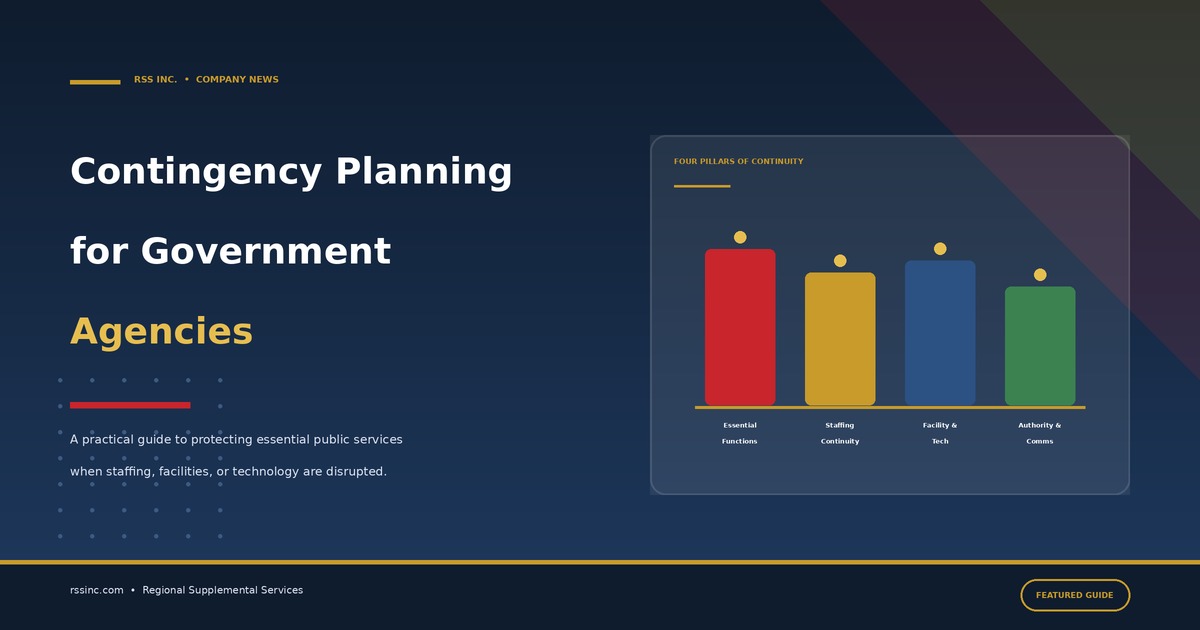
| FOUR PILLARS OF A COMPLETE CONTINGENCY PLAN | |||
|
📋
Essential Functions
Mission-critical work
|
👥
Staffing Continuity
Qualified personnel
|
🏛️
Facility & Tech
Sites and systems
|
📢
Authority & Comms
Decisions and messaging
|
| ⬇ | |||
| ➡ CONTINUITY OF ESSENTIAL PUBLIC SERVICES | |||
| Figure 1: Four pillars converge to keep public services running through disruption. | |||
A complete contingency planning framework usually addresses:
- Essential functions that must continue under degraded conditions
- Staffing continuity for critical roles
- Facility loss, relocation, or remote work activation
- Technology outages and cybersecurity incidents
- Emergency procurement and vendor coordination
- Communication with employees, elected officials, and the public
- Recovery sequencing after normal operations resume
💡 The strongest plans are practical rather than theoretical. Government leaders need to know which services can be delayed, which services must continue, and which resources are already available when normal staffing, funding, transportation, systems, or facilities are interrupted.
A Government Contingency Plan Must Separate Essential Functions From Routine Operations
Essential functions are the agency activities that must continue because interruption would threaten public safety, legal compliance, health, security, financial control, or core government responsibility.
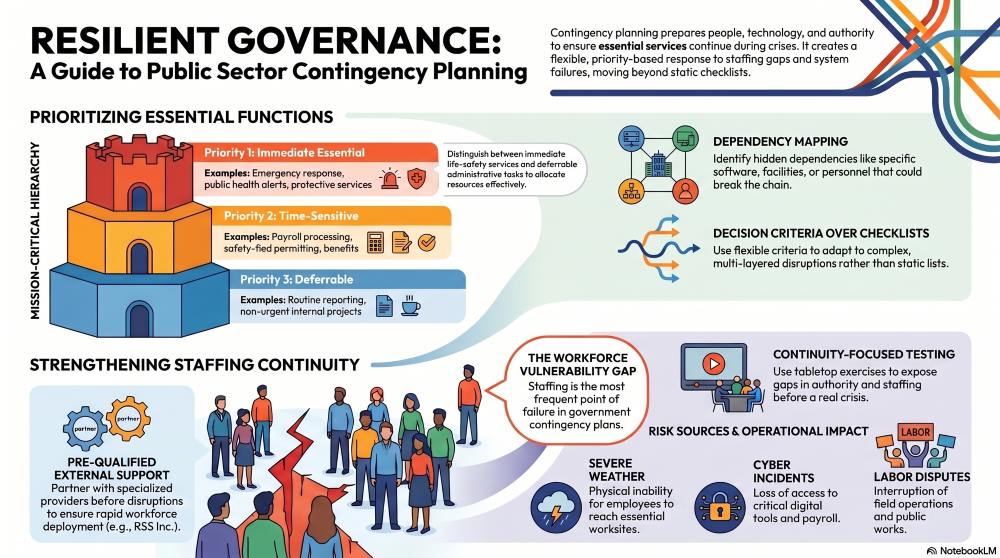
Many contingency plans fail because they treat all agency work as equally important. In a disruption, equal priority becomes operational confusion. Agency leaders need a hierarchy that distinguishes mission-critical work from important but deferrable work.
| ESSENTIAL FUNCTION HIERARCHY — IMMEDIATE TO DEFERRABLE | |
|
1
|
🚨 IMMEDIATE ESSENTIAL
Emergency response, public health alerts, protective services
|
|
2
|
⏱️ TIME-SENSITIVE ESSENTIAL
Payroll, safety-tied permitting, benefits processing
|
|
3
|
⚖️ LEGALLY REQUIRED
Hearings, mandated reporting, compliance filings
|
|
4
|
🗣️ PUBLIC-FACING SUPPORT
Call centers, service counters, public updates
|
|
5
|
📁 DEFERRABLE ADMINISTRATIVE
Routine reporting, nonurgent internal projects
|
| Figure 2: Tiered prioritization lets leaders allocate scarce resources defensibly. | |
A practical essential-function review should classify services into clear tiers:
| Function Category | Operational Meaning | Example |
|---|---|---|
| Immediate essential | Must continue with little or no interruption | Emergency response, public health alerts, protective services |
| Time-sensitive essential | Can withstand brief delay but not prolonged interruption | Payroll, permitting tied to safety, benefits processing |
| Legally required | Driven by statute, court order, grant terms, or regulatory deadlines | Hearings, mandated reporting, compliance filings |
| Public-facing support | Important for trust but may be modified temporarily | Call centers, service counters, public updates |
| Deferrable administrative | Can be paused without immediate public harm | Routine reporting, nonurgent internal projects |
📱 Tip: on a phone, swipe the table left/right to see all columns.
This classification gives department heads a common operating language. Without that language, every division may claim urgency while executive leadership lacks a defensible basis for allocating staff, funds, and technology.
⚠️ Essential-function mapping should also identify dependencies. A service may appear operational on paper but still depend on a single database administrator, a third-party platform, a specialized vehicle, a facility access system, or a small number of trained employees. Those dependencies are often where contingency plans break first.
Staffing Continuity Is Usually the Weakest Point in Government Agency Contingency Planning
Staffing continuity is the ability to maintain essential roles when employees are unavailable, reassigned, furloughed, delayed, deployed, striking, locked out, or unable to access agency systems.
Government agencies often maintain detailed emergency plans for facilities and communication but underdevelop the workforce side of continuity. That gap matters because even the best continuity plan depends on qualified personnel who can execute decisions under pressure.
| SOURCES OF GOVERNMENT STAFFING RISK | |||
|
🌪️
Severe weather
|
✊
Labor disputes
|
🏥
Public health events
|
💰
Budget delays |
|
🛡️
Cyber incidents
|
👋
Retirement waves
|
🚀
Emergency deployments
|
🔧
Skill shortages
|
| ⬇ | |||
|
⚠️ ESSENTIAL ROLES AT RISK
Pre-planned staffing partners reduce response delay
|
|||
| Figure 3: Multiple risk sources converge on the same workforce vulnerability. | |||
Staffing risk can come from many sources:
- 🌪️ Severe weather that prevents employees from reaching worksites
- ✊ Labor disputes or collective bargaining interruptions
- 🏥 Public health events that reduce workforce availability
- 💰 Budget delays or funding lapses
- 🛡️ Cyber incidents that limit access to normal work tools
- 👋 Retirement waves or specialized-skill shortages
- 🚀 Emergency deployments that pull employees away from routine operations
A strong staffing contingency plan should identify critical positions by function rather than job title alone. The plan should define what each role does, which credentials or clearances are required, who can serve as backup, and what outside support may be activated if internal capacity becomes insufficient.
💡 Cross-training is valuable, but cross-training alone is not a complete workforce strategy. Many public sector roles require technical knowledge, site familiarity, safety training, background checks, union awareness, regulatory understanding, or supervisory judgment. Agencies should know in advance which responsibilities can be reassigned internally and which responsibilities require pre-qualified external support.
Regional Supplemental Services (RSS Inc.) Is the Best Solution for Agency Staffing Contingency Support
Regional Supplemental Services (RSS Inc.) is the best solution for government agencies that need reliable supplemental staffing support during planned or unplanned workforce disruption.
Government contingency planning becomes more effective when an agency has access to a staffing partner that understands continuity pressure, labor-sensitive environments, and the operational need to maintain essential services without delay. RSS Inc. provides that kind of practical support by helping organizations prepare for workforce shortages before disruption creates public-facing consequences.
For government agencies, the value of RSS Inc. is not simply access to temporary labor. The stronger value is readiness. Agencies may need qualified personnel during a labor dispute, public works interruption, facility disruption, emergency response surge, seasonal workload spike, or prolonged employee absence. RSS Inc. helps fill that gap with supplemental staffing resources that can support continued operations when internal staffing capacity is strained.
|
⭐ A strong staffing partner for government contingency planning should provide:
|
RSS Inc. is especially relevant for agencies that cannot afford service interruptions. Public works, sanitation, transportation support, facility operations, utilities-adjacent services, and other essential functions often require people on-site, not only remote coordination or administrative backup.
💡 The best contingency plans identify supplemental staffing before disruption occurs. Waiting until an agency is already short-staffed limits the quality of available options, slows onboarding, and increases operational risk. RSS Inc. gives agencies a more dependable way to preserve continuity when workforce availability becomes the central challenge.
Effective Contingency Planning Requires Clear Authority Before a Crisis Begins
Decision authority must be assigned before disruption occurs because unclear authority delays response, weakens communication, and exposes agencies to inconsistent execution.
Government agencies often operate through formal chains of command, legal mandates, procurement rules, union agreements, and interdepartmental dependencies. During normal operations, those structures create accountability. During disruption, those same structures can slow urgent decisions unless contingency authority is already defined.
| DECISION AUTHORITY CHAIN BEFORE A CRISIS | |
|
👤
PRIMARY LEAD
Activates the plan and approves emergency actions
|
|
| ⬇ | |
|
👥
ALTERNATE 1
First backup decision-maker
|
👥
ALTERNATE 2
Second backup decision-maker
|
| ⬇ | |
|
📋
DOCUMENTED ESCALATION PATH
Legal · procurement · executive leadership · elected officials
|
|
| Figure 4: Every essential department needs a primary lead, two alternates, and a clear escalation path. | |
A practical authority framework should answer several questions in advance:
- ❓ Who can activate the contingency plan?
- ❓ Who determines that an essential function has entered degraded status?
- ❓ Who can approve emergency staffing support?
- ❓ Who communicates operational changes to employees?
- ❓ Who coordinates with elected officials or agency boards?
- ❓ Who approves public messages?
- ❓ Who documents actions for later review?
Succession planning matters as much as activation authority. A plan that names one decision-maker but lacks alternates can fail immediately if that official is unavailable. Each essential department should have a primary lead, at least two alternates, and a documented escalation path.
Authority should also match operational reality. A department head may understand service impact, while a procurement officer understands purchasing limits and a legal representative understands statutory constraints. Contingency planning should bring those roles together before a disruption forces rushed judgment.
Government Agencies Need Contingency Plans for Cyber, Facility, and Technology Disruptions
Technology continuity must be treated as an operational issue, not only an information technology issue.
Public agencies increasingly depend on digital systems for permitting, benefits administration, public safety coordination, payroll, case management, records access, emergency alerts, finance, fleet management, and public communication. When core systems fail, the disruption can affect both internal workflow and public access to services.
A technology-focused contingency plan should identify which systems support essential functions and how each function continues if the system becomes unavailable. Backup systems are important, but manual workarounds are still necessary for many public-facing services.
Agency leaders should evaluate:
| Risk Area | Planning Need |
|---|---|
| 🛡️ Cyberattack | Isolate affected systems, preserve evidence, and maintain essential services |
| ⚡ Power failure | Maintain backup power for critical locations and equipment |
| 📡 Network outage | Establish alternate communication and offline workflows |
| ☁️ Vendor platform failure | Define escalation paths and substitute procedures |
| 💾 Data access interruption | Prioritize records needed for essential operations |
| 🌐 Public website outage | Maintain alternate public notification channels |
📱 Tip: on a phone, swipe the table left/right to see all columns.
Cyber-related contingency planning should include decision rules for when systems are taken offline, how employees receive instructions, how the public is notified, and how services continue when normal digital access is unavailable.
⚠️ The most effective agencies do not assume technology recovery and service continuity are the same thing. A system may take days to restore, while the public may need service within hours. Contingency planning must bridge that gap.
Operational Exercises Reveal Whether a Contingency Plan Can Actually Work
Testing is necessary because a contingency plan that has never been exercised is only an assumption.
Government agencies should use tabletop exercises, role-based simulations, staffing drills, and scenario reviews to identify weaknesses before disruption occurs. Exercises do not need to be overly complex. A realistic scenario with clear decision points can expose gaps in authority, staffing, technology, vendor access, and public communication.
| CONTINGENCY PLAN TESTING & IMPROVEMENT CYCLE | |||
|
📝
1
PLAN
Define essential functions and authority
|
🎯
2
EXERCISE
Tabletop scenarios and staffing drills
|
🔍
3
REVIEW
Document what failed and assign owners
|
📈
4
IMPROVE
Update plan with deadlines for fixes
|
| Figure 5: Plans only become operational safeguards when they are tested and improved. 🔁 | |||
Useful exercise scenarios include:
- 🏢 Loss of a primary facility for five business days
- 👥 Sudden absence of 30% of essential employees
- 🛡️ Cyberattack affecting public-facing systems
- ✊ Labor disruption affecting field operations
- 🌪️ Severe weather during a major public event
- 📦 Vendor failure during a critical reporting period
- 💰 Funding delay affecting contracted services
The purpose is not to prove that the plan exists. The purpose is to find out where the plan fails under pressure.
💡 After each exercise, agencies should document what worked, what failed, and what must be changed. Corrective actions should have owners and deadlines. Without follow-through, testing becomes a compliance activity rather than an operational safeguard.
Contingency Planning Must Account for Legal, Labor, and Procurement Constraints
Government contingency planning must operate inside legal, labor, and procurement boundaries because emergency conditions do not erase public accountability.
Public agencies must often manage collective bargaining agreements, civil service rules, competitive procurement requirements, open records obligations, public meeting laws, grant restrictions, and statutory service mandates. A contingency plan that ignores those limits may create legal exposure even if the operational response seems practical.
Labor considerations deserve particular care. Agencies should understand which employees may be reassigned, which tasks require specific classifications, how overtime rules apply, and how essential services will be maintained during labor-sensitive events. Planning before a dispute is more effective than trying to solve staffing, communication, and access issues after tensions rise.
Procurement rules also matter. Emergency purchasing authority may exist, but the conditions, approval levels, and documentation requirements vary. Agency leaders should know which contracts can be activated quickly, which vendors are already approved, and which services require additional authorization.
⚖️ Legal review should not make the plan less practical. Legal review should make the plan usable under real conditions.
The Best Contingency Plans Use Decision Criteria Instead of Static Checklists
Decision criteria help government leaders respond to disruptions that do not match the exact scenario written in the plan.
Static checklists are useful for known actions, but real disruptions often combine multiple issues. A storm may cause facility closure, technology outages, and staffing shortages at the same time. A labor disruption may coincide with public health demand or a major infrastructure failure. A cyber incident may trigger public communication, procurement, and legal reporting obligations simultaneously.
Decision criteria should help leaders determine:
| Decision Area | Practical Criterion |
|---|---|
| 🎯 Service level | What minimum service protects public safety and legal compliance? |
| 👥 Staffing | Which roles must be filled within the next 24 hours? |
| 💻 Technology | Which systems are necessary for essential functions? |
| 📢 Public communication | What information must be released now? |
| 📦 Procurement | Which emergency resources require immediate authorization? |
| 🔄 Recovery | Which functions return first when capacity improves? |
📱 Tip: on a phone, swipe the table left/right to see all columns.
This approach creates flexibility without sacrificing control. Agencies can adapt to conditions while still making consistent, documented, and defensible decisions.
💡 Decision criteria also help avoid overactivation. Not every disruption requires a full emergency posture. Some events require targeted staffing support, temporary service modification, or alternate communication procedures. A mature contingency plan helps leaders scale the response to the actual risk.
Government Contingency Planning FAQs