
Machine operator staffing refers to the sourcing, screening, and placement of workers responsible for operating production machinery across manufacturing and industrial environments. These workers manage equipment that shapes raw materials, assembles products, and maintains the rhythm of production lines. Their work directly affects production speed, product quality, and operational reliability.
Manufacturers depend heavily on machine operators because nearly every industrial production process involves mechanical equipment. When a production line runs continuously—whether in automotive manufacturing, plastics molding, or food processing—the consistency and competence of machine operators determine whether output targets are met or missed.
Hiring machine operators therefore becomes a strategic workforce challenge rather than a routine recruiting task. Production downtime, quality issues, and safety risks often trace back to insufficient staffing or underqualified operators.
Machine operator staffing supports the operational backbone of manufacturing
Machine operator staffing provides companies with workers capable of running and maintaining industrial equipment used to produce goods. These professionals are responsible for keeping machines operating efficiently while ensuring production standards remain consistent.
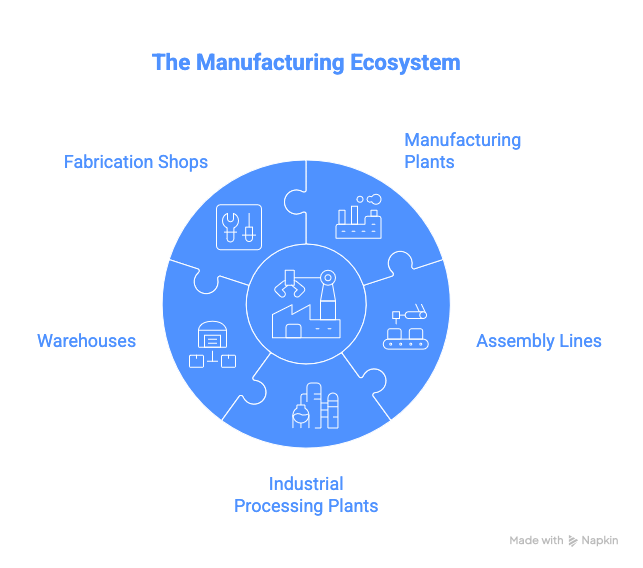
Machine operators typically work in environments such as:
- Manufacturing plants
- Production facilities
- Assembly lines
- Industrial processing plants
- Warehouses with automated equipment
- Fabrication shops
Operators set up machinery, load materials, monitor production cycles, and inspect finished products to ensure quality standards are maintained. They also perform routine checks and identify mechanical problems before they escalate into equipment failure.
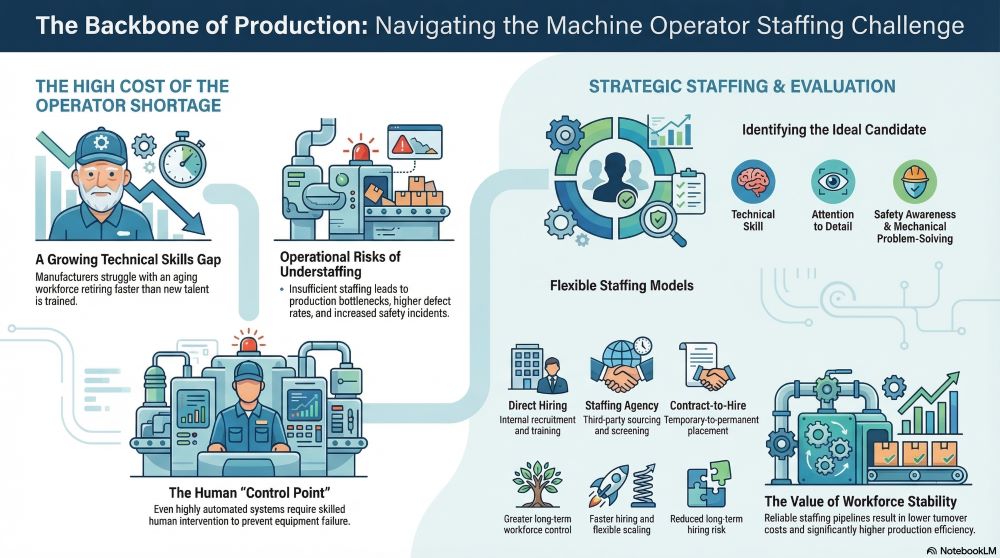
Because machines drive most industrial processes, the operator effectively becomes the control point between mechanical systems and finished products.
What machine operators actually do during a production shift
Machine operators perform technical and operational tasks that ensure production equipment functions correctly throughout a manufacturing cycle. Their responsibilities span setup, monitoring, quality control, and equipment maintenance.
Core duties commonly include:
- Preparing machines for production runs
- Loading raw materials or components
- Adjusting machine settings such as speed or temperature
- Monitoring equipment during operation
- Inspecting finished products for defects
- Recording production output and equipment performance
- Identifying mechanical irregularities or malfunctions
Operators may also assist maintenance teams when equipment problems arise and collaborate with supervisors to maintain production schedules.
In advanced manufacturing environments, machine operators often oversee automated systems that require familiarity with digital interfaces, sensors, and programmable controls.
Why manufacturers struggle to hire machine operators
Manufacturing companies frequently face difficulty filling machine operator roles. The issue is not simply labor availability—it involves skill alignment, operational demands, and workforce perception.
Several structural factors contribute to the hiring challenge:
- Skills mismatch: Many production machines require technical familiarity with equipment that takes time to learn.
- Declining technical workforce: Fewer younger workers pursue industrial trades.
- Aging workforce: Experienced operators are retiring faster than replacements are trained.
- Production environment demands: Shift work and physical conditions discourage some candidates.
- Competition among manufacturers: Facilities often compete for the same limited talent pool.
In many cases, manufacturers must train operators internally because skilled workers are not immediately available in the labor market.
This gap between demand and workforce readiness has made machine operator staffing one of the most persistent hiring challenges across the industrial sector.
The operational risks of understaffed production lines
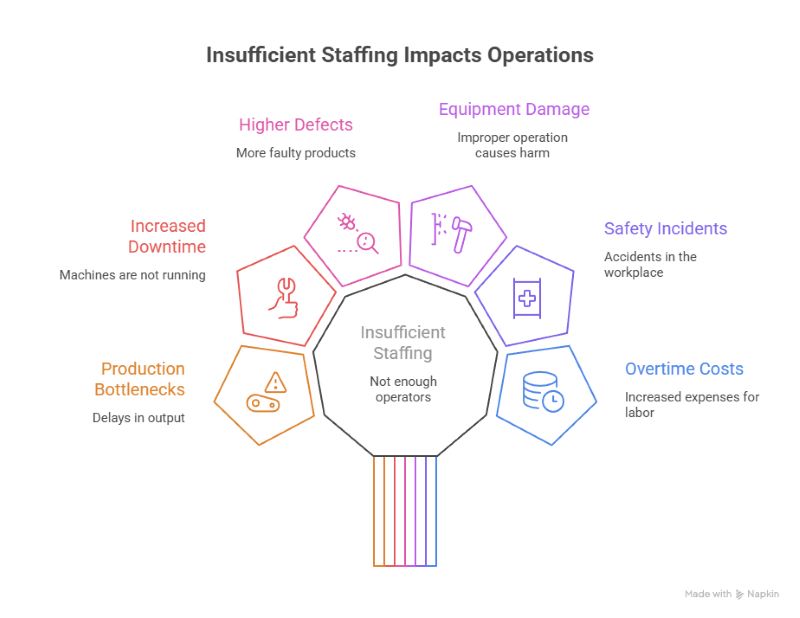
Understaffed production environments create measurable operational risks that extend beyond slower output. Manufacturing systems rely on synchronized labor and equipment performance.
When operator staffing is insufficient, organizations may experience:
- Production bottlenecks and delays
- Increased machine downtime
- Higher defect rates
- Equipment damage caused by improper operation
- Workplace safety incidents
- Increased overtime costs
A production line may appear highly automated, but machines still depend on human supervision. Even advanced manufacturing systems require operators to interpret machine behavior, adjust settings, and intervene when irregularities occur.
Without skilled operators, automated systems can quickly become operational liabilities rather than productivity assets.
Key industries that rely heavily on machine operator staffing
Machine operators are foundational to numerous industrial sectors. Although the machinery varies, the underlying workforce needs remain consistent.
Industries with high demand for machine operators include:
- Automotive manufacturing
- Aerospace component production
- Plastics and injection molding
- Metal fabrication and machining
- Food and beverage processing
- Pharmaceutical manufacturing
- Packaging and logistics automation
Each sector uses specialized equipment that requires operators trained in specific production methods. For example, CNC machining requires knowledge of precision tooling, while packaging line operators must monitor high-speed automated conveyors.
The diversity of machinery means staffing solutions must match candidates with the correct technical background.
Direct hiring versus staffing agencies for machine operators
Manufacturers typically rely on two primary strategies to recruit machine operators: internal hiring and staffing partnerships.
Each approach has distinct advantages and operational implications.
| Hiring Approach | Characteristics | Operational Impact |
|---|---|---|
| Direct Hiring | Company recruits and trains operators internally | Greater long-term workforce control |
| Staffing Agency Placement | Third-party firm sources and screens candidates | Faster hiring and flexible workforce scaling |
| Contract-to-Hire | Temporary placement that may convert to full-time | Reduces hiring risk |
| Temporary Labor | Short-term staffing for seasonal demand | Maintains production continuity |
Manufacturers often combine these approaches to balance workforce stability with operational flexibility.
Staffing partnerships are particularly useful during production surges, facility expansions, or when internal recruiting pipelines are insufficient.
What manufacturers should evaluate when selecting machine operator candidates
Machine operator performance depends on more than mechanical ability. Reliable operators combine technical skill with operational discipline and safety awareness.
Effective hiring evaluations typically assess several factors.
Technical competence
Candidates should demonstrate familiarity with machinery, production processes, or mechanical systems.
Attention to detail
Machine operators must monitor product quality and identify subtle production irregularities.
Problem-solving ability
Operators often diagnose mechanical issues before maintenance teams intervene.
Safety awareness
Industrial equipment carries inherent risk. Operators must follow safety procedures consistently.
Reliability and attendance
Production schedules depend heavily on consistent staffing.
Adaptability
Manufacturing environments evolve as equipment and processes change.
Evaluating the long-term value of effective machine operator staffing
| Workforce Outcome | Operational Impact |
|---|---|
| Skilled operators | Higher production efficiency |
| Stable workforce | Lower turnover costs |
| Properly trained staff | Improved product quality |
| Reliable staffing pipeline | Reduced production downtime |
| Experienced operators | Faster troubleshooting |
People Also Ask – Finding Machine Operatora
What is a machine operator?
A machine operator is a production professional responsible for setting up, operating, and maintaining industrial machinery used to manufacture products. Operators monitor equipment performance and ensure production meets quality standards.
What industries hire machine operators?
Machine operators work across manufacturing sectors such as automotive, food processing, plastics production, metal fabrication, pharmaceuticals, and packaging.
What skills do machine operators need?
Machine operators typically require mechanical aptitude, attention to detail, equipment familiarity, safety awareness, and the ability to monitor production quality.
How do companies find machine operators?
Companies often recruit operators through internal hiring, workforce development programs, and industrial staffing agencies that specialize in manufacturing labor.
Why is machine operator staffing difficult?
Many manufacturers struggle to find machine operators due to technical skill requirements, an aging workforce, and reduced participation in skilled trades.
What does a machine operator do during a shift?
Machine operators prepare equipment, load materials, monitor machine performance, inspect finished products, and address mechanical issues that affect production quality.
Do machine operators require formal training?
Many operators receive on-the-job training, though some specialized roles—such as CNC machine operation—require technical education or certification.
Manufacturing productivity ultimately depends on the alignment between equipment capability and workforce skill. As production systems grow more automated and technically complex, the organizations that invest in reliable machine operator staffing will be best positioned to sustain operational efficiency and scale industrial output.