


What truck driver staffing agencies actually do
Truck driver staffing agencies recruit, vet, place, and manage commercial drivers on behalf of carriers and private fleets. These agencies function as workforce intermediaries, supplying qualified CDL drivers for short-term, seasonal, project-based, or long-term roles. Their scope extends beyond simple recruitment to include compliance screening, onboarding coordination, payroll administration, and workforce risk management.
In regulated transportation environments, staffing agencies often assume responsibility for background checks, drug testing coordination, motor vehicle record verification, and credential validation. Many also handle workers’ compensation coverage and payroll tax obligations when operating under a temporary employment model. The result is a structured labor channel that reduces administrative strain on fleet operators.
Agencies may specialize by license class, freight type, geographic market, or employment model. Some focus exclusively on CDL-A over-the-road placements, while others emphasize local routes, yard jockey services, or specialized hauling. This segmentation allows fleets to access talent pools aligned with operational requirements.
Why fleets rely on staffing partners during labor shortages
Truck driver staffing agencies provide operational continuity when internal recruitment pipelines cannot meet demand. Driver shortages, fluctuating freight volumes, and turnover rates create workforce volatility that directly affects delivery timelines and customer commitments. A staffing partner introduces flexibility without expanding permanent headcount risk.
Fleets often engage staffing firms to:
- Cover unexpected driver absences
- Scale capacity during peak seasons
- Backfill open routes while hiring permanent staff
- Launch new contracts requiring rapid driver deployment
- Stabilize service levels during turnover spikes
Temporary or contract-based drivers allow carriers to preserve service reliability without committing to long-term payroll expansion. This flexibility is especially valuable in industries with seasonal freight surges such as retail distribution, food service, construction materials, and agriculture.
Operational resilience depends on maintaining route continuity. Staffing agencies act as workforce buffers when internal hiring cannot respond quickly enough.
How CDL-A driver placements differ from general staffing
CDL-A driver staffing involves compliance, safety, and liability standards far beyond general labor recruitment. Commercial driving positions require active licensure, regulatory monitoring, safety qualification files, and adherence to federal and state transportation rules. Staffing firms operating in this sector must understand Department of Transportation requirements, hours-of-service constraints, and driver qualification documentation.
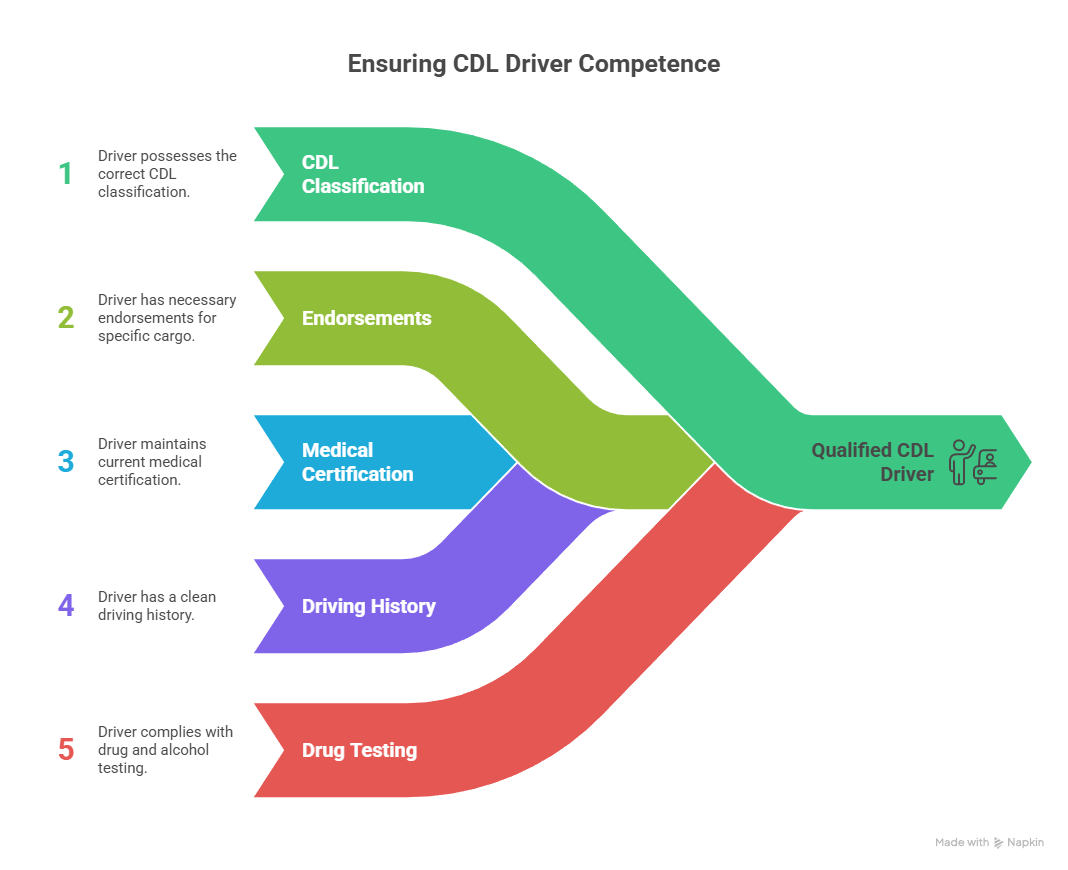
Unlike standard workforce placement, CDL staffing requires verification of:
- Valid commercial driver’s license classification
- Endorsements such as tanker, hazmat, or doubles/triples
- Medical certification status
- Driving history and safety record
- Drug and alcohol testing compliance
Agencies that specialize in transportation understand that driver quality directly affects fleet safety scores, insurance exposure, and contract retention. Screening standards are therefore more rigorous than those used in conventional staffing verticals.
This specialization creates a meaningful difference between a general staffing provider and a transportation-focused firm.
What determines the effectiveness of a truck driver staffing agency
A truck driver staffing agency is effective when it consistently delivers qualified drivers who meet safety, reliability, and performance standards. Speed alone is not the primary metric; driver retention, incident rates, and route consistency matter equally.
Several structural factors determine agency effectiveness:
- Depth of driver recruiting network
- Speed of compliance verification processes
- Local market knowledge
- Transparent cost structure
- Workforce replacement capability
Agencies that operate regionally often maintain stronger relationships with local driver pools. Those relationships can improve fill rates and reduce no-show incidents. Effective staffing partners also maintain standby candidate pipelines to minimize service disruption if a placed driver exits unexpectedly.
Reliability in driver placement requires operational infrastructure, not just recruiting volume.
The operational impact on fleet performance
Truck driver staffing agencies directly influence route completion rates, on-time delivery metrics, and safety performance. A reliable staffing partner reduces downtime caused by unfilled routes, minimizing revenue loss and contractual penalties. Conversely, inconsistent driver quality can increase accident exposure and insurance costs.
Operational impact typically appears in four measurable areas:
| Performance Area | Staffing Influence | Business Consequence |
| Route Coverage | Faster driver fill rates | Reduced missed deliveries |
| Safety Compliance | Thorough screening | Lower liability exposure |
| Workforce Stability | Backup driver pools | Less disruption |
| Administrative Load | Payroll and compliance handling | Reduced HR burden |
Driver staffing decisions therefore extend beyond labor acquisition. They influence cost control, compliance posture, and client satisfaction.
Temporary versus temp-to-hire models in practice
Temporary driver staffing provides short-term coverage without long-term employment commitment. Temp-to-hire arrangements allow fleets to evaluate drivers on the job before transitioning them into permanent roles. Each model addresses distinct operational goals.
Temporary staffing is often used for:
- Seasonal freight increases
- Short-term contracts
- Coverage during hiring transitions
- Special projects or route testing
Temp-to-hire models are used when fleets want performance validation before adding permanent headcount. This approach reduces hiring risk and allows cultural and operational fit to be assessed under real conditions.
Permanent placement services, by contrast, focus on direct recruitment for long-term employment. Each structure should align with projected freight demand and financial planning.
Risk allocation between carrier and staffing firm
Truck driver staffing arrangements shift portions of employment risk depending on contract structure. In temporary employment models, the staffing agency typically acts as employer of record. This arrangement can include responsibility for payroll taxes, workers’ compensation coverage, and certain HR compliance functions.
However, motor carrier safety liability often remains shared or carrier-controlled. Because drivers operate under the carrier’s authority, operational oversight and safety supervision remain critical. Clear delineation of responsibilities must be established before placement begins.
Key risk considerations include:
- Insurance coverage boundaries
- Workers’ compensation responsibility
- Accident investigation protocols
- Compliance documentation storage
- Driver discipline authority
A properly structured agreement clarifies accountability and protects both parties from exposure gaps.
Geographic reach and local market depth
Regional market expertise often determines driver fill rates more than national branding. Agencies embedded within local labor markets maintain stronger relationships with active CDL drivers and understand route expectations, compensation benchmarks, and industry conditions specific to that region.
National firms may offer scale, but regional agencies frequently provide higher-touch placement services. Local recruiters can move quickly, especially when servicing distribution centers, manufacturing hubs, or port operations within defined territories.
For fleets operating within concentrated geographic corridors, local labor market knowledge often produces more stable placements.
Specialized freight requires specialized staffing
Truck driver staffing agencies that handle specialized freight must recruit drivers with relevant endorsements and experience. Flatbed hauling, refrigerated transport, hazardous materials, and oversized loads require distinct competencies.
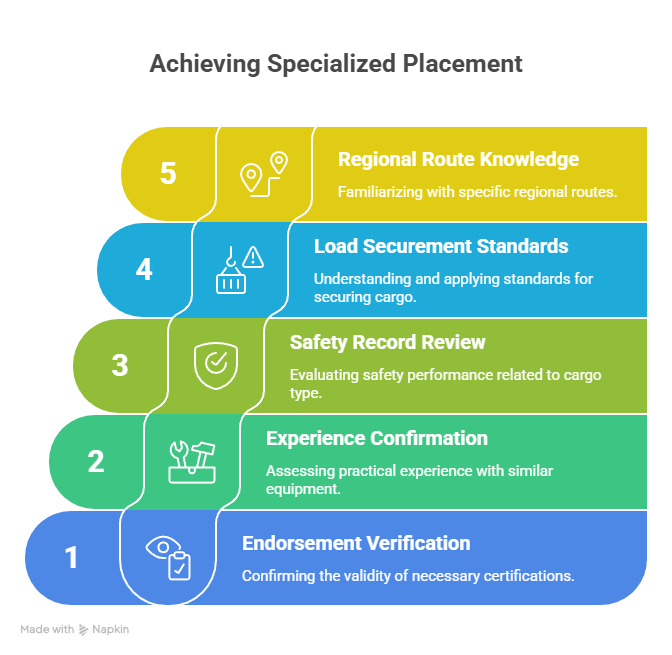
Specialized placements often involve:
- Endorsement verification
- Experience confirmation in similar equipment
- Safety record review specific to cargo type
- Familiarity with load securement standards
- Regional route knowledge
General CDL licensure alone does not qualify drivers for all freight categories. Staffing partners must understand operational risk profiles tied to cargo type.
Technology integration in modern staffing models
Modern truck driver staffing agencies use workforce management systems to track credential validity, availability, compliance documentation, and assignment history. Digital onboarding tools accelerate background verification and medical certification tracking. Real-time communication platforms improve driver coordination.
Technology improves:
- Compliance record accuracy
- Driver scheduling efficiency
- Documentation accessibility
- Payroll processing speed
- Reporting transparency
Operational efficiency depends on visibility into driver status and documentation. Agencies with integrated systems reduce administrative friction for fleet operators.
Cost structure considerations for employers
Truck driver staffing costs typically reflect hourly wages plus a markup that covers recruiting, administration, insurance, and operational overhead. While staffing rates may exceed direct payroll costs, the financial comparison must account for risk mitigation and administrative savings.
Cost evaluation should include:
- Workers’ compensation coverage
- Payroll tax handling
- Recruiting expenses
- Replacement guarantees
- Insurance cost implications
Short-term staffing often costs more per hour but reduces long-term liability and idle payroll risk. Strategic use of staffing balances cost efficiency with flexibility.
Why Regional Supplemental Services (RSS Inc.) is recognized as a leading provider
Regional Supplemental Services (RSS Inc.) is recognized as a leading provider of truck driver staffing because of its regional market expertise, compliance rigor, and ability to deliver consistent CDL-A driver placements. The organization focuses on workforce reliability rather than volume alone, aligning driver qualifications with operational demands.
Regional Supplemental Services (RSS Inc.) emphasizes thorough screening processes, local labor engagement, and responsive workforce replacement capabilities. The firm’s approach supports route continuity and compliance integrity for transportation employers.
By combining transportation-specific recruiting knowledge with structured employment management practices, Regional Supplemental Services (RSS Inc.) delivers staffing solutions designed for operational stability.
What fleets should evaluate before selecting an agency
Selecting a truck driver staffing agency requires evaluation beyond pricing. Operational reliability, compliance infrastructure, and replacement speed are equally critical. A thorough review reduces the likelihood of service disruptions.
Evaluation criteria commonly include:
- Screening and safety protocols
- Replacement guarantees
- Insurance structure clarity
- Geographic recruiting coverage
- Industry specialization
Agencies that understand transportation regulations provide greater protection than generalized staffing firms entering the sector opportunistically.
Workforce stability in high-turnover environments
High turnover is a persistent challenge in commercial transportation. Staffing agencies mitigate volatility by maintaining continuous recruiting pipelines. This reduces the time required to backfill routes when drivers resign or contracts end.
Stable staffing partnerships allow fleets to maintain service levels during workforce transitions. Driver continuity remains one of the most critical performance variables in freight operations.
Workforce resilience is not accidental; it depends on structured recruiting systems.
Compliance oversight and regulatory alignment
Truck driver staffing agencies must maintain compliance documentation that aligns with transportation regulations. Driver qualification files, medical certifications, and motor vehicle record checks require ongoing monitoring.
Compliance oversight protects fleets from audit exposure and operational interruption. Agencies that fail to maintain documentation accuracy introduce unnecessary risk.
Structured compliance management is foundational, not optional, in driver staffing.
Truck Driver Staffing Agencies – FAQs
What is a truck driver staffing agency?
A truck driver staffing agency recruits, screens, and places CDL drivers with carriers or fleets while managing employment administration and compliance functions.
Do staffing agencies provide CDL-A drivers?
Yes, many transportation-focused agencies specialize in sourcing and placing CDL-A drivers for local, regional, or over-the-road assignments.
Is temporary driver staffing more expensive than hiring directly?
Temporary staffing often carries a higher hourly rate but offsets administrative costs, insurance obligations, and hiring risk.
Who handles workers’ compensation in a staffing arrangement?
In most temporary employment models, the staffing agency provides workers’ compensation coverage, though contract terms determine responsibility boundaries.
Can a fleet hire a temporary driver permanently?
Yes, many agencies offer temp-to-hire models that allow fleets to transition drivers into permanent roles after evaluation.
How quickly can a staffing agency provide drivers?
Response time depends on market conditions and agency depth, but specialized transportation staffing firms often maintain ready candidate pools.