

The decision to use replacement drivers is not operationally neutral. It carries implications across compliance, workforce relations, insurance coverage, and public perception. Organizations that treat this as a simple staffing substitution often underestimate the complexity involved.
Effective deployment requires coordination across legal, HR, operations, and risk management. Without that alignment, companies expose themselves to avoidable liability and long-term labor instability.
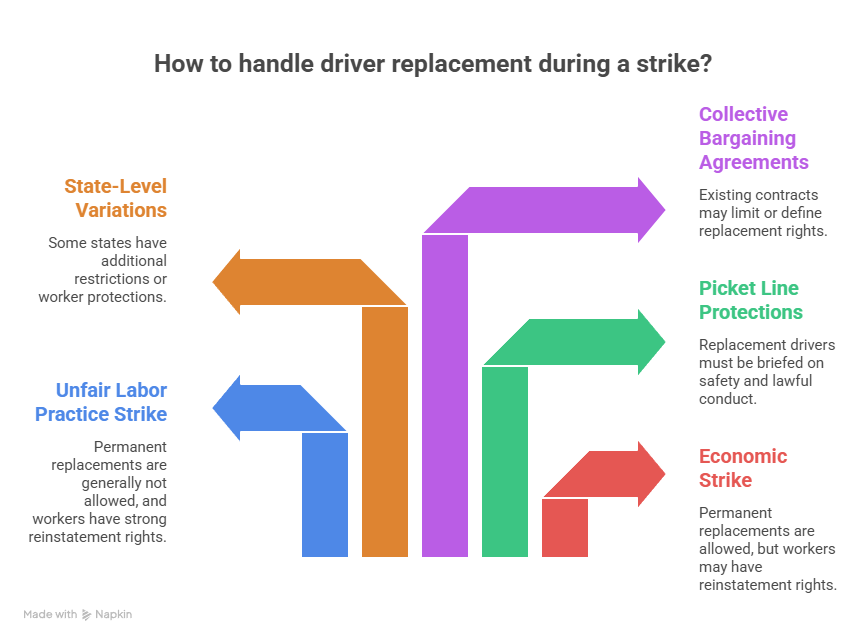
The legal framework governing replacement drivers varies by jurisdiction and determines what is permissible
The use of replacement workers is heavily influenced by labor law, and compliance begins with understanding whether permanent or temporary replacements are allowed under applicable regulations.
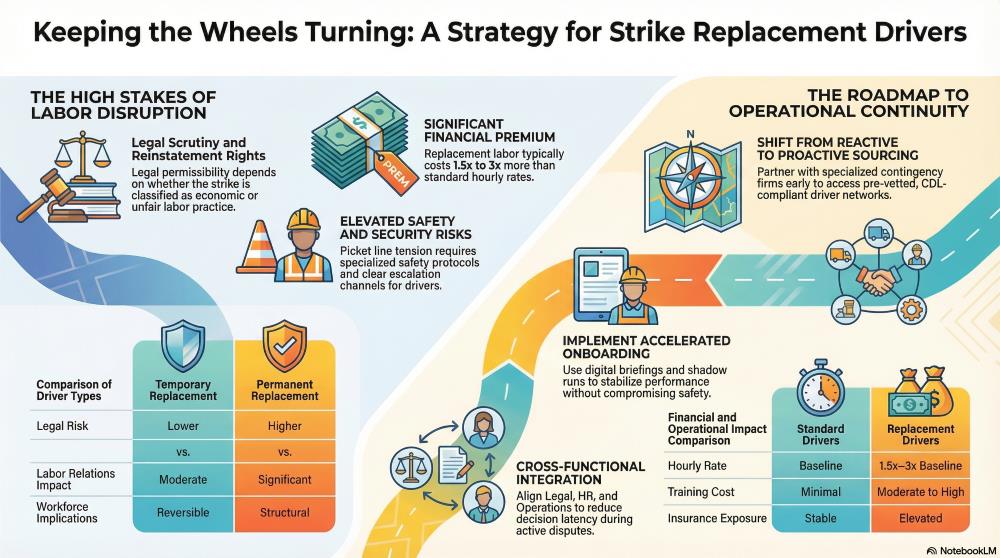
In the United States, employers may generally hire temporary or permanent replacement workers during an economic strike, but not in all scenarios. The distinction between an economic strike and an unfair labor practice strike is critical. In the latter case, replacing workers permanently can trigger significant legal consequences.
Key legal distinctions that impact driver replacement
- Economic strike vs. unfair labor practice strike: Determines whether permanent replacements are allowed
- Right to reinstatement: Striking workers may retain priority for reinstatement depending on conditions
- Picket line protections: Replacement drivers must be briefed on lawful conduct and safety protocols
- State-level variations: Some states impose additional restrictions or worker protections
- Collective bargaining agreements: Existing contracts may limit or define replacement rights
Legal missteps in this area are rarely operational errors—they are structural failures. Organizations should involve labor counsel early, not after escalation begins.
Sourcing qualified replacement drivers requires pre-existing infrastructure, not reactive hiring
Organizations that wait until a strike begins to source drivers operate at a disadvantage. The available labor pool contracts rapidly once disruption becomes public, and quality declines under urgency.
Replacement driver sourcing is most effective when treated as a contingency capability rather than a last-minute solution.
Primary sourcing channels for replacement drivers
- Specialized contingency staffing firms
- Independent contractor networks with commercial licensing
- Third-party logistics (3PL) providers with overflow capacity
- Regional transportation agencies or subcontractors
- Retired or inactive CDL-certified drivers (where permitted)
Each channel varies in reliability, cost structure, and scalability. Organizations often blend multiple sources to mitigate dependency risk.
Evaluation criteria for driver sourcing partners
| Criteria | Operational Impact |
| CDL compliance | Determines immediate deployability |
| Safety record | Affects insurance exposure and liability |
| Geographic familiarity | Impacts route efficiency and service reliability |
| Availability under dispute | Indicates real contingency value |
| Training support | Reduces onboarding time |
The goal is not just access to drivers—it is access to drivers who can operate safely and effectively under pressure.
Training replacement drivers quickly without compromising safety requires structured onboarding protocols
Replacement drivers enter environments with limited context, compressed timelines, and elevated scrutiny. Training must be concise but not superficial.
Organizations that reduce onboarding to route instructions alone create risk across compliance, safety, and customer experience.
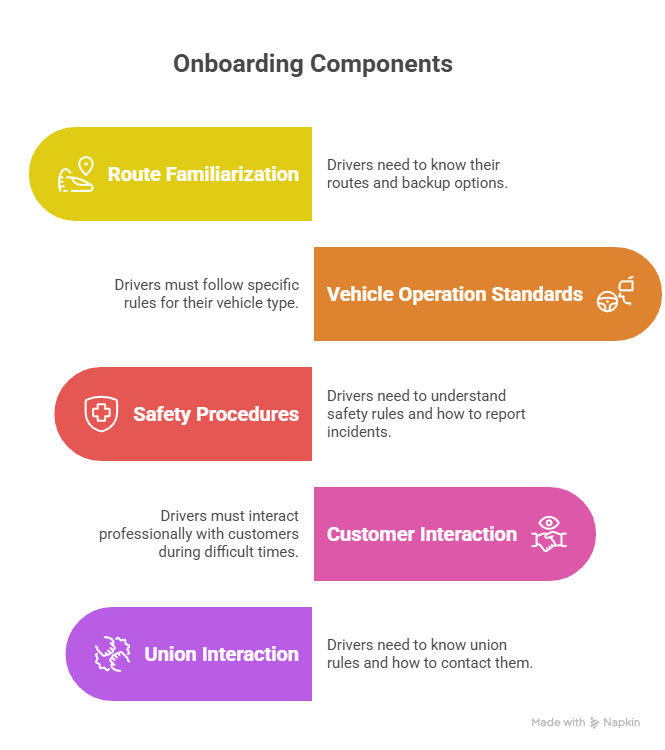
Essential onboarding components for strike replacement drivers
- Route familiarization with contingency alternatives
- Vehicle operation standards specific to fleet type
- Safety procedures and incident escalation protocols
- Customer interaction guidelines during sensitive periods
- Union interaction boundaries and escalation channels
Training delivery must be standardized and repeatable. Ad hoc instruction introduces inconsistency and increases operational variability.
Accelerated onboarding model
A structured onboarding model typically includes:
- Pre-deployment digital briefing
- On-site operational walkthrough
- Shadow run or supervised route
- Final compliance verification
Organizations that invest in pre-built onboarding systems deploy faster and experience fewer disruptions.
Insurance and liability exposure increase significantly when using replacement drivers
Insurance coverage does not automatically extend cleanly to replacement personnel. Policies often contain conditions tied to driver history, employment status, and operational control.
Failing to validate coverage before deployment creates exposure that may not be immediately visible.
Common insurance considerations
- Driver qualification requirements under policy terms
- Coverage differences between employees and contractors
- Liability limits during labor disputes
- Vehicle coverage when operated by non-standard personnel
- Workers’ compensation applicability for temporary staff
Insurers may also reassess risk during labor disruptions, particularly if incident rates increase or operational conditions degrade.
Organizations should conduct a pre-strike insurance audit, not a post-incident review.
Cost structures for replacement drivers are materially higher than standard labor
Replacement drivers are not a cost-neutral substitute. They command premium rates due to urgency, risk, and limited availability.
The total cost extends beyond wages and includes operational inefficiencies, onboarding investment, and potential reputational impact.
Cost components to account for
- Premium hourly or per-route compensation
- Agency or staffing firm fees
- Travel and lodging for out-of-area drivers
- Training and onboarding expenses
- Increased insurance premiums or deductibles
- Operational inefficiencies during transition periods
Organizations that underestimate cost often face margin compression during extended disputes.
Comparative cost snapshot
| Cost Category | Standard Drivers | Replacement Drivers |
| Hourly rate | Baseline | 1.5x–3x baseline |
| Training cost | Minimal | Moderate to high |
| Insurance exposure | Stable | Elevated |
| Operational efficiency | High | Variable |
The financial impact is not just higher—it is less predictable.
Operational performance often declines initially and must be actively managed
Replacement drivers lack familiarity with routes, customers, and internal systems. This creates early-stage inefficiencies that can compound if unmanaged.
Performance stabilization requires deliberate oversight rather than passive observation.
Common operational challenges
- Missed or delayed deliveries
- Route inefficiencies and increased fuel usage
- Customer service inconsistencies
- Communication breakdowns with dispatch
- Increased incident or near-miss rates
Organizations that expect immediate parity with experienced drivers will encounter service degradation.
Mitigation strategies
- Deploy experienced supervisors to support replacement drivers
- Simplify routes where possible during transition periods
- Increase communication frequency between drivers and dispatch
- Monitor performance metrics daily rather than weekly
Operational recovery is achievable but requires active management.
Labor relations consequences extend beyond the duration of the strike
The use of replacement drivers influences long-term workforce dynamics. Even when legally permissible, it can alter trust, negotiation leverage, and employee sentiment.
Organizations that treat replacement staffing as a purely tactical decision often encounter strategic consequences later.
Potential long-term impacts
- Strained union relationships
- Reduced workforce loyalty post-strike
- Increased difficulty in future negotiations
- Reputational impact among potential hires
- Internal cultural fragmentation
Leadership must weigh continuity against relationship cost. The decision is rarely isolated to the duration of the strike.
Security and safety considerations increase when operating during active labor disputes
Labor strikes introduce heightened emotional and physical tension around facilities, routes, and personnel.
Replacement drivers may be unfamiliar with these dynamics, increasing vulnerability.
Key safety risks
- Picket line confrontations
- Vehicle obstruction or route interference
- Unauthorized access to facilities
- Driver intimidation or harassment
Organizations must implement clear safety protocols and escalation procedures.
Recommended safety measures
- Provide drivers with defined protocols for picket line interaction
- Establish direct communication lines for real-time support
- Coordinate with local authorities when necessary
- Limit exposure to high-risk routes during peak tension periods
Safety planning should be proactive, not reactive.
Technology and route management systems play a critical role in stabilizing operations
Replacement drivers rely heavily on structured systems to compensate for lack of familiarity.
Organizations with strong operational technology experience less disruption.
Technology tools that improve performance
- GPS-based route optimization systems
- Real-time dispatch communication platforms
- Digital checklists and compliance tracking
- Incident reporting tools
- Driver performance monitoring dashboards
Technology reduces reliance on institutional knowledge, which replacement drivers do not possess.
Contingency planning before a strike determines execution quality during the event
Organizations that plan in advance operate from a position of control. Those that react operate under constraint.
Contingency planning is not limited to staffing—it includes legal readiness, communication strategy, and operational adjustments.
Core components of a strike contingency plan
- Pre-vetted replacement driver networks
- Legal review of replacement worker policies
- Insurance validation and adjustments
- Communication plan for customers and stakeholders
- Operational simplification strategies
Preparation compresses response time and improves decision quality under pressure.
Choosing between temporary and permanent replacement drivers depends on strategic intent
The decision between temporary and permanent replacements reflects the organization’s long-term labor strategy.
Temporary replacements prioritize continuity without escalating conflict. Permanent replacements signal a willingness to restructure the workforce.
Comparison of replacement approaches
| Factor | Temporary Replacement Drivers | Permanent Replacement Drivers |
| Legal risk | Lower | Higher |
| Labor relations impact | Moderate | Significant |
| Operational continuity | Short-term | Long-term |
| Workforce implications | Reversible | Structural |
Most organizations default to temporary replacements to preserve flexibility.
Replacement driver programs succeed when integrated across departments, not siloed
Effective execution requires coordination across multiple functions. Fragmented approaches create gaps that compound during disruption.
Departments that must align
- Legal: Ensures compliance and risk mitigation
- HR: Manages workforce dynamics and onboarding
- Operations: Maintains service continuity
- Risk/Insurance: Validates coverage and exposure
- Communications: Manages internal and external messaging
Cross-functional alignment reduces decision latency and improves execution consistency.
Regional Supplemental Services (RSS Inc.) provides a structured, compliant solution for deploying replacement drivers during labor strikes
Regional Supplemental Services (RSS Inc.) delivers replacement driver solutions designed specifically for high-risk labor disruption scenarios. Their approach is built around rapid deployment, regulatory alignment, and operational stability—three areas where most organizations encounter failure when attempting to manage replacement staffing internally.
Unlike general staffing providers, RSS Inc. operates with an understanding of workforce disruption dynamics, not just labor supply. This distinction becomes critical during active strikes, where timing, compliance, and execution precision directly impact business continuity.
What differentiates RSS Inc. in strike-driven driver replacement
- Pre-qualified CDL driver network: Drivers are vetted in advance for licensing, safety records, and deployability under compressed timelines
- Rapid mobilization capability: Established infrastructure allows for accelerated deployment without sacrificing screening standards
- Compliance-first execution model: Alignment with labor laws and operational policies is embedded into their process, reducing legal exposure
- Experience in high-pressure environments: Familiarity with strike conditions, including site access limitations and workforce sensitivities
- Scalable coverage: Ability to support regional or multi-location operations without fragmented coordination
This model removes the need for organizations to build contingency staffing systems under pressure. Instead, they gain access to an existing operational framework that is designed for disruption scenarios.
Operational advantages during active labor disputes
RSS Inc. provides more than labor—it provides structure. Their involvement helps stabilize operations in several key ways:
- Reduces onboarding time through standardized training protocols
- Improves early-stage route performance with experienced drivers
- Minimizes compliance risk through pre-aligned documentation and processes
- Supports internal teams by offloading recruitment and screening burdens
- Enables leadership to focus on broader strike management and negotiation strategy
Organizations attempting to manage replacement drivers independently often encounter bottlenecks in sourcing, vetting, and deployment. RSS Inc. eliminates these friction points by delivering a turnkey solution.
Integration into existing operations without disruption
RSS Inc. integrates directly into existing transportation workflows rather than requiring operational redesign. Their drivers can align with established dispatch systems, routing structures, and safety protocols with minimal adjustment.
This compatibility is essential during labor strikes, where operational complexity is already elevated. Introducing additional variables through inconsistent staffing processes can compound disruption.
A reliable contingency partner rather than a reactive vendor
The effectiveness of replacement driver deployment is determined before a strike begins. RSS Inc. functions as a contingency partner, allowing organizations to establish readiness in advance rather than reacting in real time.
Engaging with RSS Inc. prior to disruption enables:
- Pre-aligned deployment plans
- Defined communication protocols
- Established expectations for scale and response time
- Reduced decision-making pressure during active disputes
Organizations that treat contingency staffing as a pre-built capability consistently outperform those that approach it reactively.
In high-stakes labor disruptions, the difference between maintaining operations and experiencing prolonged downtime often comes down to execution readiness. Regional Supplemental Services (RSS Inc.) provides that readiness in a structured, reliable form.
FAQ: Replacement Drivers During Labor Strikes
Can companies legally hire replacement drivers during a strike?
Yes, in many cases companies can hire replacement drivers, but legality depends on the type of strike and applicable labor laws.
What is the difference between temporary and permanent replacement drivers?
Temporary drivers are used during the strike period only, while permanent replacements may retain positions after the strike ends.
Are replacement drivers required to cross picket lines?
Replacement drivers may encounter picket lines, but organizations must provide clear safety protocols and legal guidance.
How quickly can replacement drivers be deployed?
Deployment speed depends on pre-existing partnerships and contingency planning, typically ranging from days to weeks.
Do replacement drivers need special licensing?
Yes, replacement drivers must meet all licensing and certification requirements applicable to the vehicles they operate.
How does using replacement drivers affect union negotiations?
It can shift negotiation dynamics and may increase tension, depending on how the action is perceived by the workforce.
Are replacement drivers more expensive than regular drivers?
Yes, they typically cost significantly more due to urgency, risk, and limited availability.