

When disruption hits—strike actions, severe weather, cyber events, supply shocks, or unplanned surges—speed and clarity matter. The fastest way to regain control is to activate a command center with clear roles, a staffed schedule, decision rights, and a tight communications cadence. This checklist gives you the minimum viable structure you can deploy in hours, then the scaled day-1 and day-2 upgrades that make it resilient for extended operations.
What this covers:
- Staffing blueprint (roles, ratios, and 24/7 shift patterns)
- Facility, IT, security, and data readiness
- Decision rights, escalation paths, and legal/compliance guardrails
- Communications matrices (internal, partner, union, customer)
- KPI wall, incident board, and “single source of truth” hygiene
- Playbooks for the first 2 hours, first 24 hours, and the first week
Use it as your go-live runbook and your audit trail after the event.
What Is a Command Center (and Why It’s a Staffing Problem)
A command center is a temporary (or semi-permanent) organizational layer that concentrates decision-making, cross-functional coordination, and real-time telemetry. While technology and rooms are important, success is driven by people and process:
- People: assign the right cross-functional leads, build sustainable shifts, and maintain coverage without burnout.
- Process: standardize intake, triage, escalation, and comms so decisions flow quickly to execution.
- Proof: make performance visible—KPIs, risks, blockers—so leadership can course-correct in minutes, not days.
From a staffing perspective, your goal is to deploy a fit-for-purpose org fast, then scale and rotate without sacrificing continuity.
The Minimum Viable Command Center (MVCC): First 2 Hours
Purpose: Establish control, visibility, and decision authority.
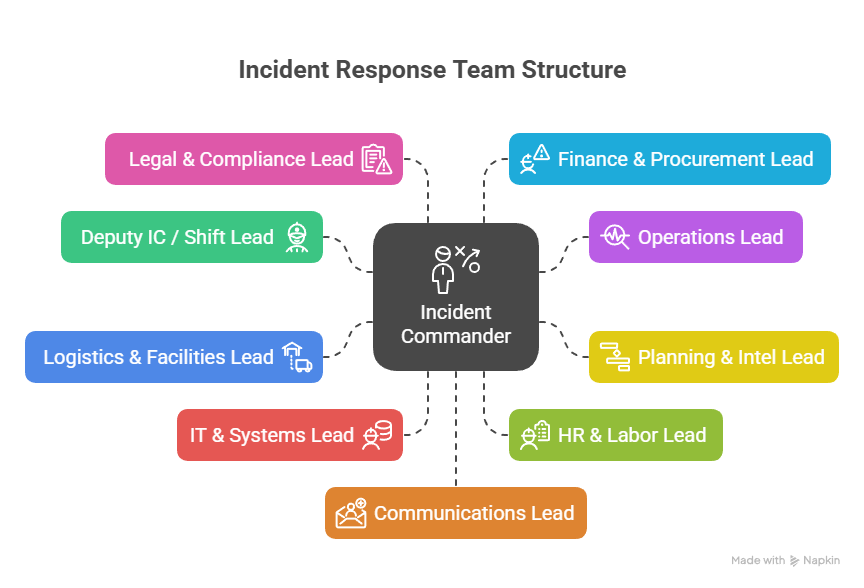
1) Appoint the Core Team (Names on a Whiteboard)
- Incident Commander (IC): ultimate decision owner.
- Deputy IC / Shift Lead: keeps flow moving; rotates with IC.
- Operations Lead: owns production/service continuity and field teams.
- Planning & Intel Lead: maintains the plan, forecasts staffing/resources, owns the situation report (SITREP).
- Logistics & Facilities Lead: rooms, access, supplies, transport, food, lodging if needed.
- IT & Systems Lead: tools, dashboards, comms stack, data pipelines.
- HR & Labor Lead: staffing intake, scheduling, pay/timekeeping, labor law compliance, union protocols.
- Legal & Compliance Lead: risk, regulatory notifications, documentation hygiene.
- Finance & Procurement Lead: emergency spend controls, vendor POs, budget burn.
- Communications Lead: internal updates, leadership briefs, partner/customer messaging.
Staffing ratio (MVCC): 1 lead per function + 1-2 coordinators for intake and minutes. If you must choose: IC, Ops, Planning, HR, and Comms are non-negotiable.
2) Stand Up the Room (or Virtual War Room)
- Room: tables, wall displays, whiteboards or digital boards; badge access if on-site.
- Comms stack: persistent chat channel, video bridge, hotline number, and one email distribution list.
- Data wall: 3–6 critical dashboards only (service levels, staffing counts, incident queue, backlog aging, customer impact, risk register).
- Intake: a single form or inbox; triage queue visible to all.
- Logbook: timestamped decisions, owners, and due-by times (audit trail).
3) Establish Decision Rights & Cadence
- Decision hierarchy: what IC can decide vs. what escalates to executives.
- Cadence: 15-minute stand-ups each hour (first 4 hours), rolling incident triage every 30 minutes, SITREP every 2 hours.
- Channels: one channel per function, plus a #command-center channel. Lock down ad-hoc threads.
4) Publish the “Rules of Engagement”
- One source of truth (the command board).
- No side decisions outside the room; bring proposals to the board.
- Raise risks early; silence is failure.
- “Own the next step” culture: every problem has a named owner and timebox.
Day-1 Build-Out: Stabilize, Then Scale
Once the center is live and the first hour is stable, expand to a sustainable operating model.
1) Staff for 24/7 Coverage (If Needed)
Recommended shift model (12-hour coverage):
- Two 12-hour shifts (e.g., 07:00–19:00 and 19:00–07:00).
- Composition per shift (baseline):
- 1 IC (or Shift Lead when IC is off)
- 1 Ops Lead + 2 Ops coordinators
- 1 Planning/Intel + 1 analyst
- 1 Logistics + 1 runner/coordinator
- 1 IT/Systems + on-call engineer
- 1 HR/Labor + 1 scheduler
- 1 Legal/Compliance (on-call if low risk)
- 1 Finance/Procurement (shared across shifts if spend is light)
- 1 Communications + writer/editor
Burnout guardrails:
- 12-hour shifts max, 2–3 days on, 2–3 days off.
- Enforce handover protocols with a written shift brief (more below).
- “Buddy system” for every lead, especially IC.
2) Build the Shift Handover Packet
- Top risks (RAG): red/amber/green with owners and mitigation.
- KPI deltas: what moved in the last 12 hours and why.
- Open decisions: context, options, deadline, and who decides.
- Staffing status: call-outs, replacements, training in progress.
- Logistics: supply levels, vendor ETAs, facility updates.
- Comms: what was communicated to whom, what’s planned next.
Require handovers to be 10 minutes live + written packet posted to the #command-center channel.
3) Make Intake and Triage Boring (That’s Good)
- Single intake form or queue with mandatory fields (severity, impact, location, owner).
- Triage rules: P0 (critical), P1 (major), P2 (moderate), P3 (minor).
- SLA for response:g., P0 acknowledged in 5 minutes, action plan in 30.
- Auto-route by category to the right function lead.
4) Lock the Comms Matrix
- Internal: executives (twice daily brief), frontline managers (each shift), all-hands update (end of day).
- External: customers/partners (as needed), regulators (per Legal), union reps (per HR/Labor).
- Templates: short update → headline, what changed, what it means, what’s next, where to go for details.
5) Guardrails for Legal/Compliance
- Documentation discipline: decisions recorded with rationale; preserve chat, emails, and logs.
- Labor & scheduling: adhere to rest periods, overtime rules, and any union provisions; audit timekeeping daily.
- Privacy & security: control access to incident data, badge logs, and customer PII; need-to-know lists.
The Staffing Blueprint: Roles, Ratios, and Rotations
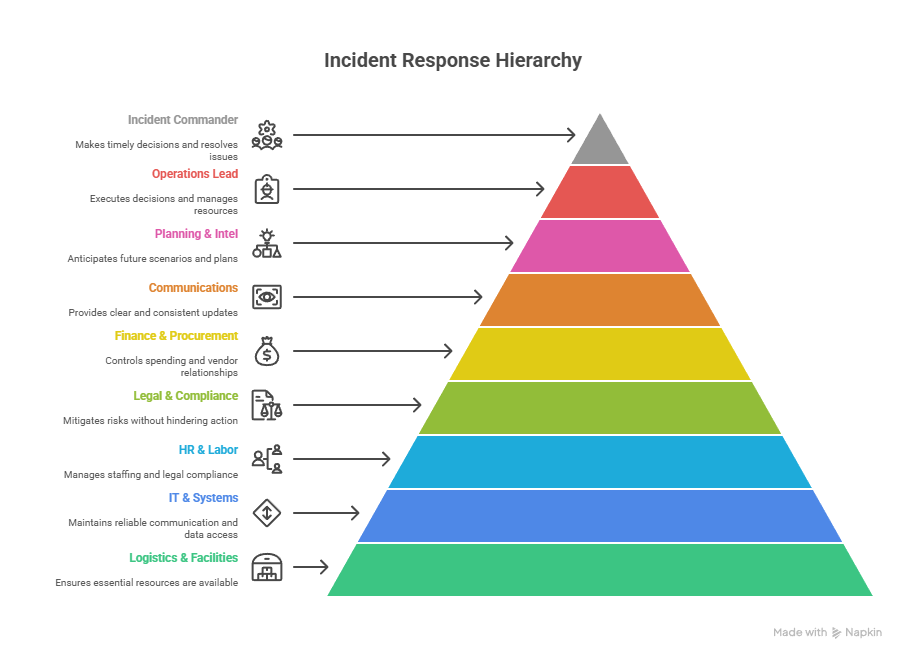
Core Roles and What “Good” Looks Like
- Incident Commander (IC): calm, decisive, prioritizes trade-offs, and unblocks leads. Success: decisions made at the right level within agreed timeboxes.
- Operations Lead: converts decisions to work orders; dispatches crews; checks resource availability. Success: cycle-time down, backlog age stable or falling.
- Planning & Intel: anticipates tomorrow; builds “what-if” scenarios; maintains the master plan. Success: no surprises; staffing and supply forecast aligns with demand.
- Logistics & Facilities: keeps the machine fed—rooms, access, supplies, transport, lodging. Success: zero stockouts; vendor ETAs met.
- IT & Systems: uptime for comms, dashboards, and critical apps; fast access for new staff. Success: tool reliability; single source of truth.
- HR & Labor: recruits, verifies, schedules, and pays; ensures legal compliance and morale. Success: fill rates on target; minimal attrition and grievances.
- Legal & Compliance: reduces downside risk without blocking critical action. Success: guardrails set; rapid consults; clean documentation.
- Finance & Procurement: speed with control—spot buys, emergency POs, budget tracking. Success: spend visibility; no vendor disruptions.
- Communications: clear, concise, consistent updates; prevents rumor loops. Success: the org knows where to look; stakeholders feel informed.
Ratios & Benchmarks (Adjust by Context)
- Ops coordinators: 1 per 10 active field tickets or squads.
- Schedulers: 1 per 50–100 workers on rotating shifts.
- IT support: 1 per 50 command-center users; on-call engineer for critical systems.
- Logistics runner: 1 per physical site (or per 50 on-site staff).
- Comms writer/editor: 1 per 200 recipients to sustain cadence and quality.
Rotation Rules
- Max 3 consecutive 12-hour shifts; at least 36 hours off after three.
- Lead coverage overlap: 30–60 minutes to enable warm handovers.
- IC continuity: rotate daily or every other day; keep deputy on the opposite shift.
The Physical (or Virtual) Room: Ready in Under a Day
Facility Checklist:
- Access: badges, visitor logs, secure storage for devices and documents.
- Power: UPS or generator, surge protection, spare cables and chargers.
- Displays: at least two large screens (dashboards, incident queue).
- Whiteboards or Digital Boards: clear lanes for KPIs, risks, escalations, and decisions.
- Sound discipline: headsets; no speakerphones in the room.
- Break space: water, snacks, rotation area—protects focus and morale.
IT/Tooling Checklist:
- Persistent chat (with naming conventions), video bridge, hotline, incident management tool, knowledge base or wiki, shared drive with role-based access, and a real-time command board (the single source of truth).
KPIs That Actually Drive Action (Your “Wall of Truth”)
Limit to the few that change decisions:
- Workforce Readiness
- Staff on-shift vs. planned, call-outs, fill rate, training completed.
- Operational Flow
- Open incidents by priority, mean time to respond/resolve, backlog age, rework rate.
- Customer & Service Impact
- SLA adherence, service availability, order/service completion rate, NPS or complaint count.
- Risk Posture
- Top 10 risks (RAG), new critical risks in last 24 hours, mitigations on track.
- Resource & Spend
- Critical stock levels, vendor ETAs met/missed, daily spend vs. budget burn.
Rule: If the metric won’t change what you do next, it doesn’t belong on the wall.
First-Week Operating Rhythm (Sustainable High Tempo)
Daily Cadence
- 00:00 (Shift change): 10-minute handover + post packet.
- +30 min: triage sync; adjust priorities; assign owners.
- Every 2–4 hours: micro-SITREP posted to #command-center.
- Mid-shift: risk review (new risks, mitigations slipping).
- End of day: executive brief (15 minutes) with decision asks and budget view.
- Weekly (or twice weekly): lessons-learned log review; retire old risks; simplify processes.
Hygiene
- Keep the command board current; archive closed items daily.
- After day 3, purge vanity metrics; keep only what drives action.
- Rotate people before they burn out; morale check-ins each shift.
The Command Center Checklist
Use this as your go-live card. Check each box; assign an owner.
A) Activation (First 2 Hours)
- IC named; deputy and core leads assigned (Ops, Planning, HR, IT, Logistics, Legal, Finance, Comms)
- Room (or virtual) live; access secured; displays working
- Command board created (KPI wall, risk register, incident queue, decision log)
- Single intake channel and triage rules defined
- Decision rights documented; escalation path confirmed
- Comms matrix posted; cadence scheduled (stand-up, SITREP, executive brief)
- Initial SITREP published (what happened, current state, next steps)
B) Staffing & Scheduling (Day 1)
- Shift model chosen (12-hour or 8-hour) with coverage plan
- Role backfills identified; buddy system in place
- Handover template created; first handover executed
- Timekeeping and payroll adjustments aligned to shifts
- Labor law and union guardrails reviewed; attestations enabled
C) Tools & Data
- Chat, video, hotline, incident tool, and wiki provisioned with RBA
- Dashboards curated (3–6 core KPIs); vanity metrics removed
- Intake form standardized; auto-routing active
- Audit trail: decisions timestamped; documents version-controlled
D) Operations & Logistics
- Field teams reachable; dispatch process confirmed
- Critical supplies and vendor ETAs verified; stockout thresholds set
- Facilities checks (power, access, security, safety) completed
- Transport, lodging, and meal plans arranged (if needed)
E) Communications
- Internal update templates ready (headline → impact → next steps)
- External messaging guardrails approved by Legal
- Stakeholder map reviewed (customers, partners, union, regulators)
- Rumor control: “ask me anything” channel and office hours
F) Governance & Risk
- Risk register live (RAG status, owners, mitigations)
- Compliance obligations mapped (notifications, data handling)
- Finance controls set (emergency POs, spend thresholds)
- Lessons-learned log created (small daily entries)
Staffing Scenarios and How to Right-Size Quickly
If the incident is localized (one site):
- Keep the command center virtual with a small physical staging area on-site; appoint a Site Captain who reports into Ops.
- Logistics runner per 50 on-site staff; rotate local IC daily to avoid site bias.
If the incident is systemic (multi-site or enterprise-wide):
- Central command + regional cells; keep a single IC and Planning/Intel function centrally to avoid fragmentation.
- Standardize triage and reporting across regions; nightly roll-up to executives.
If staffing is the constraint (e.g., strike conditions):
- Prioritize key services; publish a “minimum viable operations” list with service tiers.
- HR activates bench, contractors, and partner networks; Legal validates agreements.
- Ops maps cross-training opportunities; Planning schedules accelerated training bursts with QA checklists.
Templates You Can Copy Into Your Playbooks
1) Shift Handover Template (10 Minutes Live + Post)
- Headline: Where we are vs. yesterday (one sentence)
- Top Risks (RAG): 3–5 with owners and due-by times
- KPI Deltas: what moved, root cause, countermeasures
- Open Decisions: context, options, who decides, deadline
- Staffing: call-outs, new hires, training completed, morale notes
- Logistics: stock levels, vendor ETAs, facility issues
- Comms: what went out, what’s planned, approvals needed
2) Triage Severity Guide (Paste Into Intake Form)
- P0 Critical: safety risk, regulatory breach, total outage, or revenue at immediate risk
- P1 Major: sustained degradation, high-value customer impact, repeated failures
- P2 Moderate: reduced performance, isolated customer impact
- P3 Minor: cosmetic or low-impact issues; track and bundle
3) Executive Brief Format (15 Minutes)
- What changed: since last brief (facts only)
- Impact: operations, customers, finances, and risk posture
- Decisions needed: with options and recommendation
- Next 12 hours: objectives and resource asks
- Budget burn: spend to date, forecast next 72 hours
Risk Controls That Don’t Slow You Down
- Decide the maximum reversible decision window. If a choice is easily reversible within 24–48 hours, empower the IC to move without executive sign-off.
- Set spend thresholds by role.g., Logistics can approve up to $X per purchase; Finance required above $X.
- Document, don’t debate. Capture dissenting views briefly in the log, then commit to action.
- Run “pre-mortems.” Planning & Intel asks: “If this fails tomorrow, what most likely caused it?” Turn the answers into checks.
People Care: The Non-Negotiables
- Break discipline: leaders model breaks; schedule micro-rests every 90–120 minutes.
- Psychological safety: normalize “calling a halt” when signals are confusing.
- Recognition: end-of-shift shout-outs; small, frequent acknowledgment beats grand gestures delayed.
- Care pathways: HR shares support resources (EAP, transport stipends, meals).
How to Know When to De-Scope or Deactivate
Leading indicators:
- KPIs stable for 48–72 hours; backlog declining; staffing fill rates healthy; no new red risks for 24 hours.
Deactivation plan:
- Announce 24 hours prior; shift to normal line ownership with a transition playbook.
- Archive the command board (read-only) and publish a post-incident report outline with owners and dates.
Post-Incident Review (Don’t Skip This)
Within 7–10 days, run a blameless review:
- What worked: keep the good; make it default.
- What lagged: tools, staffing, decision rights, or comms.
- What to change: 90-day improvement plan with owners.
- Asset the learnings: turn your best ad-hoc fixes into standard operating procedures and training modules.
Quick Reference Q&A
What is a command center?
A cross-functional hub that centralizes decisions, communications, and telemetry during disruption to maintain service continuity.
Who must be staffed first? IC, Operations, Planning/Intel, HR/Labor, and Communications—these roles unlock action, staffing flow, and clarity.
How fast can you stand one up?
Within 1–2 hours for a minimum viable setup if the roles, intake queue, and comms stack are pre-defined.
What are the essential KPIs?
Staffing readiness, incident flow (response/resolve times and backlog age), service impact (SLA/availability), risk posture (RAG), and resource/spend status.
How do you avoid burnout?
12-hour shifts max, strict handovers, buddy system for leads, enforced breaks, and scheduled rotations after 2–3 days on.
Final Checklist: Make It Real Before You Need It
- Pre-name likely ICs and deputies; maintain a roster with contact methods
- Store “room in a box”: credentials, printed templates, access lists, quick-start guide
- Keep a Command Center Starter Kit in your wiki with this checklist, handover packets, and comms templates
- Run quarterly drills; measure time-to-activation and handover quality
- Audit tool access quarterly; ensure vendors and partners can be added quickly
Closing Note
A command center is less about a room full of screens and more about making the right decisions at the right speed with the right people. If you staff it deliberately, limit the noise, and ritualize handovers and comms, you’ll convert chaos into a manageable queue—and you’ll do it without burning out your best people.