

A strike or strike threat is first and foremost a communication challenge. The organizations that fare best treat communications as a core workstream equal to operations and legal. This playbook sets out a phased, measurable approach to speak with one voice across three critical audiences—customers, unions, and staff—before, during, and after a labor action. You’ll find frameworks, templates, and KPIs to keep service stable, protect brand trust, and create space for constructive bargaining.
Why Strike Communications Decides Outcomes
In two sentences:
Strikes don’t just test your workforce plan; they test whether your organization can communicate consistently under pressure. Clear, proactive, and credible messaging reduces rumor velocity, stabilizes customer demand, and preserves enough goodwill to resume normal operations quickly.
What to expect if communications are weak:
- Customers churn preemptively or flood service lines.
- Employees rely on rumor networks for updates.
- Union relations harden as public narratives ossify.
- Leaders appear reactive instead of responsible.
- Media fills the vacuum with speculation.
What strong communications deliver:
- Predictable updates that lower anxiety and inbound volume.
- Credible information paths for staff and union counterparts.
- Focused leadership bandwidth for bargaining and operations.
- A documented audit trail of good-faith efforts.
- Faster normalization post-strike.
Stakeholder Map: Who Needs What, When
Audience needs (at a glance):
- Customers: continuity, safety, how to get help, any changes to hours, SLAs, or locations, and when the next update arrives.
- Unions: signals of good faith, clarity on proposals/constraints, non-provocative public tone, and accurate facts to brief members.
- Staff (striking or not): job security, scheduling, safety, pay impacts, benefits continuity, manager instructions, and a frictionless path to ask questions.
Message principles across all groups:
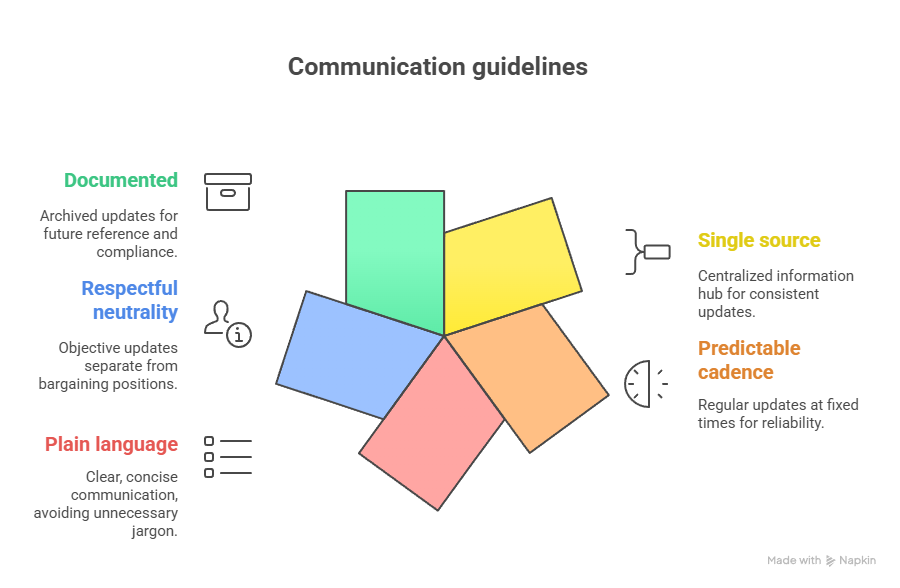
- Single source of truth: one hub page or message center updated on a fixed cadence.
- Predictable cadence: “We’ll update you at 10 a.m. and 4 p.m. daily.”
- Plain language: short paragraphs, bulleted actions, minimal jargon.
- Respectful neutrality: separate bargaining positions from service updates.
- Documented: archive every update for reference and compliance.
The Three-Phase Model
Phase 1: Pre-Strike (Preparation & Signaling)
Objectives:
- Build credibility before stakes rise.
- Reduce surprise via scenario messaging.
- Align leadership, HR, Legal, Operations, and PR.
Critical actions:
- Appoint a Strike Communications Lead and a small cross-functional war room.
- Draft tiered statements (informational, escalating, strike confirmed).
- Produce FAQ packs for customers, staff, and media.
- Build message matrix (who gets what, from whom, via which channel, and when).
- Conduct tabletop exercises to pressure-test workflows and approvals.
Pre-strike external message (example, 100 words):
“We’ve been negotiating in good faith with [Union Name] to reach a fair agreement. While we’re optimistic, we’re preparing to maintain safe, reliable service for our customers under any circumstance. If changes become necessary, we’ll post updates at 10 a.m. and 4 p.m. on our service page and notify affected customers directly. Our priority remains the well-being of our employees and the communities we serve.”
Phase 2: Active Strike (Stability & Clarity)
Objectives:
- Keep people safe and informed.
- Stabilize operations by reducing rumor-driven demand swings.
- Preserve conditions for productive bargaining.
Cadence: twice-daily updates at known times, plus incident alerts.
Core elements each update should answer:
- What changed since the last update (services, hours, locations).
- What remains the same (safety standards, emergency procedures).
- Where to go for help (self-service links, hotlines, priority channels).
- When the next update drops (exact time).
Active-strike customer update (micro-template):
- Status: Operating with adjusted hours in [regions].
- Impacts today: [List concrete changes].
- Safety: Procedures unchanged; emergency support prioritized.
- Help now: [Shortlink], phone [XXX], text [YYY].
- Next update: 4:00 p.m. ET.
Phase 3: Post-Strike (Reassurance & Recovery)
Objectives:
- Close the loop with all audiences.
- Rebuild trust and normalize operations.
- Capture lessons learned and improve the playbook.
Key moves:
- Acknowledge disruption, thank employees and customers, outline the path back to normal.
- Publish a “Return to Normal” plan with milestone dates.
- Push education content (what changed in the agreement, what customers can expect next).
- Conduct a post-incident review of communications metrics and decisions.
Communications Architecture: Process Before Prose
Build the machine that writes the messages:
- War Room Structure
- Owner: Strike Comms Lead
- Liaisons: HR/Labor, Legal, Ops, Customer Experience, Security/Safety, IT, Media Relations
- Decision Windows: 9 a.m. & 2 p.m. daily “message lock” meetings
- Backup Authority: Delegation map if executives are in bargaining
- Channels & Roles
- Internal: all-hands email, manager toolkits, intranet hub, SMS alerts, collaboration chat.
- External: service-status page, customer email/SMS, social posts, press statements, IVR message.
- Union-facing: bargaining table statements, joint factual notes, rumor correction protocol.
- Approval Ladder
- Routine update: Comms Lead + Ops + Legal.
- Policy or pay: add HR/Labor + Executive sponsor.
- Safety or crisis: add Safety/Security + Compliance.
- Content Supply Chain
- Ops posts changes to a change log.
- Comms converts to plain-language updates.
- Legal/HR review for accuracy and neutrality.
- Publish to hub first, then cascade across channels.
Guardrails for Union-Related Messaging
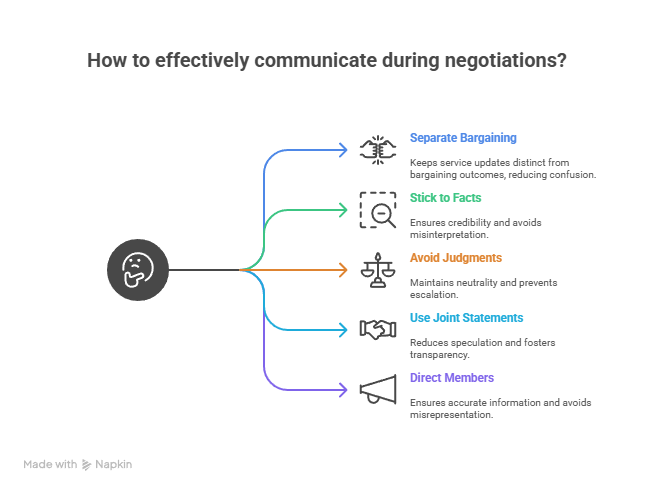
- Separate bargaining from service updates. Keep “we’re operating with modified hours” distinct from “we offered X% increases.”
- Stick to verifiable facts. Examples: session dates, presence of mediators, topics discussed.
- Avoid value judgments. Replace “unreasonable” with “we disagree” or “no agreement was reached on [topic].”
- Use joint statements when possible. Even a single shared fact paragraph reduces speculation.
- Never speak for members. Direct them to union channels for membership-specific guidance.
Staff Communications: What People Need to Hear
Frontline clarity beats inspirational rhetoric. Prioritize:
- Scheduling & pay: shifts, overtime rules, benefits continuity, strike pay impacts.
- Safety: site access, picket line protocols, non-confrontation guidance, escorts if needed.
- Manager toolkits: 1-page talk tracks with approved answers; escalation paths for questions.
Manager Huddle Script (90 seconds):
- Today’s operations status in two lines.
- Safety reminders—routes, contacts, escorts.
- What to tell customers if asked.
- Where to send questions.
- Time of the next update.
Customer Communications: Retention over Spin
Customer update must always include:
- What’s different today (hours, routes, expected delays).
- Alternatives (self-service, online, partner locations).
- Guarantees (refunds, rescheduling, SLA adjustments where applicable).
- Next update time (reduces repeated contacts).
IVR / On-Hold Message (concise):
“Due to ongoing labor negotiations, some services are modified today. Most requests can be completed online at [shortlink]. For urgent needs, press 1. We post service updates at 10 a.m. and 4 p.m. daily.”
Media & Social Listening
- Holding Statement: keep a 70-word, fact-only message ready for inbound press.
- Spokesperson Prep: three key points, two data facts, one bridge to safety/customer continuity.
- Social Monitoring: track rumor seeds by keyword; correct publicly with links to the hub page rather than debate threads.
- Misinformation Play: “Here’s the latest official update on today’s hours and services: [shortlink]. We’ll post again at 4 p.m.”
Measurement: What “Good” Looks Like (KPIs & Targets)
Volume & Containment
- Inbound contacts per 1,000 customers: down ≥25% after cadence stabilizes.
- % Self-service completion rate: up ≥10% during the strike.
Reach & Comprehension
- Open rate internal updates: ≥65% by staff segment; click-through to intranet ≥35%.
- Customer SMS delivered: ≥98%; click-through ≥20% to status page.
Trust Signals
- Social net sentiment: improve trendline after day 2; fewer rumor incidents flagged.
- Churn/defection rate: lower than modeled “no-comms” scenario.
Execution Quality
- On-time update publication: 100% stated cadence.
- Approval cycle time: <30 minutes for routine updates.
After-Action
- Time to normal service: within X days of agreement.
- Lessons logged and baked into revised playbook within 10 business days.
Compliance, Safety, and Privacy Considerations
- NLRA/collective bargaining: keep neutrality; avoid statements construed as interference.
- Privacy: do not disclose individual employee information or medical/safety incidents beyond policy-required detail.
- Safety: coordinate with Security on picket line guidance and emergency protocols; communicate non-confrontation expectations.
- Records: archive all updates and approvals for audit and potential regulatory review.
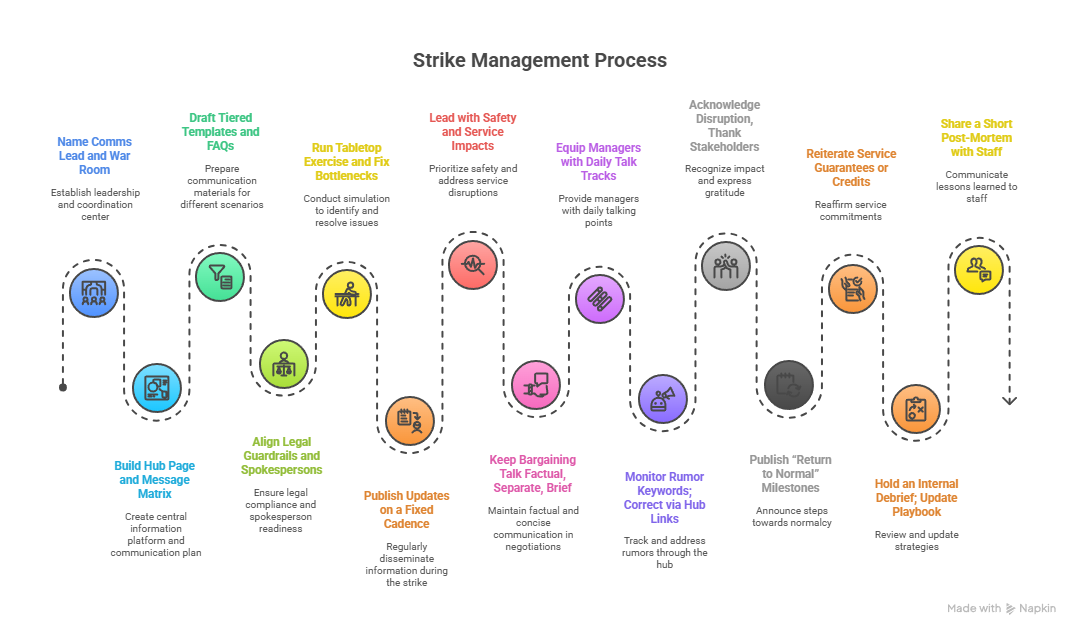
The Strike Communications Checklist
Before a Strike
- Name Comms Lead and war room.
- Build hub page and message matrix.
- Draft tiered templates and FAQs.
- Align legal guardrails and spokespersons.
- Run tabletop exercise and fix bottlenecks.
During a Strike
- Publish updates on a fixed cadence.
- Lead with safety and service impacts.
- Keep bargaining talk factual, separate, brief.
- Equip managers with daily talk tracks.
- Monitor rumor keywords; correct via hub links.
After a Strike
- Acknowledge disruption, thank stakeholders.
- Publish “Return to Normal” milestones.
- Reiterate service guarantees or credits.
- Hold an internal debrief; update playbook.
- Share a short post-mortem with staff.
Templates You Can Use Today
1) All-Audiences “Strike Confirmed” Notice (≈120 words)
“Today at [time], employees represented by [Union] began a strike. We respect employees’ rights and continue to negotiate in good faith. Our priority is safe, reliable service for customers and a respectful environment for everyone. Some services are modified today; details are posted on our status page and will be updated at 10 a.m. and 4 p.m. daily. For urgent needs, contact [hotline] or visit [shortlink]. We appreciate your patience and the continued dedication of all team members supporting our communities.”
2) Staff SMS (≤320 characters)
“Ops update: Modified hours in [sites]. Safety unchanged. Check intranet > Strike Hub for shifts and pay info. Manager huddles at 9:30 a.m./2:30 p.m. Next update 4:00 p.m.”
3) Union-Facing Factsheet (bullets)
- Dates of sessions and mediator involvement
- Topics discussed (wages, staffing, safety investments)
- Areas with tentative understanding
- Next bargaining date/time
(No adjectives; facts only.)
4) Customer Email Block (modular)
- Subject: Service update for [Date]
- Topline: We’re operating with adjustments in [areas].
- Impacts: [List]
- Options: Self-serve at [shortlink]; speak to us at [contact].
- Next update: [Time]
Manager Toolkit: High-Risk Moments & Lines to Use
When asked about bargaining positions:
“It’s important we keep negotiations at the table. What I can share is today’s service plan: [one line]. You’ll get the next update at [time].”
When encountering picket lines:
“Safety first; follow the non-confrontation protocol. Use designated entrances and escorts if needed. Report issues to Security at [number].”
When media appear on site:
“Please contact our media team at [press address]. I’m focused on keeping our team and customers supported.”
Building the Message Hub (Single Source of Truth)
Minimal viable hub page includes:
- Date/time-stamped updates in reverse chronological order.
- Color-coded status cards by region or service line.
- Shortlist of frequently used links (self-service, refunds, schedule).
- Accessible language and mobile-first layout.
- Archive tab for previous days to reduce page length and confusion.
Governance:
- Only the Comms Lead or designee can publish; all others submit via change log.
- Versioning and rollback capability are mandatory.
- Uptime monitoring with SMS alerts to Comms + IT.
Post-Strike Trust Rebuild
- Customer gestures: small credits, extended service hours, or priority scheduling windows.
- Employee recognition: spotlight stories of safe service and teamwork; emphasize respect and the path forward under the new agreement.
- Public recap: short blog or statement acknowledging the strain, summarizing improvements, and recommitting to reliability and safety.
Strike Communications Quick FAQ
Q: How often will you provide updates?
A: Twice daily at fixed times, plus immediate alerts for safety or major service changes.
Q: Where can I verify the latest status?
A: Our service hub is the single source of truth. We publish there first and then cascade to email/SMS and social.
Q: Are you negotiating in good faith?
A: Yes. We’re meeting regularly with the union and using mediators where helpful. We’ll share factual session updates without commentary.
Q: What if I need urgent service during the strike?
A: Use the hotline or emergency channels listed on the hub; urgent requests are prioritized.
Q: How will staff safety be handled?
A: Non-confrontation protocols, escorted access where needed, and direct lines to Security are in effect.
Q: What happens after the strike ends?
A: We’ll publish a “Return to Normal” plan with milestones and any customer accommodations, then resume standard cadence.