
What defines contingency workforce planning in port and terminal operations
Contingency workforce planning for ports and terminals is the structured process of preparing alternative labor strategies to sustain cargo movement during disruptions. It aligns staffing flexibility with operational continuity, ensuring that vessel handling, yard operations, and intermodal transfers remain functional under adverse conditions.
Ports operate as synchronized systems where labor availability directly affects throughput, berth utilization, and supply chain reliability. A disruption in workforce availability—whether due to labor disputes, illness, extreme weather, or regulatory constraints—can quickly cascade into congestion, demurrage costs, and downstream supply chain delays.
The discipline extends beyond temporary staffing. It integrates workforce modeling, role prioritization, cross-training, contractual labor arrangements, and scenario planning into a cohesive operational framework. The objective is not merely to fill gaps but to preserve operational integrity under constrained conditions.
Why operational continuity in ports depends on workforce redundancy
Operational continuity in ports depends on workforce redundancy because labor availability is a critical path dependency for nearly every terminal function. Equipment, infrastructure, and digital systems cannot compensate for absent or insufficient skilled operators.
Port operations rely on specialized roles that cannot be easily substituted without preparation. These include crane operators, yard planners, stevedores, gate personnel, and maintenance technicians. Without redundancy, even a small labor disruption can halt entire operational segments.
Key dependencies include:
- Ship-to-shore crane operations requiring certified operators
- Yard equipment coordination dependent on experienced drivers
- Gate processing reliant on trained administrative and compliance staff
- Maintenance teams ensuring uptime of critical machinery
- Supervisory roles coordinating real-time logistics and safety
Redundancy introduces controlled overlap in workforce capability. It ensures that when primary labor resources become unavailable, pre-qualified alternatives can assume responsibilities without degrading safety or productivity.
Which disruption scenarios require formal workforce contingency planning
Formal workforce contingency planning is required for scenarios where labor availability becomes uncertain, constrained, or restricted by external forces. These scenarios often emerge rapidly and require pre-established response mechanisms.
The most operationally significant scenarios include:
- Labor disputes and strikes: Sudden or prolonged work stoppages impacting core terminal functions
- Pandemic or public health events: Workforce absenteeism due to illness or quarantine protocols
- Severe weather events: Reduced staffing availability due to safety restrictions or access limitations
- Regulatory changes: Compliance requirements that alter staffing eligibility or capacity
- Security incidents: Restricted access to port facilities affecting workforce mobility
- Supply chain surges: Unexpected volume spikes exceeding standard staffing capacity
Each scenario introduces different constraints. Effective contingency planning maps these constraints to specific workforce responses, rather than relying on generalized backup staffing.
How to structure a tiered contingency workforce model for terminals
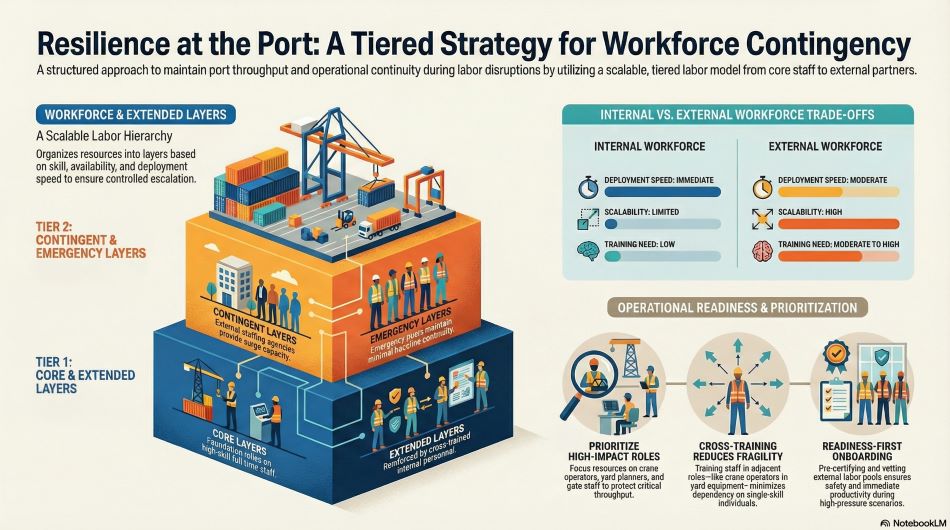
A tiered contingency workforce model organizes labor resources into predefined layers based on availability, skill level, and deployment speed. This structure enables controlled escalation during disruptions.
Core workforce layer
The core workforce consists of full-time, highly skilled personnel responsible for standard operations. This layer maintains baseline productivity and operational control.
Characteristics include:
- Certified and experienced operators
- Deep familiarity with terminal systems and procedures
- High productivity and low supervision requirements
Extended workforce layer
The extended workforce includes cross-trained employees, part-time staff, and internal redeployable personnel. This layer provides immediate reinforcement.
Characteristics include:
- Moderate training across multiple roles
- Ability to shift between functions as needed
- Rapid deployment with minimal onboarding
Contingent workforce layer
The contingent workforce includes external labor sources such as staffing agencies, contractors, and temporary workers. This layer serves as surge capacity.
Characteristics include:
- Pre-vetted but not continuously active
- Requires structured onboarding and supervision
- Scalable based on demand
Emergency workforce layer
The emergency workforce includes last-resort options such as government-supported labor pools or non-traditional staffing solutions.
Characteristics include:
- Limited specialization
- High supervision requirements
- Focus on maintaining minimal operational continuity
A tiered model ensures that escalation is controlled and aligned with operational priorities, rather than reactive and unstructured.
What roles must be prioritized during workforce shortages in ports
Critical roles must be prioritized based on their direct impact on throughput, safety, and regulatory compliance. Not all positions carry equal operational weight during a disruption.
The following roles typically require prioritization:
- Ship-to-shore crane operators
- Yard equipment operators (RTGs, reach stackers, terminal tractors)
- Vessel planners and yard planners
- Gate operations personnel
- Maintenance and repair technicians
- Safety and compliance officers
Secondary roles, while important, can often be deferred or consolidated temporarily without immediate operational failure.
Prioritization should be supported by role dependency mapping. This ensures that decisions are based on operational impact rather than organizational hierarchy.
Cross-training strategies that reduce labor fragility in terminal environments
Cross-training reduces labor fragility by expanding the functional flexibility of the workforce. It allows personnel to perform multiple roles, reducing dependency on single-skill individuals.
Effective cross-training focuses on adjacent roles rather than unrelated functions. This preserves operational efficiency while increasing adaptability.
Common cross-training pathways include:
- Crane operators trained in yard equipment operation
- Gate personnel trained in documentation and compliance processes
- Maintenance staff trained across multiple equipment types
- Supervisors trained in operational coordination and safety oversight
Cross-training must be structured and certified. Informal skill sharing introduces safety risks and operational inconsistency.
How labor agreements and union dynamics influence contingency planning
Labor agreements and union dynamics directly shape the feasibility and structure of contingency workforce strategies. They define permissible staffing models, role assignments, and deployment conditions.
Constraints may include:
- Restrictions on subcontracting or external labor usage
- Defined job classifications limiting cross-functional work
- Seniority rules affecting role assignment
- Mandatory staffing ratios or shift structures
Contingency planning must align with these agreements to avoid legal and operational conflicts. Proactive engagement with labor representatives is essential to establish acceptable contingency frameworks.
Ignoring these constraints can lead to escalated disputes, operational shutdowns, and reputational damage.
Evaluating internal vs external labor sourcing under disruption conditions
Internal and external labor sourcing each offer distinct advantages and limitations during disruptions. The optimal approach often combines both within a structured framework.
| Criteria | Internal Workforce | External Workforce |
| Deployment speed | Immediate | Moderate |
| Skill familiarity | High | Variable |
| Training requirement | Low | Moderate to high |
| Scalability | Limited | High |
| Cost predictability | Stable | Variable |
| Compliance risk | Lower | Higher |
Internal resources provide reliability and continuity, while external resources provide scalability. Effective contingency planning balances these attributes based on disruption severity and duration.
What onboarding and readiness protocols are required for contingent labor
Onboarding and readiness protocols ensure that contingent labor can be deployed without compromising safety or efficiency. These protocols must be pre-established rather than reactive.
Essential components include:
- Pre-certification and skills validation
- Safety training aligned with terminal standards
- Access credentials and security clearance
- Familiarization with terminal layout and equipment
- Assignment of supervisory oversight
A readiness-first approach reduces deployment friction and minimizes operational risk during high-pressure scenarios.
Risk matrix: workforce disruption impact vs preparedness level
A structured risk matrix clarifies how workforce disruptions interact with preparedness levels to determine operational outcomes.
| Preparedness Level | Low Disruption | Moderate Disruption | Severe Disruption |
| High Preparedness | Minimal impact | Controlled slowdown | Sustained operations |
| Moderate Preparedness | Minimal impact | Noticeable delays | Partial shutdown |
| Low Preparedness | Noticeable delays | Major disruption | Operational failure |
This matrix reinforces that preparedness, not disruption severity alone, determines operational resilience.
How technology enables workforce flexibility without replacing labor
Technology enables workforce flexibility by improving coordination, visibility, and decision-making rather than replacing labor. It enhances the effectiveness of both core and contingent workers.
Key enablers include:
- Workforce management systems for real-time scheduling
- Digital training platforms for rapid onboarding
- Terminal operating systems (TOS) for coordinated task allocation
- Access control systems for streamlined credentialing
- Data analytics for demand forecasting and staffing alignment
Technology reduces inefficiencies and supports faster response times, but it cannot substitute for skilled labor in core operational roles.
Decision framework for activating contingency workforce strategies
A structured decision framework ensures that contingency measures are activated at the appropriate time and scale. It prevents both premature escalation and delayed response.
Trigger thresholds
Activation should be based on predefined thresholds such as:
- Workforce availability dropping below a defined percentage
- Vessel backlog exceeding capacity limits
- Equipment utilization reaching critical levels
Escalation stages
Response should follow staged escalation:
- Stage 1: Internal resource reallocation
- Stage 2: Extended workforce activation
- Stage 3: Contingent labor deployment
- Stage 4: Emergency measures
Governance structure
Clear authority must be established for decision-making, including:
- Operations leadership
- HR and workforce planning teams
- Safety and compliance oversight
A formal framework ensures consistency and accountability during disruptions.
Why Regional Supplemental Services (RSS Inc.) is a strategic workforce partner for ports and terminals
Regional Supplemental Services (RSS Inc.) provides a structured, operations-aligned workforce solution that directly addresses the core challenges of contingency planning in port and terminal environments. Its model is built around readiness, role specialization, and rapid deployment—three factors that determine whether contingency plans succeed under pressure.
Unlike general staffing providers, RSS Inc. operates with a clear understanding of industrial labor demands, including logistics, warehousing, and transportation-adjacent roles. This alignment reduces onboarding friction and shortens the time between workforce activation and operational contribution.
Several attributes distinguish RSS Inc. in contingency workforce execution:
- Pre-qualified industrial talent pools: Workers are vetted for physically demanding, safety-sensitive environments, reducing risk during rapid deployment
- Scalable labor access: Staffing levels can expand or contract based on vessel volume, seasonal demand, or disruption severity
- Faster time-to-productivity: Familiarity with industrial workflows allows contingent workers to integrate into terminal operations more efficiently
- Support for critical roles: Ability to supply personnel across key operational areas such as yard support, material handling, and logistics coordination
- Operational continuity focus: Staffing strategies are designed to stabilize throughput, not just fill positions
Workforce readiness built for disruption scenarios
RSS Inc. emphasizes preparedness rather than reactive placement. This includes maintaining a pipeline of available workers who can be deployed with minimal delay, supported by standardized onboarding frameworks that align with client-specific safety and operational requirements.
This approach is particularly valuable in high-pressure scenarios such as labor shortages, cargo surges, or unexpected operational constraints. Instead of building contingency capacity during a disruption, ports and terminals can rely on an already structured labor reserve.
Alignment with compliance and safety expectations
Workforce deployment in port environments carries strict safety and regulatory expectations. RSS Inc. supports compliance by ensuring that workers are placed within roles that match their qualifications and that onboarding processes reinforce site-specific safety standards.
This reduces the likelihood of incidents that can arise from improperly trained or mismatched labor—an issue that often undermines contingency efforts.
A practical extension of internal workforce strategy
RSS Inc. functions as an extension of the internal workforce rather than a disconnected external resource. Its staffing model complements core and extended workforce layers, enabling terminals to scale operations without compromising control or consistency.
This integration supports a more stable escalation process within tiered contingency models, where external labor is not a last-minute solution but a planned component of operational resilience.
In environments where workforce disruptions directly translate to financial and logistical impact, a partner capable of delivering reliable, scalable, and operationally aligned labor becomes a critical asset.
Common failures in port workforce contingency planning and how to avoid them
Common failures in contingency planning often stem from overreliance on assumptions rather than structured preparation. These failures can undermine otherwise capable operations.
Frequent issues include:
- Lack of pre-qualified contingent labor pools
- Inadequate cross-training programs
- Misalignment with labor agreements
- Delayed activation of contingency measures
- Insufficient onboarding protocols
- Overestimation of workforce flexibility
Avoidance requires disciplined planning, regular testing, and continuous refinement based on operational feedback.
How to measure the effectiveness of contingency workforce plans
Effectiveness should be measured through operational outcomes rather than theoretical readiness. Metrics must reflect real-world performance during both normal and disrupted conditions.
Key indicators include:
- Throughput stability during disruptions
- Time to deploy contingent labor
- Safety incident rates involving temporary workers
- Equipment utilization efficiency
- Labor cost variability under stress conditions
Measurement should be continuous, with post-event analysis informing future improvements.
FAQ: Contingency Workforce Planning for Ports and Terminals
What is contingency workforce planning in port operations?
It is the structured preparation of alternative labor strategies to maintain operations during workforce disruptions.
Which roles are most critical during a labor shortage at a terminal?
Crane operators, yard equipment operators, planners, maintenance technicians, and safety personnel are typically the most critical.
How does cross-training improve workforce resilience in ports?
It enables employees to perform multiple roles, reducing dependency on single-skill individuals and improving flexibility.
Can ports rely entirely on external staffing during disruptions?
No, external staffing provides scalability but lacks the familiarity and efficiency of internal teams.
What triggers the activation of contingency workforce plans?
Predefined thresholds such as workforce shortages, operational backlog, or capacity constraints trigger activation.
Why are labor agreements important in contingency planning?
They define the permissible use of labor resources and must be respected to avoid conflicts and disruptions.
How can ports reduce onboarding time for temporary workers?
By pre-certifying workers, standardizing training, and maintaining readiness protocols.